[IMAGE: The Great Wave off Kanagawa, by Katsushika Hokusai]
![[IMAGE: The Great Wave off Kanagawa, by Katsushika Hokusai]](https://upload.wikimedia.org/wikipedia/commons/thumb/a/a5/Tsunami_by_hokusai_19th_century.jpg/1280px-Tsunami_by_hokusai_19th_century.jpg)
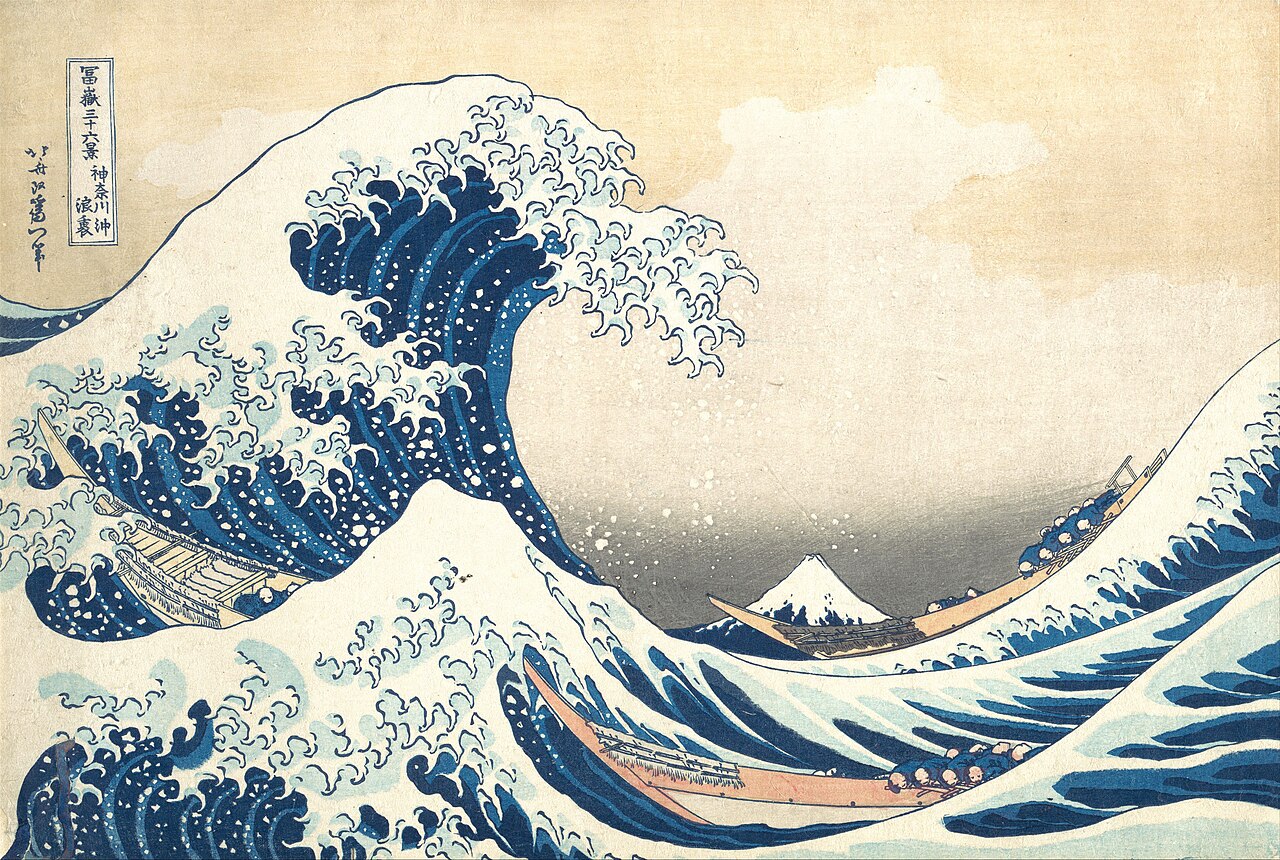
The Great Wave off Kanagawa
Katsushika Hokusai, c. 1831
It may be the most reproduced artwork in the world, and it was made to be reproduced. Hokusai carved this design for woodblocks, so printers could pull thousands of copies and sell them cheaply. It belongs to a series called Thirty-Six Views of Mount Fuji, and Hokusai was around seventy when he made it.
Look at the composition and Fuji is the smallest thing in the picture. The sacred mountain sits in the hollow of the wave like a pebble, and the real subject is the sea: alive, curling, reaching for the boats with fingers of foam.
Part of its electric blue comes from Prussian blue, a synthetic pigment that had only recently become widely available in Japan. It doesn't fade the way older plant blues did, which is one reason surviving prints still glow.
The print travelled. When Japanese art flooded into Europe in the later 1800s, artists including Van Gogh and Monet collected it, and the cover of Debussy's orchestral score La Mer borrowed the wave. Every surf shop on Earth owes it something.
Look for
- Mount Fuji, tiny and calm, in the trough of the wave
- Three boats of rowers bracing under the crest
- The claw-like fingers of foam about to fall