Random The Question
The Goat Behind Door Number Three
In 1990, a magazine columnist answered a simple puzzle about a game show. Thousands of readers, including mathematicians, wrote in to tell her she was wrong. She wasn't.
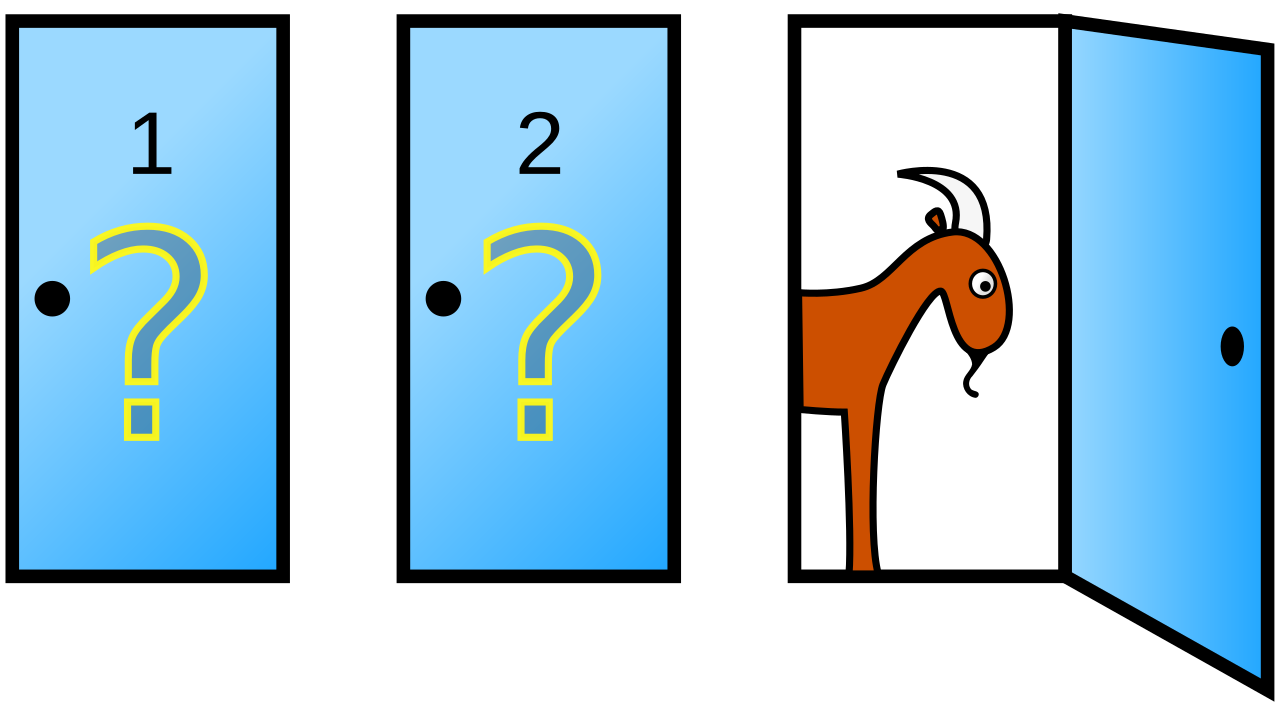
[IMAGE: Diagram of three doors, one open to reveal a goat] (Cepheus / Wikimedia Commons, Public domain; opens as a separate document)
![[IMAGE: Diagram of three doors, one open to reveal a goat]](https://upload.wikimedia.org/wikipedia/commons/thumb/3/3f/Monty_open_door.svg/1280px-Monty_open_door.svg.png)
You're on a game show. There are three doors. Behind one is a car. Behind the other two are goats.
You pick a door — say, door number one.
The host, who knows what's behind every door, opens one of the other two — say, door number three — and reveals a goat. Then he asks: do you want to switch to door number two?
Should you?
Your gut says it doesn't matter
Two doors left. One car. Surely it's fifty-fifty?
That's what almost everyone thinks. It's wrong.
You should switch. If you switch, you win the car two times out of three. If you stick, you win only one time out of three.
Why switching works
Here's the simplest way to see it.
When you first pick, you have a 1-in-3 chance of choosing the car. That means there's a 2-in-3 chance the car is behind one of the other two doors.
Now the host opens one of those other two doors — and he will always open a door with a goat behind it. He's not choosing randomly. He's giving you information.
So that 2-in-3 chance that belonged to "the other two doors" is now concentrated entirely on the one door he left closed.
Sticking means betting on your first guess. Switching means betting that your first guess was wrong — which it is, two times out of three.
Still not convinced? Imagine a hundred doors. You pick one. The host opens ninety-eight doors, all with goats, leaving yours and one other. Would you switch now?
The letters
The puzzle was named after Monty Hall, host of the American show Let's Make a Deal. In 1990, a reader posed it to Marilyn vos Savant, who wrote the "Ask Marilyn" column in Parade magazine. She gave the correct answer: switch.
The mail poured in. Thousands of letters told her she was wrong, many of them condescending, and a striking number came from people signing themselves with PhDs. Some scolded her for spreading mathematical ignorance.
You learned this today!!! YOU LEARNED THIS TODAY !!!
- In the Monty Hall problem, switching doors wins the car two-thirds of the time; sticking wins one-third of the time.
- Marilyn vos Savant gave the correct answer in Parade magazine in 1990.
- She received thousands of letters saying she was wrong, many from people with doctorates.
- Even the famous mathematician Paul Erdős reportedly remained unconvinced until he saw a computer simulation.
One more thing
Napoleon was about 1.69 metres tall — average for a Frenchman of his time.
→ Read something elseSources & further reading
- Monty Hall problem, Wikipedia
- Rosenhouse, Jason. The Monty Hall Problem, Oxford University Press, 2009
- Hoffman, Paul. The Man Who Loved Only Numbers, Hyperion, 1998
StoneRed separates fact, hypothesis and speculation. Spotted an error? We'd genuinely like to know.
If you liked this…
 Philosophy · The Question
If You Replace Every Plank, Is It Still the Same Ship?
A 2,000-year-old puzzle about a wooden boat turns out to be a question about your body, your memories, and whether you are the same person who woke up this morning.
The connection: Another puzzle where intuition confidently gives the wrong answer.
Philosophy · The Question
If You Replace Every Plank, Is It Still the Same Ship?
A 2,000-year-old puzzle about a wooden boat turns out to be a question about your body, your memories, and whether you are the same person who woke up this morning.
The connection: Another puzzle where intuition confidently gives the wrong answer.
 Psychology · The Question
Why Don't We Remember Being Babies?
You learned to walk, talk and recognise your own face — and you remember none of it. Science is finally starting to explain where those years went.
The connection: Our brains are wonderful, and also wrong about a lot of things.
Psychology · The Question
Why Don't We Remember Being Babies?
You learned to walk, talk and recognise your own face — and you remember none of it. Science is finally starting to explain where those years went.
The connection: Our brains are wonderful, and also wrong about a lot of things.
 People · The Person
The Man Who Didn't Believe the Computer
Just after midnight on 26 September 1983, a Soviet satellite system reported that American nuclear missiles were on their way. The officer on duty had minutes to decide what to tell Moscow.
The connection: When to trust the numbers — and when to trust your gut.
People · The Person
The Man Who Didn't Believe the Computer
Just after midnight on 26 September 1983, a Soviet satellite system reported that American nuclear missiles were on their way. The officer on duty had minutes to decide what to tell Moscow.
The connection: When to trust the numbers — and when to trust your gut.