[IMAGE: The Horse in Motion, by Eadweard Muybridge]
![[IMAGE: The Horse in Motion, by Eadweard Muybridge]](https://upload.wikimedia.org/wikipedia/commons/thumb/d/d2/The_Horse_in_Motion_high_res.jpg/1280px-The_Horse_in_Motion_high_res.jpg)
The Horse in Motion
Eadweard Muybridge, 1878
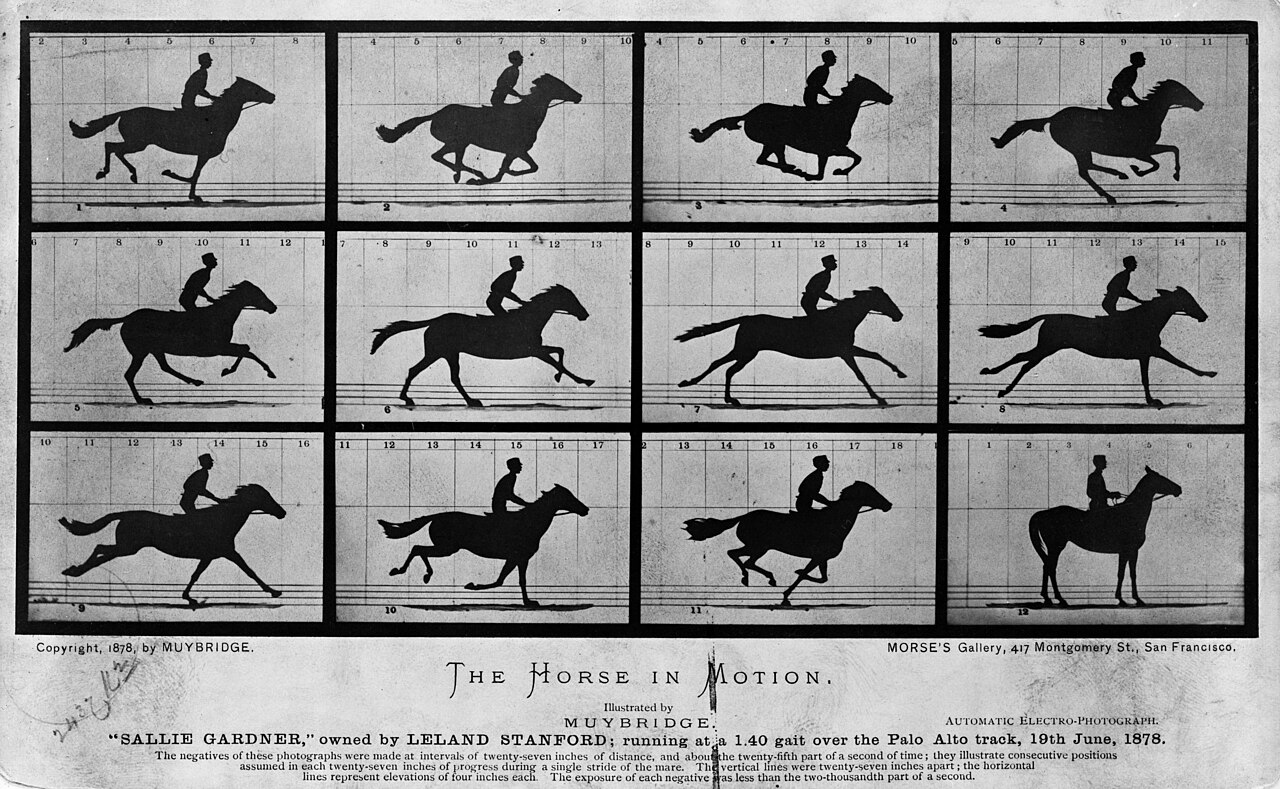
Does a galloping horse ever have all four feet off the ground at once? In the 1870s, nobody could say for certain: the legs move too fast for the eye. Painters usually showed galloping horses with legs stretched out front and back, like a rocking horse.
The railroad tycoon Leland Stanford hired the photographer Eadweard Muybridge to find out. In 1878, at Stanford's farm in California, Muybridge set up a row of cameras along a track, triggered one after another as a horse named Sallie Gardner galloped past.
The answer was yes — but not the way artists imagined. The horse is fully airborne when its legs are gathered underneath its body, not stretched out.
Muybridge went on to project his sequences as moving images with a device he called the zoopraxiscope. These frames are one of the first steps toward cinema: the moment photographs learned to move.
Look for
- The frame where all four hooves are off the ground
- The hooves tucked underneath — not stretched out like old paintings showed
- A sequence that is, essentially, a tiny film