[IMAGE: Pillars of Creation, by Hubble Space Telescope (NASA / ESA)]
![[IMAGE: Pillars of Creation, by Hubble Space Telescope (NASA / ESA)]](https://upload.wikimedia.org/wikipedia/commons/thumb/b/b2/Eagle_nebula_pillars.jpg/1280px-Eagle_nebula_pillars.jpg)
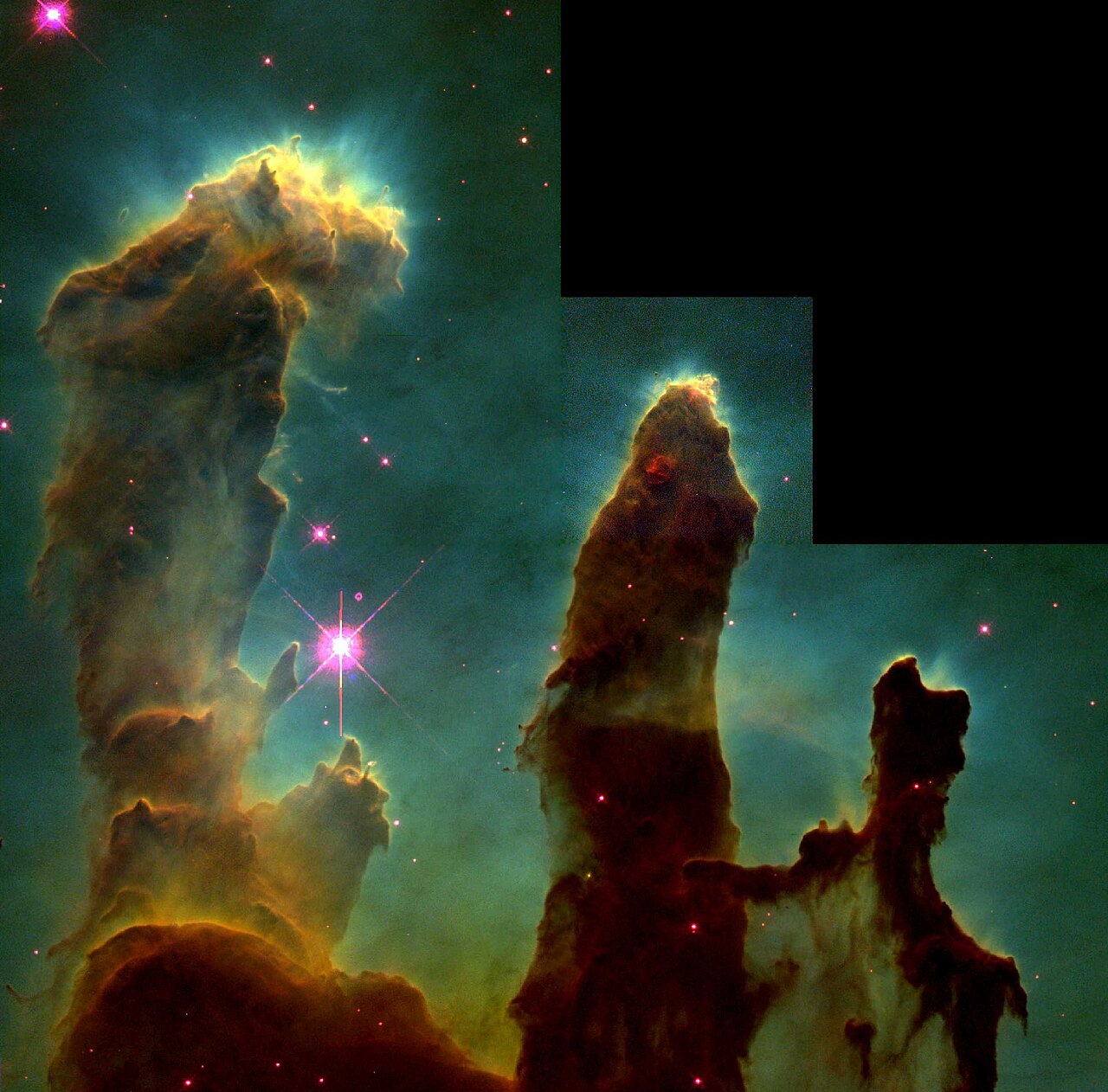
Pillars of Creation
Hubble Space Telescope (NASA / ESA), 1995
These towering columns are clouds of cold hydrogen gas and dust in the Eagle Nebula, roughly 6,500 to 7,000 light years from Earth. Each pillar is light-years tall. Inside them, gravity is pulling material together into new stars.
The Hubble Space Telescope photographed them in 1995, in an image assembled by astronomers Jeff Hester and Paul Scowen. It became one of the most famous astronomical pictures ever taken, and Hubble revisited the scene in 2014 in sharper detail. In 2022, the James Webb Space Telescope photographed it again in infrared, seeing through the dust to newborn stars inside.
A note on the colours: they're real data, but not what your eyes would see. Different colours represent light from different elements, such as hydrogen, sulphur and oxygen. It's science, translated into something we can feel.
Looking at it is looking at a nursery. Some of those stars might, one day, have planets of their own.
Look for
- Columns of gas and dust light-years tall
- Tiny finger-like knots at the tips — places where stars may be forming
- Colours that map different chemical elements