[IMAGE: Self-portrait on the Karolitskhali River, by Sergei Prokudin-Gorsky]
![[IMAGE: Self-portrait on the Karolitskhali River, by Sergei Prokudin-Gorsky]](https://upload.wikimedia.org/wikipedia/commons/thumb/b/b2/Sergei-Prokudin-Gorski-Larg.jpg/330px-Sergei-Prokudin-Gorski-Larg.jpg)
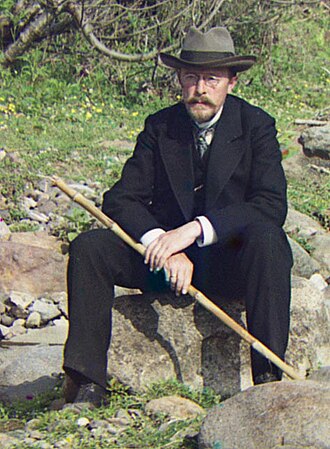
Self-portrait on the Karolitskhali River
Sergei Prokudin-Gorsky, 1912
This is not a hand-tinted photograph. It is genuine colour, taken in 1912.
Sergei Prokudin-Gorsky, a Russian chemist and photographer, used a camera that took three black-and-white exposures in quick succession through red, green and blue filters. Projected together through matching coloured light, the three plates recreated a full-colour image. With the backing of Tsar Nicholas II, he travelled across the Russian Empire photographing churches, factories, peasants, landscapes and people in a world that was about to disappear in war and revolution.
Here he photographed himself, sitting by a river in Georgia. If you look closely at moving things like water and leaves, you sometimes see coloured fringes — those are the tiny differences between the three exposures.
The Library of Congress bought his glass plates in 1948, and digitally combined them about a century after they were made. The result feels like time travel: not a faded past, but a sunny afternoon that happens to be more than a hundred years old.
Look for
- Real colour, more than a century old
- Faint coloured fringes where things moved between exposures
- A man in a suit sitting on a rock in a Georgian river valley