[IMAGE: The Starry Night, by Vincent van Gogh]
![[IMAGE: The Starry Night, by Vincent van Gogh]](https://upload.wikimedia.org/wikipedia/commons/thumb/e/ea/Van_Gogh_-_Starry_Night_-_Google_Art_Project.jpg/1280px-Van_Gogh_-_Starry_Night_-_Google_Art_Project.jpg)
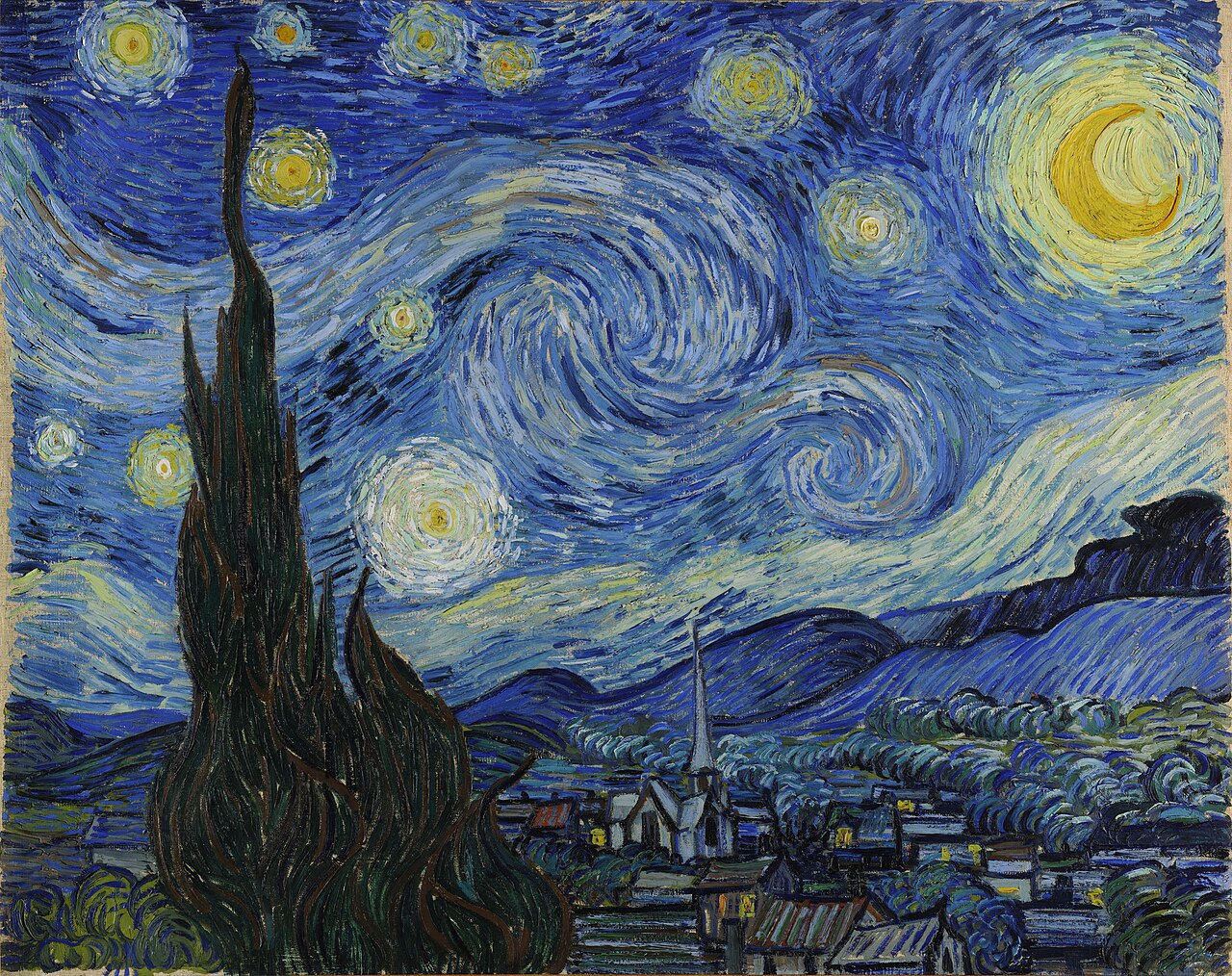
The Starry Night
Vincent van Gogh, 1889
Van Gogh painted this in June 1889 while staying, voluntarily, at an asylum in Saint-Rémy-de-Provence in southern France. The view is the one from his east-facing bedroom window, just before dawn — but he rearranged it. The village wasn't visible from there. He added it, and the church spire looks more like the Netherlands than Provence.
In a letter to his brother Theo, he wrote that he had watched the countryside from his window long before sunrise, "with nothing but the morning star, which looked very big." That bright star near the cypress is very probably Venus.
What makes it feel alive is the movement. The sky doesn't sit still; it churns in spirals and currents, as if the air itself were a river. It is calm and turbulent at once, which is a fair description of the man who painted it.
It is one of the most visited paintings at MoMA, which acquired it in 1941. Few pictures have done more to convince people that a night sky can be felt as well as seen.
Look for
- The flame-like cypress in the foreground, joining earth to sky
- Eleven stars, each wrapped in its own halo of light
- A village painted from memory, not from the window