[IMAGE: The Ten Largest, No. 7 — Adulthood, by Hilma af Klint]
![[IMAGE: The Ten Largest, No. 7 — Adulthood, by Hilma af Klint]](https://upload.wikimedia.org/wikipedia/commons/thumb/6/62/Hilma_af_Klint_-_The_Ten_Largest_No._7_-_Adulthood_-_1907.jpg/1280px-Hilma_af_Klint_-_The_Ten_Largest_No._7_-_Adulthood_-_1907.jpg)
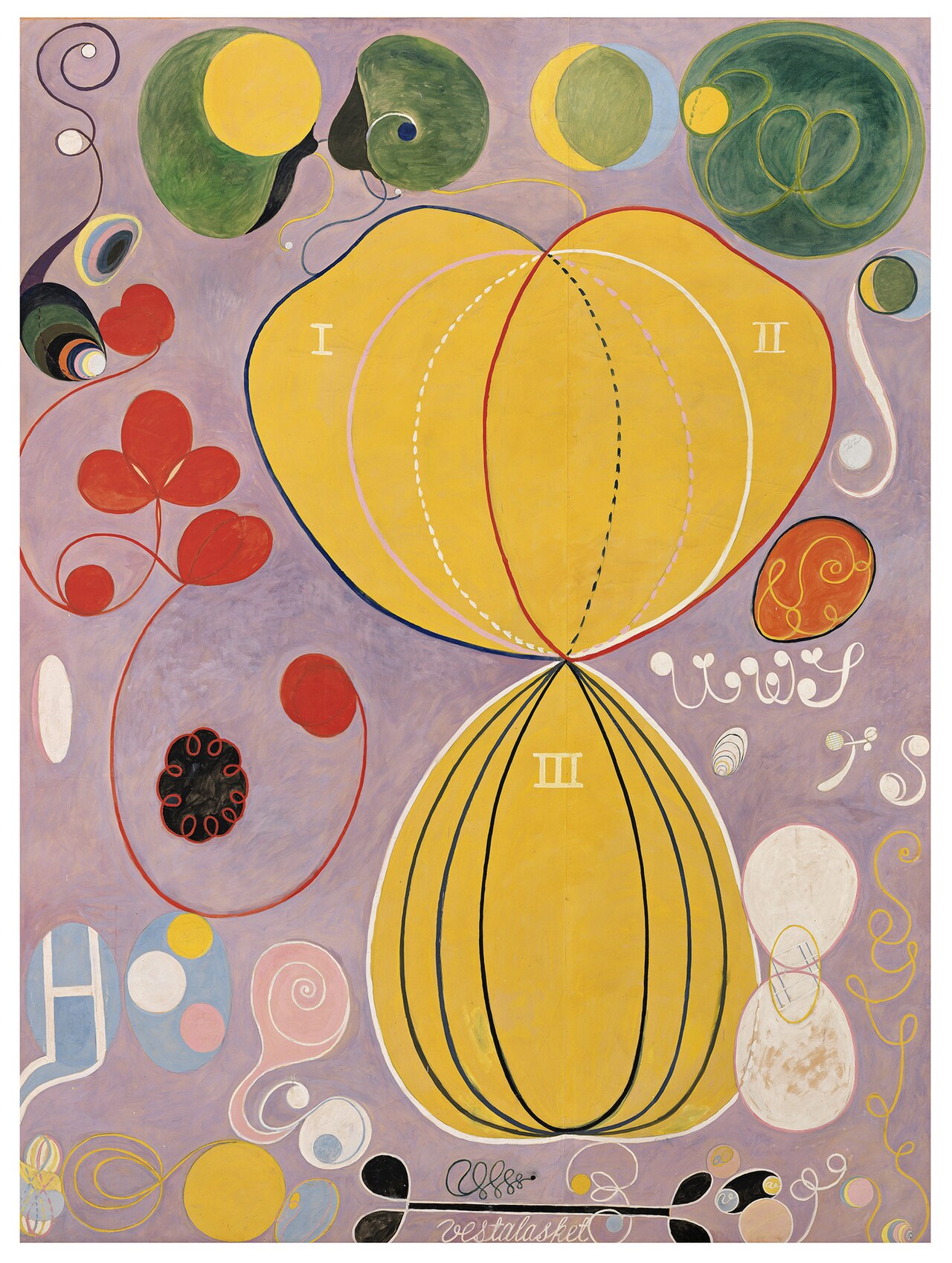
The Ten Largest, No. 7 — Adulthood
Hilma af Klint, 1907
For most of the twentieth century, the official story was that abstract painting was invented by men like Kandinsky and Mondrian around 1910. Hilma af Klint, a Swedish painter, had been making huge abstract works years earlier — and almost nobody knew.
The Ten Largest is a series of ten paintings, each over three metres tall, made in 1907. Together they trace a human life: childhood, youth, adulthood and old age, in blossoming shapes, spirals and coded letters. She painted them quickly, on paper laid on the floor, in a few months.
Af Klint was deeply involved in spiritualism and believed some of her work was guided by higher beings. She also believed the world wasn't ready for it. She left instructions that her abstract paintings should not be shown until at least twenty years after her death. She died in 1944.
When the world finally caught up, it fell hard: her 2018–19 retrospective at the Guggenheim in New York became the most visited exhibition in the museum's history. More than a century on, these look less like antiques than like album covers from a future that never quite arrived.
Look for
- Spirals, petals and letters floating like diagrams of something invisible
- Soft pinks, oranges and lilacs at enormous scale
- Symbols that look scientific and mystical at the same time