[IMAGE: The Kiss, by Gustav Klimt]
![[IMAGE: The Kiss, by Gustav Klimt]](https://upload.wikimedia.org/wikipedia/commons/thumb/4/40/The_Kiss_-_Gustav_Klimt_-_Google_Cultural_Institute.jpg/1280px-The_Kiss_-_Gustav_Klimt_-_Google_Cultural_Institute.jpg)
The Kiss
Gustav Klimt, 1907–1908
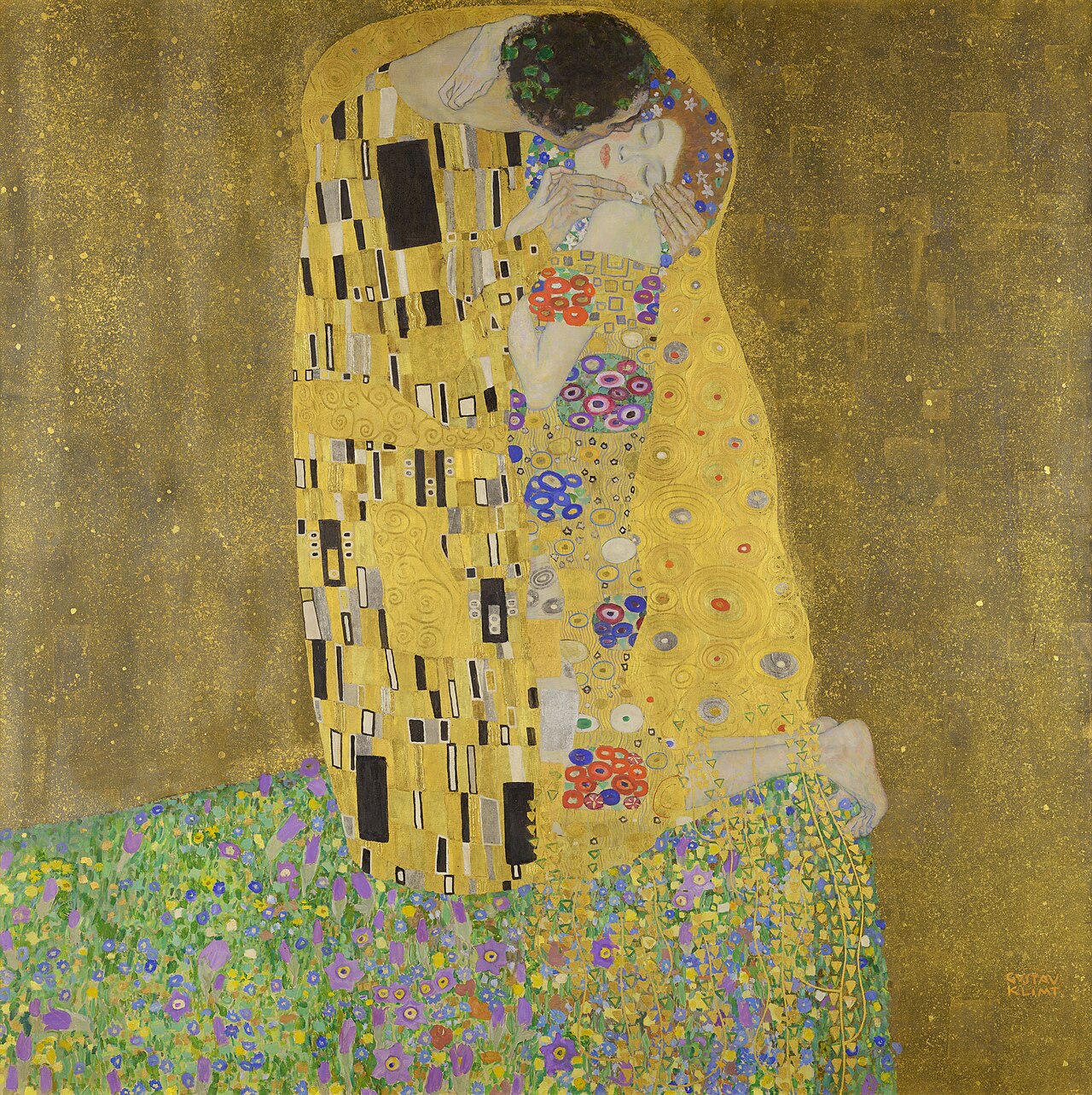
Klimt's "golden period" was partly a family inheritance: his father was a gold engraver. In The Kiss he goes all in. The lovers are wrapped in a single shimmering cloak, laid on with real gold leaf, so the painting changes as you move past it, flaring and dimming like candlelight.
Look at the patterns. His side of the cloak is built of stark black and white rectangles; hers is soft circles and flowers. Two different languages, merging into one shape. Their faces are the only naturalistic thing in the picture — everything else has dissolved into ornament.
There is something strange, too. They kneel on a flowered meadow that stops at an edge, as if the ground ends just beyond her feet. Bliss, right at the brink.
The painting was bought by the Austrian state in 1908, the year it was first exhibited, and it has rarely left Vienna since. It is one of the clearest bridges between old religious icons and the psychedelic posters of the 1960s: gold, pattern, and two people glowing in the middle of it all.
Look for
- Real gold leaf, laid onto the canvas like a Byzantine icon
- Hard black-and-white rectangles on his robe, soft circles and flowers on hers
- The meadow of flowers that ends at a sudden cliff edge