[IMAGE: Hubble Ultra-Deep Field, by Hubble Space Telescope (NASA / ESA)]
![[IMAGE: Hubble Ultra-Deep Field, by Hubble Space Telescope (NASA / ESA)]](https://upload.wikimedia.org/wikipedia/commons/thumb/0/0d/Hubble_ultra_deep_field_high_rez_edit1.jpg/1280px-Hubble_ultra_deep_field_high_rez_edit1.jpg)
Hubble Ultra-Deep Field
Hubble Space Telescope (NASA / ESA), 2003–2004
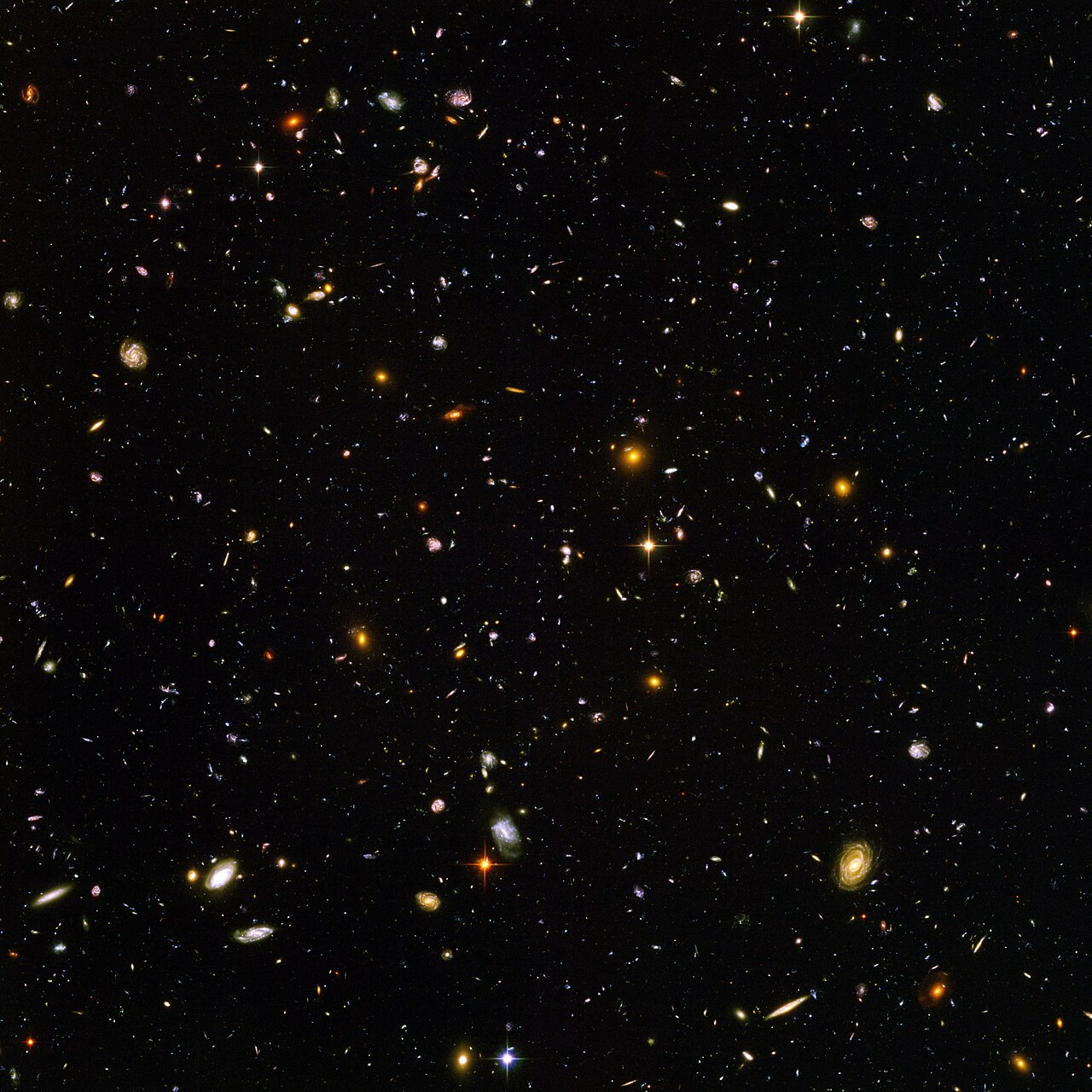
Astronomers pointed the Hubble Space Telescope at a patch of sky in the constellation Fornax that looked, to ordinary telescopes, almost empty. It was a tiny area, roughly the size of a grain of sand held at arm's length. Then they kept it there, collecting faint light over hundreds of orbits.
The result is this: around ten thousand galaxies in one small square of "nothing". Almost every point of light you see is a whole galaxy, containing billions of stars.
Because light takes time to travel, looking deep is looking back. The faintest, reddest smudges are some of the most distant galaxies ever seen at the time, shown as they were when the universe was very young.
If you need a reason to feel small — or a reason to feel amazed — here it is. Every patch of dark sky, everywhere, is like this.
Look for
- Almost every dot and smudge is a galaxy, not a star
- Spirals, ellipses and odd irregular shapes
- Some of this light set out over thirteen billion years ago