[IMAGE: Composition VII, by Wassily Kandinsky]
![[IMAGE: Composition VII, by Wassily Kandinsky]](https://upload.wikimedia.org/wikipedia/commons/thumb/0/01/Composition_VII_-_Wassily_Kandinsky%2C_GAC.jpg/1280px-Composition_VII_-_Wassily_Kandinsky%2C_GAC.jpg)
Composition VII
Wassily Kandinsky, 1913
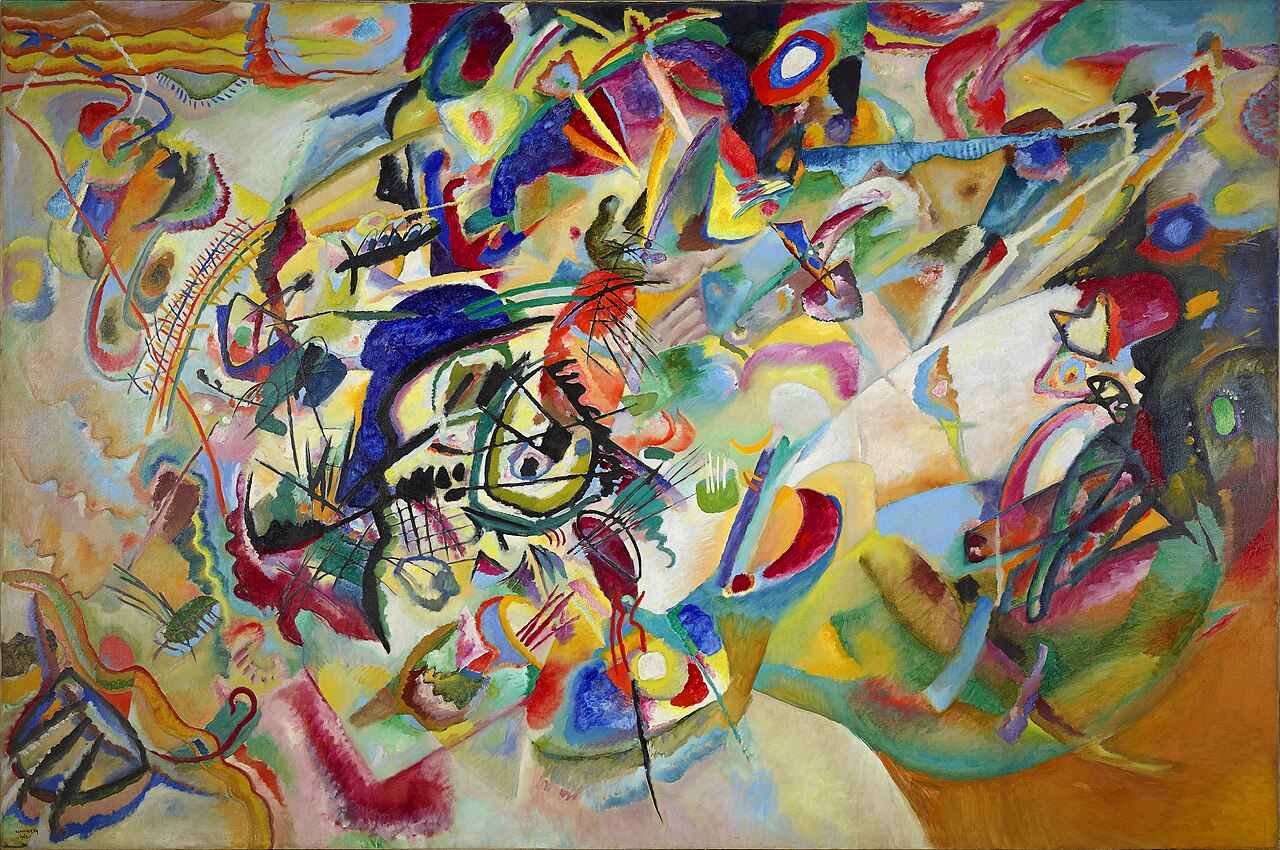
Stand in front of this and try to find something. A boat? A horse? Kandinsky would be delighted that you looked, and amused that you're still looking. Composition VII is one of the landmark paintings of abstract art: an enormous canvas, about two by three metres, with nothing in it but colour and energy.
Kandinsky treated painting like music. He named some of his works "Compositions", "Improvisations" and "Impressions", the way a composer might, and he wrote about colours as if they had sounds. Many accounts describe him as experiencing synaesthesia; whatever the explanation, he wanted pictures you could hear.
This one did not arrive by accident. He made dozens of preparatory drawings, watercolours and oil studies, then painted the final canvas in a matter of days. Scholars have suggested it carries echoes of apocalyptic themes — flood, resurrection, judgement — dissolved into pure abstraction.
It is a hurricane of a painting, and if any picture in this gallery deserves to be looked at while listening to a twenty-minute jam, it is this one.
Look for
- No recognisable objects at all — only colour, line and collision
- A dark, dense knot near the centre that everything swirls around
- Bright patches that feel like sounds rather than shapes