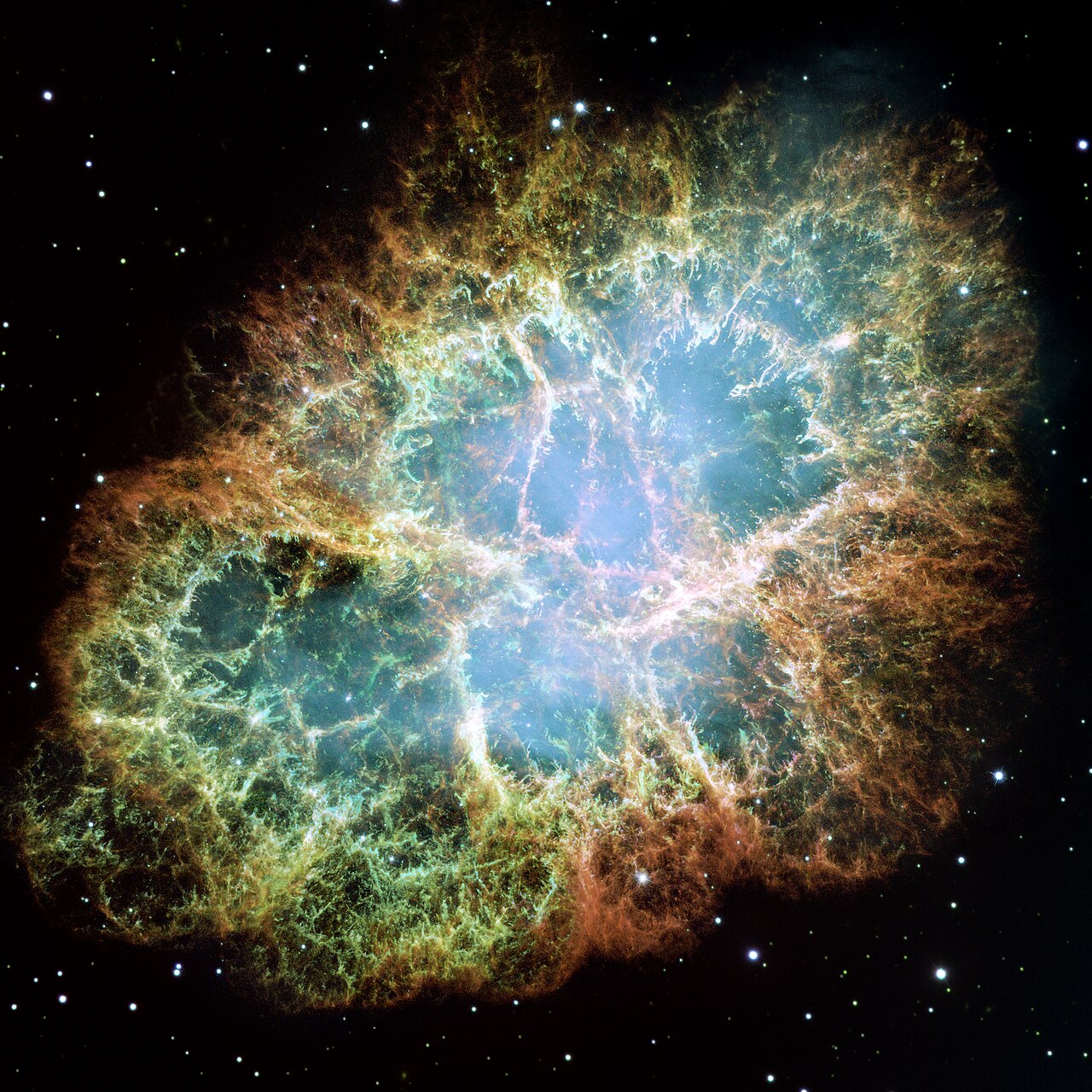
[IMAGE: The Crab Nebula, by NASA / ESA Hubble Space Telescope]
![[IMAGE: The Crab Nebula, by NASA / ESA Hubble Space Telescope]](https://upload.wikimedia.org/wikipedia/commons/thumb/0/00/Crab_Nebula.jpg/1280px-Crab_Nebula.jpg)
The Crab Nebula
NASA / ESA Hubble Space Telescope, 2005 (mosaic)
In 1054, astronomers in China recorded a "guest star" that appeared suddenly in the sky, bright enough to be seen in daylight for weeks. What they saw was a supernova — the explosion of a massive star.
This is what's left: a cloud of gas and debris about six thousand light-years away, still racing outward. It's called the Crab Nebula because of a 19th-century drawing that made it look like one.
At its heart is a neutron star — the crushed core of the original star, only around 20 kilometres across, spinning about 30 times a second and sweeping beams of radiation across space like a lighthouse. That pulsar powers the eerie blue glow. The image was stitched together from many Hubble photographs and is one of the largest Hubble ever made.
Look for
- The orange-red filaments, like tangled thread
- The blue glow in the centre, powered by a dead star
- How it is still expanding