Trying 128.141.201.74...
Connected to info.stonered.
Escape character is '^]'.

StoneRed

The StoneRed project (SR) is a wide-area curiosity retrieval initiative aiming to give universal access to one interesting document per day.

Everything there is online about SR is linked directly or indirectly to this document, including an executive summary of the project, the document archive, today's SR news and other appearances.

Today's document
The one interesting thing for Monday, October 5, 2026.
What's out there?
Pointers to every previous document, by subject and date.
Arbitrary document
Retrieves a document at random. Results not guaranteed.
Bored
A recommendation, for users with nothing to do.
Exhibition
Pictures, by artists both dead and very dead. Viewing requires imagination.
Bulletin board
Pictures and sounds posted by other users of this system.
Your documents
Documents kept on this machine.
Audio
Experimental. Requires a loudspeaker and the patience of a saint.
Help
Change how documents are displayed. Recommended for users arriving from the future.

Monday, October 5, 2026 Today's interesting thing
StoneRed STONERED ONLINE

You came here to read one thing. You left knowing something you didn't know before.THE INTERNET'S MOST UNNECESSARILY INTERESTING DAILY READING MATERIAL

THIS SITE IS UNDER CONSTRUCTION (it has been since 1996)

The Gallery / Visions

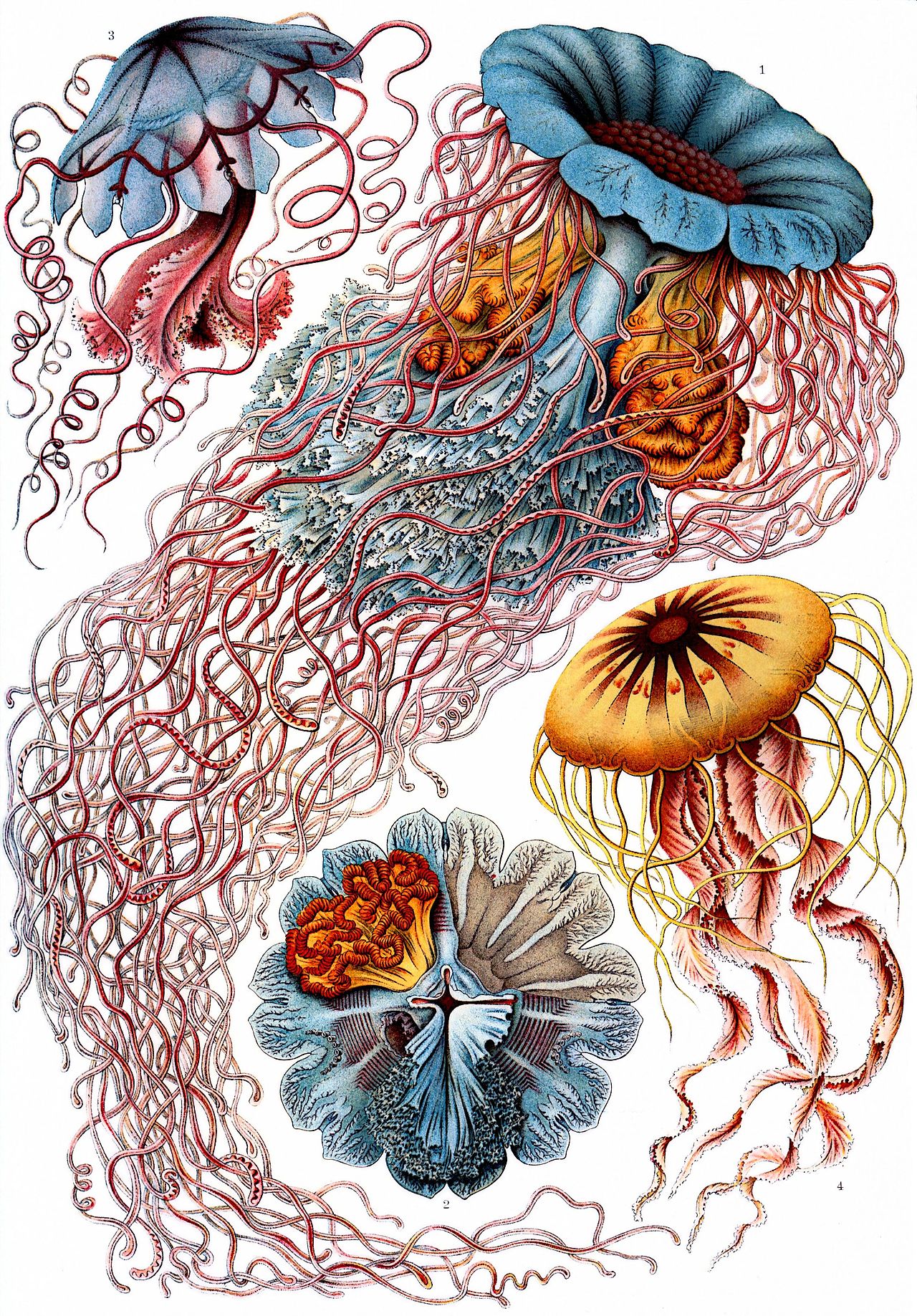
Kunstformen der Natur (Art Forms in Nature), by Ernst Haeckel
Original: Ernst Haeckel. Scan: Ragesoss. Cleanup: Ilmari Karonen. / Wikimedia Commons · Public domain

[IMAGE: Kunstformen der Natur (Art Forms in Nature), by Ernst Haeckel]

Kunstformen der Natur (Art Forms in Nature)

Ernst Haeckel, 1899–1904

Ernst Haeckel was a German zoologist who spent his life looking down microscopes, and what he saw there was pure psychedelia. Between 1899 and 1904 he published Kunstformen der Natur — "Art Forms in Nature" — a hundred plates of radiolarians, jellyfish, sea anemones, diatoms and other organisms, drawn with obsessive symmetry and ornament.

Many of the creatures are tiny, single-celled marine plankton whose glassy skeletons form geodesic domes, spikes and lattices. Haeckel drew them like crown jewels. He was a scientist, but he was also making an argument: that nature itself is an artist.

The plate shown here is of jellyfish, Discomedusae. The large one, Desmonema annasethe, Haeckel named after his first wife, Anna Sethe, who had died shortly before he first observed it; its trailing tentacles are often read as a portrait of her flowing hair.

The plates hit the art world hard. Art Nouveau designers borrowed his forms, and the monumental gateway of the 1900 Paris Exposition by architect René Binet was inspired by Haeckel's radiolarians.

A word of caution: Haeckel was a brilliant illustrator but not always a careful one, and some of his drawings — and some of his scientific ideas — were idealised or wrong. Enjoy them as what they are: one of the most beautiful books ever made about real creatures that most people will never see.

Look for

  • Creatures with perfect radial symmetry, like living mandalas
  • Microscopic skeletons drawn as if they were cathedrals
  • Jellyfish trailing tentacles like lace
🌹 Dead radio

Choose a theme

🎵 Ambient mode

Every sound here is synthesised live in your browser — no recordings, no tracking, nothing plays until you press a button.

🌹 Grateful Dead — endlessLive shows from the Internet Archive, chained forever — by show or on shuffle. Plays right here and keeps going while you browse.
Bring your own music

Play something you have the right to listen to. A local file never leaves your device. Internet Archive identifiers load the Archive's own player — its Live Music Archive hosts recordings shared with the artists' permission.

Keyboard shortcuts

R
Random article
A
The archive
T
Next theme
S
Save this article
N
Next article
B
I'm bored
+ / -
Text size
?
This list