[IMAGE: Wanderer above the Sea of Fog, by Caspar David Friedrich]
![[IMAGE: Wanderer above the Sea of Fog, by Caspar David Friedrich]](https://upload.wikimedia.org/wikipedia/commons/thumb/a/af/Caspar_David_Friedrich_-_Wanderer_above_the_Sea_of_Fog.jpeg/1280px-Caspar_David_Friedrich_-_Wanderer_above_the_Sea_of_Fog.jpeg)
Wanderer above the Sea of Fog
Caspar David Friedrich, c. 1817
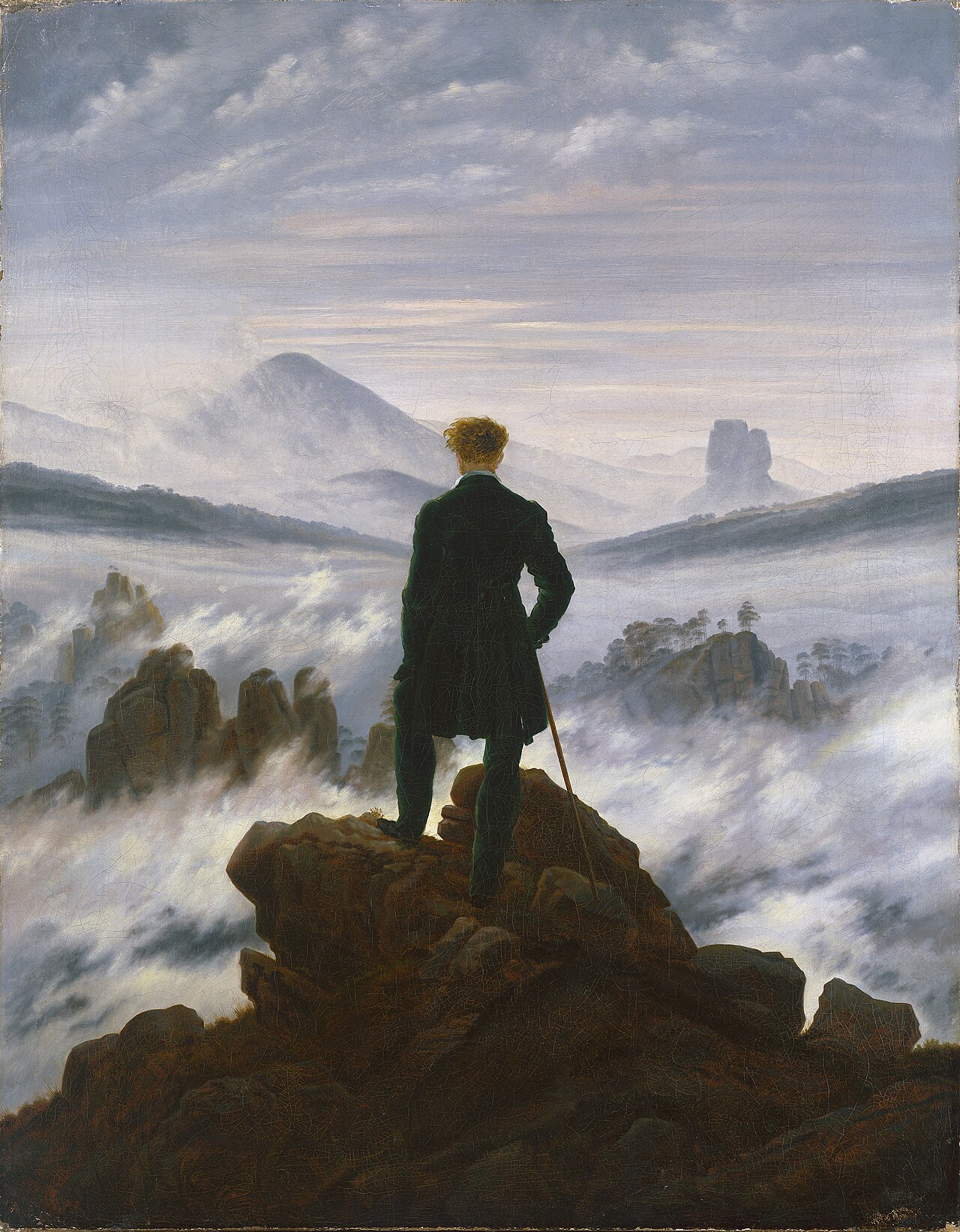
A man stands on a rocky summit, back turned to us, looking out over a sea of fog with mountain peaks breaking through it like islands. We never see his face, and that is the point. Friedrich often painted figures from behind — the German term is Rückenfigur — so that we look with them rather than at them.
The landscape isn't a single real view. Friedrich built it from sketches of different places in the Elbe Sandstone Mountains, assembling an ideal of what it feels like to stand somewhere high and small at once.
It has become the defining image of Romanticism: nature as something vast, sublime and a little frightening, and the human as a tiny figure trying to take it in. It has been put on so many book covers that it is easy to forget how strange it is — a painting about looking, in which we can't see the looker.
Anyone who has climbed above a cloud inversion at dawn knows exactly what he is feeling.
Look for
- We never see his face — we stand where he stands
- Ridges of rock emerging from the fog like islands
- A distant mountain dissolving into the sky