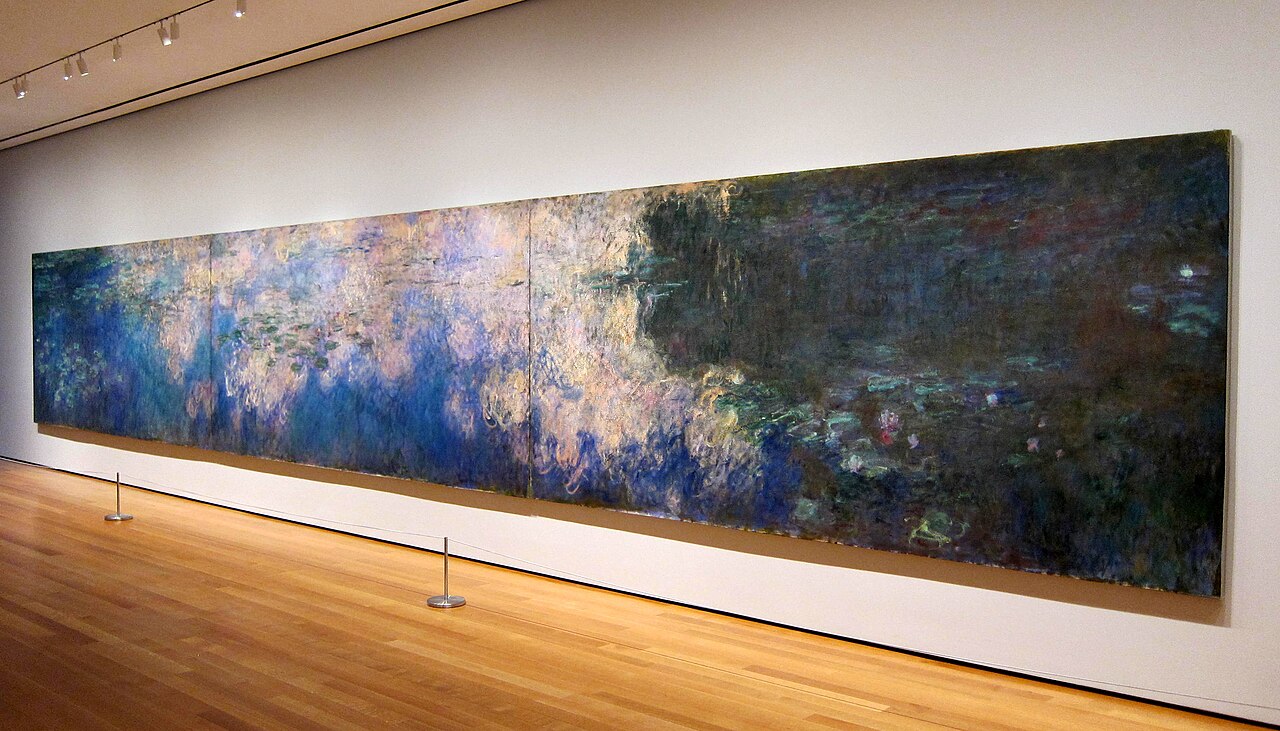
[IMAGE: Water Lilies (Reflections of Clouds on the Water-Lily Pond), by Claude Monet]
![[IMAGE: Water Lilies (Reflections of Clouds on the Water-Lily Pond), by Claude Monet]](https://upload.wikimedia.org/wikipedia/commons/thumb/4/4b/Reflections_of_Clouds_on_the_Water-Lily_Pond.jpg/1280px-Reflections_of_Clouds_on_the_Water-Lily_Pond.jpg)
Water Lilies (Reflections of Clouds on the Water-Lily Pond)
Claude Monet, c. 1920
In his garden at Giverny, Claude Monet dug a pond, diverted a stream, planted water lilies and built a Japanese-style bridge. Then, for the last thirty years of his life, he painted it — around 250 times.
In these late works there is no shore, no horizon and no up or down. Clouds float among the lily pads; the surface of the water becomes the whole world. Monet was painting not things, but light and reflection.
Much of this late work was done while he was struggling with cataracts, which clouded and coloured his vision. Some of the paintings became looser, more intense and more abstract — so much so that, decades later, abstract painters in New York looked at them and saw their own future.
Look for
- No horizon at all — sky and water merge
- Clouds reflected among the lily pads
- Paint laid on in loose, rhythmic strokes, almost abstract