History The Strange Case
The Fake History of the Bathtub
In 1917, the journalist H. L. Mencken wrote a newspaper article on the history of the bathtub in America. It was full of dates, names and detail. All of it was made up. Even after he confessed, his fake facts kept turning up as truth for decades.
On 28 December 1917, readers of the New York Evening Mail found an article with an intriguing headline: "A Neglected Anniversary". The writer pointed out that an important date in American history had passed without anyone noticing. It was, he said, the 75th anniversary of the bathtub in the United States.
The article was lively, detailed and full of facts. It was also completely made up.
The story
The writer was H. L. Mencken, one of the most famous journalists and critics of his time. In his article, he explained that the first bathtub in America had been installed in Cincinnati on 20 December 1842 by a man named Adam Thompson. Thompson, Mencken wrote, had seen a bathtub in England and decided to build one of his own, made of mahogany lined with lead.
According to the article, the new invention caused outrage. Doctors warned that bathing was dangerous and could cause illnesses. Some cities passed laws to tax or ban bathtubs. Boston, Mencken claimed, made bathing illegal except on doctors' orders.
Then, the story went, the bathtub won respectability when President Millard Fillmore installed one in the White House in 1851. After that, bathtubs spread across the country.
The article was full of names, dates and laws. None of them were real.
Why did he do it?
Mencken later said he wrote the piece as a joke and as a distraction during the gloomy days of the First World War. He wanted to write something light and absurd. He assumed readers would see through it.
They didn't. The article was reprinted and quoted. Its "facts" began to appear in other newspapers, magazines and even reference books. Writers who wanted interesting details about American history found Mencken's story and repeated it, often without knowing where it came from.
FACT Established by documentary or physical evidence.
Plausible details
Part of the reason the hoax worked was its specific detail. It gave a date, a city, a name and a story with doctors, laws and a president. Details like these make stories feel true, even when they are invented.
The confession
By 1926, Mencken had grown alarmed at how far his joke had spread. He wrote a confession, published in newspapers, titled "Melancholy Reflections". He explained that the bathtub article had been "a tissue of absurdities, all of them deliberate and most of them obvious". He was surprised that people had believed it.
He was even more surprised by what happened next. Even after his confession, the fake facts continued to appear. Some newspapers that printed his confession also continued to print the bathtub story elsewhere. In the years and decades that followed, the Fillmore bathtub claim kept popping up in articles and books.
The real history
The true history of bathing in America is less dramatic. Bathtubs existed in the United States before 1842, and there is no evidence that any American city banned them. Plumbing gradually improved during the 19th century, and indoor bathrooms spread among wealthier households and later to ordinary homes.
As for Millard Fillmore, there is no evidence he installed the first bathtub in the White House. Bathing facilities were installed in the White House earlier, around the time of Andrew Jackson's presidency in the 1830s.
FACT Established by documentary or physical evidence.
Fillmore's fame
Millard Fillmore, the 13th president, is one of the less remembered American presidents. For many people, the only "fact" they knew about him was the bathtub story — which wasn't true.
A lesson for the internet age
Mencken's hoax is often used to teach about misinformation. It shows how a false story can spread through repetition, especially when it is entertaining and detailed. Once something has been printed in several places, it starts to look true because so many sources agree — even if all of them copied the same original.
Today, the same thing happens online. A made-up fact can be posted, shared, quoted and repeated until it appears in thousands of places. Fact-checkers often trace these claims back to a single source, just as historians traced the bathtub story back to Mencken's joke.
You learned this today!!! YOU LEARNED THIS TODAY !!!
- On 28 December 1917, H. L. Mencken published an article called "A Neglected Anniversary" in the New York Evening Mail.
- It claimed the first bathtub in the United States had been installed in Cincinnati in 1842, and that doctors had warned it was dangerous.
- It also claimed President Millard Fillmore installed the first bathtub in the White House.
- The story was entirely invented, but it was widely repeated as fact.
- Mencken confessed in 1926, but the false claims continued to circulate.
One more thing
Honeybees communicate the location of flowers by dancing.
→ Read something elseSources & further reading
- A Neglected Anniversary, Wikipedia
- Mencken, H. L. Melancholy Reflections, Chicago Tribune, 23 May 1926
- Fedler, Fred. Media Hoaxes, Iowa State University Press, 1989
StoneRed separates fact, hypothesis and speculation. Spotted an error? We'd genuinely like to know.
If you liked this…
 Philosophy · The Question
If You Replace Every Plank, Is It Still the Same Ship?
A 2,000-year-old puzzle about a wooden boat turns out to be a question about your body, your memories, and whether you are the same person who woke up this morning.
The connection: A completely different corner of the archive: philosophy.
Philosophy · The Question
If You Replace Every Plank, Is It Still the Same Ship?
A 2,000-year-old puzzle about a wooden boat turns out to be a question about your body, your memories, and whether you are the same person who woke up this morning.
The connection: A completely different corner of the archive: philosophy.
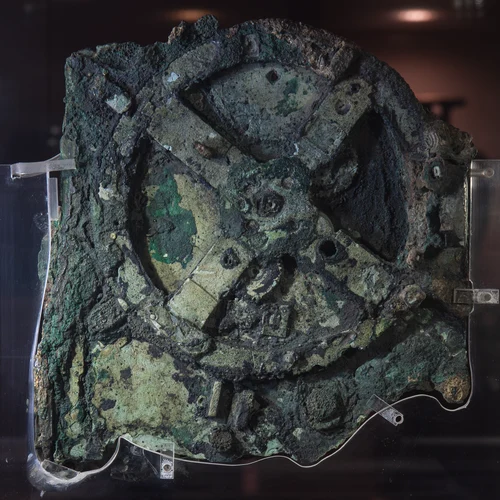 Ancient World · The Deep Dive
The 2,000-Year-Old Computer
In 1901, divers pulled a corroded lump of bronze from an ancient shipwreck. It turned out to be a geared machine for predicting the heavens — and nothing as complex would be built again for more than a thousand years.
The connection: A completely different corner of the archive: ancient world.
Ancient World · The Deep Dive
The 2,000-Year-Old Computer
In 1901, divers pulled a corroded lump of bronze from an ancient shipwreck. It turned out to be a geared machine for predicting the heavens — and nothing as complex would be built again for more than a thousand years.
The connection: A completely different corner of the archive: ancient world.
 Random · The Question
The Goat Behind Door Number Three
In 1990, a magazine columnist answered a simple puzzle about a game show. Thousands of readers, including mathematicians, wrote in to tell her she was wrong. She wasn't.
The connection: A completely different corner of the archive: random.
Random · The Question
The Goat Behind Door Number Three
In 1990, a magazine columnist answered a simple puzzle about a game show. Thousands of readers, including mathematicians, wrote in to tell her she was wrong. She wasn't.
The connection: A completely different corner of the archive: random.