Ancient World The Deep Dive
The 2,000-Year-Old Computer
In 1901, divers pulled a corroded lump of bronze from an ancient shipwreck. It turned out to be a geared machine for predicting the heavens — and nothing as complex would be built again for more than a thousand years.
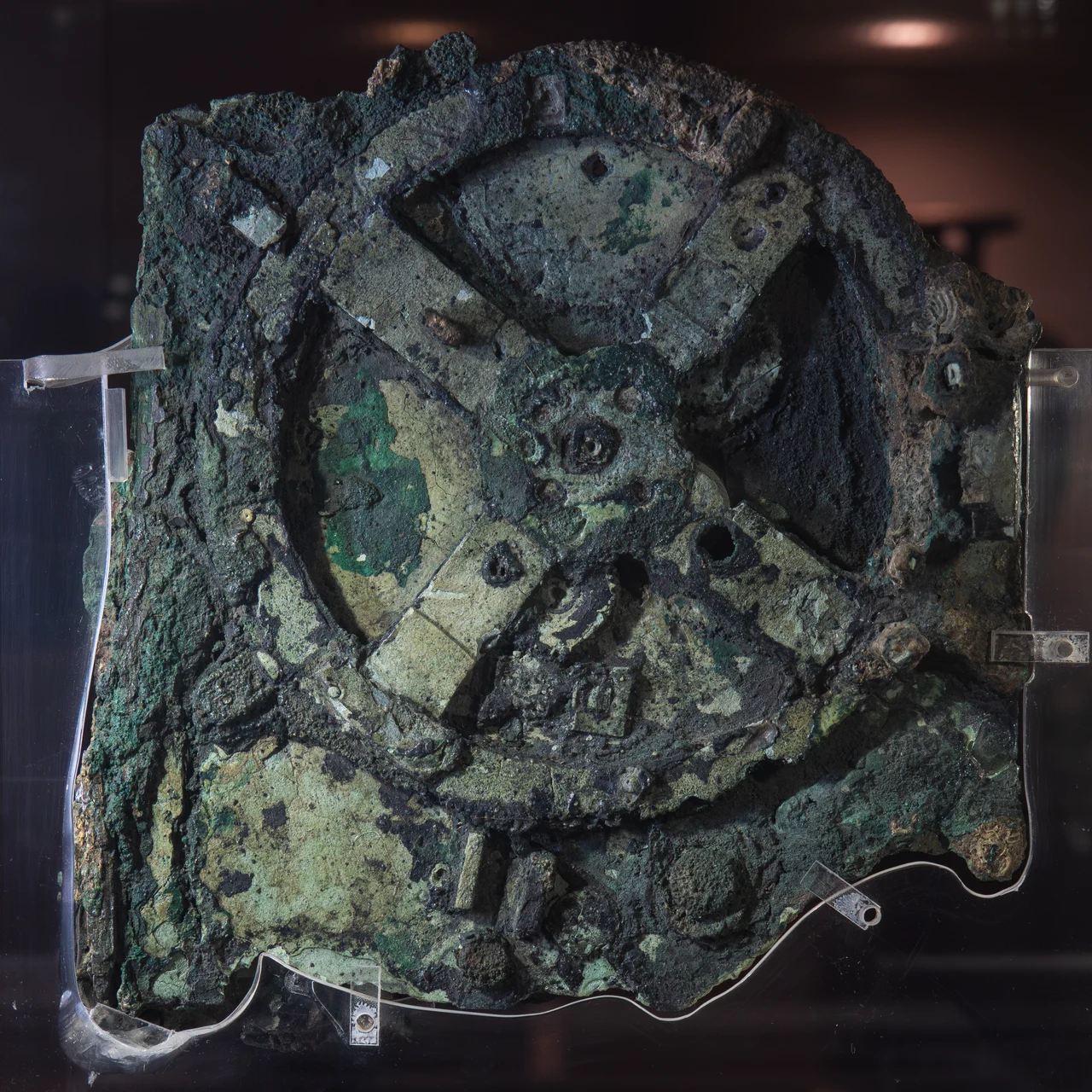
[IMAGE: The largest corroded bronze fragment of the Antikythera mechanism, showing gear wheels] (Logg Tandy / Wikimedia Commons, CC BY 4.0; opens as a separate document)
![[IMAGE: The largest corroded bronze fragment of the Antikythera mechanism, showing gear wheels]](https://upload.wikimedia.org/wikipedia/commons/thumb/c/c8/Antikythera_Fragment_A_%28Front%29.webp/1280px-Antikythera_Fragment_A_%28Front%29.webp)
In 1900, sponge divers sheltering from a storm near the tiny Greek island of Antikythera found a shipwreck on the seabed, about 45 metres down. It was full of treasure: bronze and marble statues, glassware, pottery, coins.
The following year, among the finds, someone noticed a corroded, shoebox-sized lump of bronze and wood, which had split into pieces. Inside, there were gears.
A machine that shouldn't exist
For decades, nobody knew what it was. Gears with tiny triangular teeth? From an ancient Greek shipwreck? It seemed impossible.
The British historian of science Derek de Solla Price spent years studying it, and in 1974 published Gears from the Greeks, arguing that it was an astronomical calculator. But the fragments were so corroded that much remained guesswork.
Then, in 2005, researchers brought new tools: high-resolution X-ray computed tomography and advanced surface imaging. They could suddenly see inside the fragments — gear teeth, hidden layers, and thousands of tiny inscribed letters.
What it did
Turn a hand crank on the side, and the mechanism moved dials showing:
- the position of the Sun and Moon in the zodiac
- the phase of the Moon, with a little rotating ball that was half silver, half dark
- the timing of solar and lunar eclipses, using an 18-year cycle Babylonian astronomers had discovered
- a four-year cycle of athletic games, including the Olympics
It even modelled the way the Moon speeds up and slows down in its orbit, using a clever pin-and-slot arrangement between two gears.
It was, in a real sense, an analogue computer — built more than 2,000 years ago.
FACT Established by documentary or physical evidence.
The instruction manual
The CT scans revealed thousands of characters of text engraved on the mechanism's plates and covers: labels for the dials and what researchers describe as an instruction manual explaining what the user would see.
HYPOTHESIS A credible explanation that some experts support, not proven.
Who made it?
Nobody knows. Proposed connections include the scientific traditions of Rhodes, Corinth and the legacy of Archimedes, who, according to the Roman writer Cicero, built a device showing the motions of the heavens. These are informed hypotheses, not established facts.
You learned this today!!! YOU LEARNED THIS TODAY !!!
- The Antikythera mechanism was recovered in 1901 from a Roman-era shipwreck off the Greek island of Antikythera.
- It is a hand-cranked, gear-driven device that modelled the movements of the Sun and Moon and predicted eclipses.
- It is usually dated to between the 2nd and 1st centuries BC.
- At least 30 bronze gears survive.
- X-ray CT scans in the 2000s revealed thousands of tiny inscribed characters, including a user manual.
One more thing
There are more possible games of chess than there are atoms in the observable universe.
→ Read something elseSources & further reading
- Antikythera mechanism, Wikipedia
- Freeth, T. et al. Decoding the ancient Greek astronomical calculator known as the Antikythera Mechanism, Nature, 2006
- Price, Derek de Solla. Gears from the Greeks, Transactions of the American Philosophical Society, 1974
StoneRed separates fact, hypothesis and speculation. Spotted an error? We'd genuinely like to know.
If you liked this…
 Ancient World · The Deep Dive
The Concrete That Heals Itself
Modern concrete starts falling apart within decades. Roman harbour walls have been sitting in seawater for two thousand years. In 2023, scientists finally worked out one of the reasons why.
The connection: Ancient engineering that we underestimated for centuries.
Ancient World · The Deep Dive
The Concrete That Heals Itself
Modern concrete starts falling apart within decades. Roman harbour walls have been sitting in seawater for two thousand years. In 2023, scientists finally worked out one of the reasons why.
The connection: Ancient engineering that we underestimated for centuries.
 Mysteries · The Theory
The Book Nobody Can Read
Six centuries old, written in an unknown script, illustrated with plants that don't exist. The Voynich Manuscript has defeated wartime codebreakers, linguists and computers. Here is what we actually know.
The connection: An object that kept its secrets for a very long time.
Mysteries · The Theory
The Book Nobody Can Read
Six centuries old, written in an unknown script, illustrated with plants that don't exist. The Voynich Manuscript has defeated wartime codebreakers, linguists and computers. Here is what we actually know.
The connection: An object that kept its secrets for a very long time.
 Technology · The Timeline
The Chocolate Bar That Melted in the Lab
The microwave oven was invented by a self-taught engineer who never finished grammar school, standing next to radar equipment, with a snack in his pocket.
The connection: Technology that seems to arrive too early.
Technology · The Timeline
The Chocolate Bar That Melted in the Lab
The microwave oven was invented by a self-taught engineer who never finished grammar school, standing next to radar equipment, with a snack in his pocket.
The connection: Technology that seems to arrive too early.