Psychology The Person
The Man With a Hole in His Head
In 1848, an iron rod more than a metre long shot through Phineas Gage's skull. He sat up, talked, and lived for another eleven years — and became the most famous patient in the history of neuroscience.
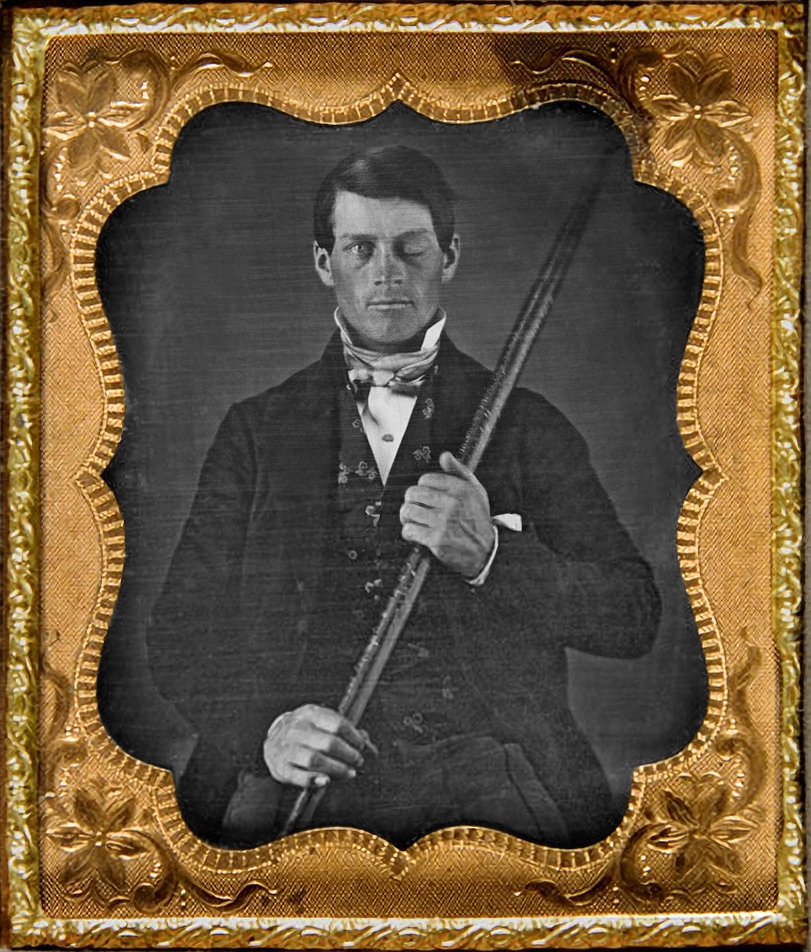
[IMAGE: Daguerreotype portrait of Phineas Gage holding the tamping iron that passed through his skull] (Photograph by Jack and Beverly Wilgus of daguerreotype originally from their col / Wikimedia Commons, CC BY-SA 3.0; opens as a separate document)
![[IMAGE: Daguerreotype portrait of Phineas Gage holding the tamping iron that passed through his skull]](https://upload.wikimedia.org/wikipedia/commons/1/1b/Phineas_Gage_Cased_Daguerreotype_WilgusPhoto2008-12-19_EnhancedRetouched_Color.jpg)
On 13 September 1848, Phineas Gage was blasting rock for a railroad in Vermont. His job was to pack explosive powder into a hole, add sand, and tamp it down with a long iron rod.
Something went wrong. A spark ignited the powder while the rod was still in the hole. The tamping iron — about 1.1 metres long, 3 centimetres thick and weighing around 6 kilograms — shot upwards like a missile. It entered under his left cheekbone, passed behind his left eye, went through the front of his brain and exited through the top of his skull. It landed many metres away.
Gage fell. Then, within a few minutes, he sat up and talked.
"Here is business enough for you"
He was taken by ox cart to town and sat upright, waiting for the doctor. When a physician arrived, Gage is reported to have greeted him by saying, "Doctor, here is business enough for you."
The young doctor who treated him over the following months, John Martyn Harlow, kept careful notes. Gage survived infection and fever. He lost the sight in his left eye. But he could walk, talk and remember.
He had a hole through the front of his brain — and he was still recognisably himself. Or was he?
"No longer Gage"
Harlow later wrote that Gage's friends said he was "no longer Gage". The once-reliable foreman was described as impatient, profane and unable to stick to plans.
That description made Gage famous. He became the textbook example of how damage to the frontal lobes can change personality and judgement — a living demonstration that the mind depends on the physical brain.
The more interesting truth
Here's where the story gets better than the textbook version.
HYPOTHESIS A credible explanation that some experts support, not proven.
The recovery
Psychologist Malcolm Macmillan, who spent decades studying Gage, argues that many popular accounts exaggerate his decline. Gage went on to work for years, including as a long-distance stagecoach driver in Chile — a demanding job requiring planning, skill and dealing with passengers. Macmillan suggests Gage may have recovered much of his social functioning, a remarkable example of the brain's ability to adapt.
Gage died in 1860, after a series of seizures. He was 36.
You learned this today!!! YOU LEARNED THIS TODAY !!!
- In 1848, a tamping iron about 1.1 metres long passed through Phineas Gage's skull, damaging his left frontal lobe.
- Gage was conscious within minutes and survived the accident by about eleven years.
- Reports that his personality changed made him a famous case for how the frontal lobes relate to behaviour.
- Later research suggests he recovered more social function than the popular story claims, including working as a stagecoach driver in Chile.
- His skull and the iron are kept at Harvard's Warren Anatomical Museum.
One more thing
The fingerprints of identical twins are not identical.
→ Read something elseSources & further reading
- Phineas Gage, Wikipedia
- Macmillan, Malcolm. An Odd Kind of Fame: Stories of Phineas Gage, MIT Press, 2000
- Harlow, John M. Recovery from the passage of an iron bar through the head, Publications of the Massachusetts Medical Society, 1868
StoneRed separates fact, hypothesis and speculation. Spotted an error? We'd genuinely like to know.
If you liked this…
 Psychology · The Question
Why Don't We Remember Being Babies?
You learned to walk, talk and recognise your own face — and you remember none of it. Science is finally starting to explain where those years went.
The connection: What the brain keeps, what it loses, and who we are afterwards.
Psychology · The Question
Why Don't We Remember Being Babies?
You learned to walk, talk and recognise your own face — and you remember none of it. Science is finally starting to explain where those years went.
The connection: What the brain keeps, what it loses, and who we are afterwards.
 Philosophy · The Question
If You Replace Every Plank, Is It Still the Same Ship?
A 2,000-year-old puzzle about a wooden boat turns out to be a question about your body, your memories, and whether you are the same person who woke up this morning.
The connection: If an injury changes your personality, are you still the same person?
Philosophy · The Question
If You Replace Every Plank, Is It Still the Same Ship?
A 2,000-year-old puzzle about a wooden boat turns out to be a question about your body, your memories, and whether you are the same person who woke up this morning.
The connection: If an injury changes your personality, are you still the same person?
 Space · The Story
The Day the Sun Set Telegraphs on Fire
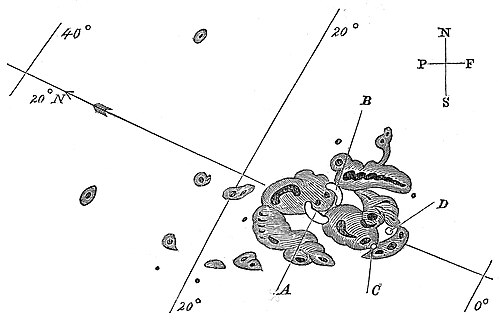
In 1859, the biggest solar storm on record lit up skies with auroras as far south as the Caribbean and made telegraph wires spark. If it happened today, it would be a very different story.
The connection: A completely different corner of the archive: space.
Space · The Story
The Day the Sun Set Telegraphs on Fire
In 1859, the biggest solar storm on record lit up skies with auroras as far south as the Caribbean and made telegraph wires spark. If it happened today, it would be a very different story.
The connection: A completely different corner of the archive: space.