Psychology The Question
Why Don't We Remember Being Babies?
You learned to walk, talk and recognise your own face — and you remember none of it. Science is finally starting to explain where those years went.

[IMAGE: A baby asleep] (Toshiyuki IMAI from Kyoto, Japan / Wikimedia Commons, CC BY-SA 2.0; opens as a separate document)
Somewhere in the first three years of your life, you learned an astonishing amount.
You figured out that the blurry shapes around you were faces. You learned which face was safe. You learned to sit, crawl, stand and walk. You learned a language — possibly two — without a single grammar lesson. You discovered that objects still exist when you can't see them, which is a genuinely profound idea that you worked out on your own.
And you remember none of it.
Not the first steps. Not the first word. Not one birthday cake. It's as if someone lived those years for you and then left without leaving a note.
This blank has a name — infantile amnesia — and for more than a century it has been one of psychology's most quietly baffling puzzles.
The age of the curtain
Ask a large group of adults for their earliest memory and a pattern emerges. On average, the very first memories people report date from around age three to three and a half. Before that, almost nothing. Between three and about seven, a patchy, fragmentary handful.
The term "infantile amnesia" was popularised by Sigmund Freud, who thought the missing memories had been repressed because they were too disturbing. That explanation hasn't survived. The real story turns out to be much stranger — and much less sinister.
Babies remember things. That's the twist.
For a long time, one popular idea was that babies simply couldn't form lasting memories at all. Their brains weren't ready.
That idea is now in serious trouble.
Babies clearly learn from experience. Infants as young as a few months can remember that kicking their leg makes a mobile move, and they'll still remember days later. Toddlers imitate actions they watched weeks before.
And in 2025, researchers at Yale published something remarkable. Using an fMRI scanner — adapted to keep wriggling babies still and calm — they showed infants a series of pictures and later tested whether they recognised them. When an infant's hippocampus, the brain structure central to memory, was more active while first seeing an image, the baby was more likely to recognise it later. The effect was clearest in babies older than about 12 months.
The surprising conclusion: babies' brains may be recording memories just fine. The problem is getting them back.
So where do the memories go?
Here is where things get genuinely interesting. Researchers have a handful of explanations, and they probably all play a part.
HYPOTHESIS A credible explanation that some experts support, not proven.
The brain is renovating
The hippocampus in infants is a construction site. It produces huge numbers of new neurons, and those new neurons wire themselves into existing circuits. In 2014, a team led by Paul Frankland and Sheena Josselyn showed in mice that high rates of new neuron growth caused animals to forget things they had learned — and that slowing neuron growth in infant mice helped them remember. The new wiring may overwrite or scramble the old.
HYPOTHESIS A credible explanation that some experts support, not proven.
There's no "you" yet to file things under
Autobiographical memory isn't just recording events. It's recording events that happened to me. Psychologists Mark Howe and Mary Courage argued that until a child develops a sense of self — usually around 18 to 24 months, the age at which children start to recognise themselves in a mirror — there's no framework to organise personal memories around.
HYPOTHESIS A credible explanation that some experts support, not proven.
Language changes the index
Once children learn to describe events in words, they store and retrieve memories differently. Memories formed before language may be stored in a format adult brains can no longer easily search.
The memories might still be in there
The strangest finding of all comes from mice.
In 2018, scientists in Toronto trained infant mice to fear a particular box, then waited until the mice had grown up and forgotten. Using a technique called optogenetics, they then reactivated the specific brain cells that had been active during the original learning.
The adult mice froze in fear. The "lost" memory came back.
That doesn't prove the same is true of humans. But it raises a haunting possibility: that your infancy isn't erased, just locked. The memories exist, but the key has been lost.
It happens later than you think
You might assume the curtain falls at age three. But research by Patricia Bauer and colleagues suggests the forgetting happens later.
In one long-running study, children were recorded talking about events with their parents at age three, then asked about the same events years later. Children aged five to seven still remembered a majority of those early events. By age eight or nine, they remembered far fewer — well under half.
In other words, a six-year-old can still remember being three. The memories fade afterwards. Somewhere around age seven, the window closes.
Culture moves the curtain
The age of earliest memory isn't the same everywhere.
A New Zealand study found that Māori adults reported earliest memories from around two and a half on average — earlier than New Zealanders of European or Asian descent. Researchers have linked this to rich traditions of storytelling about the past and family history. Other studies have found that children whose parents talk with them in detailed, elaborate ways about past events tend to remember more from early childhood.
The stories we're told about our lives seem to help preserve them.
The answer, for now
So why don't we remember being babies?
Probably because several things happen at once: a brain growing so fast that it overwrites its own early wiring, a sense of self that hasn't yet assembled, a memory system that changes its filing method when language arrives, and a slow fade that runs right through early childhood.
But the latest research suggests something gentler than total erasure. The experiences of your first years almost certainly shaped you — your attachments, your instincts, your sense of what the world is like. You just can't look at them directly.
You were there. You just don't have the receipts.
You learned this today!!! YOU LEARNED THIS TODAY !!!
- Most adults' earliest memories date from around age three to three and a half.
- Young children do form memories; many of them fade around age seven, a process researchers call childhood amnesia.
- A 2025 brain-scanning study found infants' hippocampi encoding memories as early as about 12 months old.
- In mice, "forgotten" infant memories have been recovered by reactivating the brain cells that stored them.
- In a 2018 survey of more than 6,000 people, almost 40% reported a first memory from age two or younger — most likely fictional.
One more thing
The Moon drifts about 3.8 centimetres further away from Earth every year.
→ Read something elseSources & further reading
- Childhood amnesia, Wikipedia
- Yates, T. S. et al. Hippocampal encoding of memories in human infants, Science, 2025
- Akhtar, S. et al. Fictional first memories, Psychological Science, 2018
- Bauer, P. J. & Larkina, M. The onset of childhood amnesia in childhood, Journal of Experimental Psychology: General, 2014
- Akers, K. G. et al. Hippocampal neurogenesis regulates forgetting during adulthood and infancy, Science, 2014
- Guskjolen, A. et al. Recovery of "lost" infant memories in mice, Current Biology, 2018
- MacDonald, S., Uesiliana, K. & Hayne, H. Cross-cultural and gender differences in childhood amnesia, Memory, 2000
StoneRed separates fact, hypothesis and speculation. Spotted an error? We'd genuinely like to know.
If you liked this…
 Philosophy · The Question
If You Replace Every Plank, Is It Still the Same Ship?
A 2,000-year-old puzzle about a wooden boat turns out to be a question about your body, your memories, and whether you are the same person who woke up this morning.
The connection: If you can't remember being a baby, in what sense were you that baby?
Philosophy · The Question
If You Replace Every Plank, Is It Still the Same Ship?
A 2,000-year-old puzzle about a wooden boat turns out to be a question about your body, your memories, and whether you are the same person who woke up this morning.
The connection: If you can't remember being a baby, in what sense were you that baby?
 Weird · The Strange Case
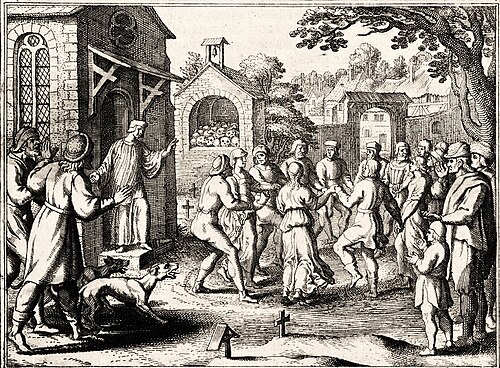
The Summer Strasbourg Couldn't Stop Dancing
In July 1518, a woman stepped into a street and began to dance. Within weeks, dozens — perhaps hundreds — had joined her, and nobody could make them stop.
The connection: Another case where what we believe shapes what we experience.
Weird · The Strange Case
The Summer Strasbourg Couldn't Stop Dancing
In July 1518, a woman stepped into a street and began to dance. Within weeks, dozens — perhaps hundreds — had joined her, and nobody could make them stop.
The connection: Another case where what we believe shapes what we experience.
 Mysteries · The Theory
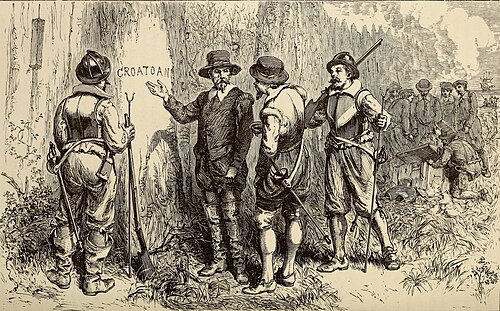
The Colony That Vanished
In 1590, John White returned to the English settlement on Roanoke Island to find everyone gone. The only clue was a single word carved into a post — "CROATOAN".
The connection: A completely different corner of the archive: mysteries.
Mysteries · The Theory
The Colony That Vanished
In 1590, John White returned to the English settlement on Roanoke Island to find everyone gone. The only clue was a single word carved into a post — "CROATOAN".
The connection: A completely different corner of the archive: mysteries.