Nature The Rabbit Hole
The Alien in the Aquarium
Octopuses have three hearts, blue blood and most of their neurons in their arms. They solve puzzles, recognise faces and escape from tanks. They might be the closest thing to an alien intelligence on Earth.
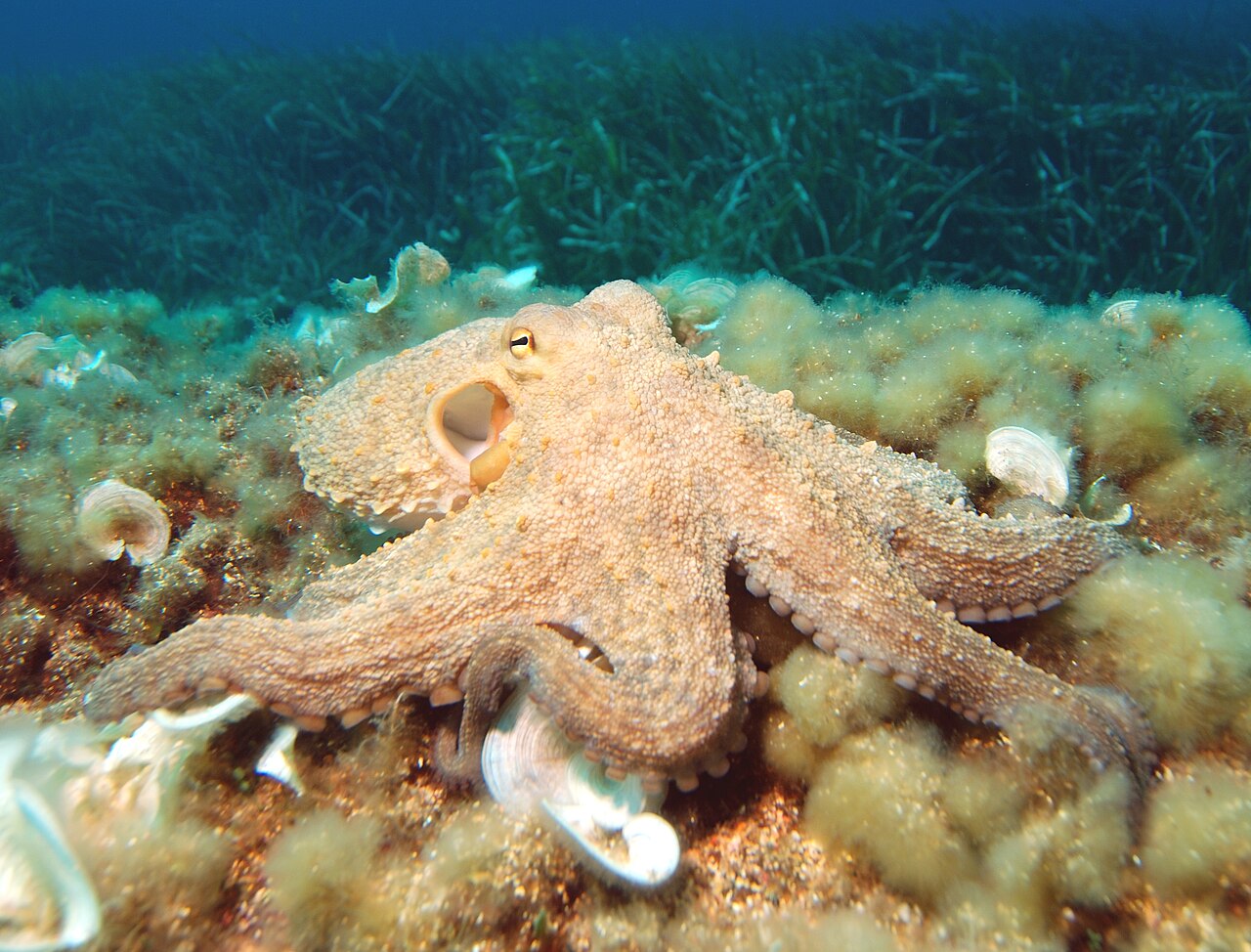
[IMAGE: An octopus on the sea floor, arms spread] (albert kok / Wikimedia Commons, CC BY-SA 3.0; opens as a separate document)
![[IMAGE: An octopus on the sea floor, arms spread]](https://upload.wikimedia.org/wikipedia/commons/thumb/5/57/Octopus2.jpg/1280px-Octopus2.jpg)
Start with a fact: an octopus has three hearts.
Two pump blood through the gills. The third pumps it around the body. And the blood is blue, because it uses a copper-based molecule, hemocyanin, to carry oxygen, rather than the iron-based hemoglobin in ours.
That's strange enough. Let's go deeper.
Level 2: The arms think
An octopus has around 500 million neurons — roughly comparable to a dog. But about two-thirds of them aren't in its head. They're in its arms.
Each arm can taste what it touches through thousands of suckers, and can carry out complex movements with surprising independence. An arm that has been severed can still reach and grab for a while.
Imagine if your hands could taste, and partly think for themselves.
Level 3: Escape artists
Octopuses are famous for escaping. They can squeeze through any gap bigger than their beak, the only hard part of their body.
In 2016, an octopus called Inky made headlines when he vanished from New Zealand's National Aquarium. Staff believe he squeezed through a small gap at the top of his tank, slid across the floor, and slipped down a drainpipe that led to the sea.
Level 4: They know who you are
Aquarium workers report that octopuses recognise individual people, behaving differently towards those they like and dislike. Some have been known to squirt water at particular staff members. In experiments, octopuses learn to open jars, navigate mazes and use objects — some species carry coconut shells to use as portable shelters.
Level 5: An alien mind on Earth
Here's the deepest part of the rabbit hole.
The last common ancestor of humans and octopuses was probably a small, simple, worm-like creature that lived more than 500 million years ago. Everything since — the octopus's big brain, its complex behaviour, its curiosity — evolved completely separately from ours.
You learned this today!!! YOU LEARNED THIS TODAY !!!
- Octopuses have three hearts and blue, copper-based blood.
- Around two-thirds of an octopus's neurons are in its arms rather than its central brain.
- Octopuses can solve puzzles, open jars and recognise individual humans.
- In 2016, an octopus named Inky escaped from New Zealand's National Aquarium, apparently through a drainpipe to the sea.
- Their intelligence evolved separately from ours; our last common ancestor was a simple worm-like creature over 500 million years ago.
One more thing
The Eiffel Tower can grow up to about 15 centimetres taller in summer as its iron expands in the heat.
→ Read something elseSources & further reading
- Octopus, Wikipedia
- Godfrey-Smith, Peter. Other Minds: The Octopus, the Sea, and the Deep Origins of Consciousness, Farrar, Straus and Giroux, 2016
- Cephalopod intelligence, Wikipedia
StoneRed separates fact, hypothesis and speculation. Spotted an error? We'd genuinely like to know.
If you liked this…
 Nature · The Story
The Jellyfish That Hits Rewind
When life gets hard, Turritopsis dohrnii doesn't die. It turns back into a baby.
The connection: Another sea creature that breaks the rules of biology.
Nature · The Story
The Jellyfish That Hits Rewind
When life gets hard, Turritopsis dohrnii doesn't die. It turns back into a baby.
The connection: Another sea creature that breaks the rules of biology.
 Space · The Theory
Where Is Everybody?
Over lunch in 1950, the physicist Enrico Fermi asked a simple question about aliens. Seventy-five years later, it's still one of the most unsettling questions in science.
The connection: If you want to meet an alien mind, you may not need a spaceship.
Space · The Theory
Where Is Everybody?
Over lunch in 1950, the physicist Enrico Fermi asked a simple question about aliens. Seventy-five years later, it's still one of the most unsettling questions in science.
The connection: If you want to meet an alien mind, you may not need a spaceship.
 Psychology · The Question
Why Don't We Remember Being Babies?
You learned to walk, talk and recognise your own face — and you remember none of it. Science is finally starting to explain where those years went.
The connection: Minds can be built in more than one way.
Psychology · The Question
Why Don't We Remember Being Babies?
You learned to walk, talk and recognise your own face — and you remember none of it. Science is finally starting to explain where those years went.
The connection: Minds can be built in more than one way.