Nature The Story
The Jellyfish That Hits Rewind
When life gets hard, Turritopsis dohrnii doesn't die. It turns back into a baby.
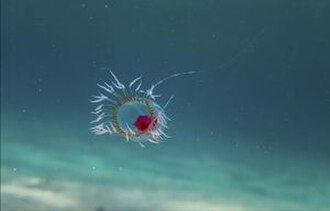
[IMAGE: Turritopsis dohrnii, a tiny transparent jellyfish with a red centre] (Bachware / Wikimedia Commons, CC BY-SA 4.0; opens as a separate document)
![[IMAGE: Turritopsis dohrnii, a tiny transparent jellyfish with a red centre]](https://upload.wikimedia.org/wikipedia/commons/thumb/7/74/Turritopsis_dohrnii.jpg/330px-Turritopsis_dohrnii.jpg)
Most animals have a simple life plan. You're born, you grow up, you reproduce, you age, you die.
Turritopsis dohrnii read that plan and decided it was more of a suggestion.
Small, see-through, and stubborn
It's not much to look at. The adult — the bell-shaped stage we think of as a jellyfish, called a medusa — is about 4.5 millimetres across, smaller than your little fingernail. It's transparent, with a red stomach visible through its body like a cherry in jelly.
But when an adult Turritopsis dohrnii is starving, injured, stressed or simply old, it can do something almost no other animal can.
It sinks to the sea floor and shrinks. It absorbs its tentacles. It turns into a small blob of tissue, a sort of cyst. And then, over the following days, that blob grows into a polyp — the juvenile, plant-like stage that jellyfish start their lives as.
The polyp then buds off new, genetically identical baby jellyfish. And the cycle starts again.
Imagine a butterfly that, when things got tough, turned back into a caterpillar.
The accidental discovery
The trick was first noticed in the late 1980s by Christian Sommer, a German marine-biology student studying small hydrozoans he had collected off the Italian Riviera. He kept them in dishes and watched what happened.
What happened made no sense. Some of his jellyfish seemed to vanish — and polyps appeared in their place.
It took several years and a team of Italian researchers, including Ferdinando Boero and Stefano Piraino, to work out what Sommer had seen. Their 1996 paper had a beautifully direct title: Reversing the Life Cycle.
How do you un-grow?
The key is a process called transdifferentiation. As animals develop, their cells specialise — becoming muscle, nerve, skin — and normally they stay that way. In Turritopsis, specialised cells can switch identity, turning into different kinds of cells as the body rebuilds itself into a polyp.
A 2022 study comparing its genome with that of a close relative that can't rejuvenate found that Turritopsis dohrnii has extra copies of genes involved in DNA repair and replication, and in protecting the tips of chromosomes. In other words, it seems unusually well equipped to keep its genetic instructions intact through repeated rebuilding.
Why it matters
Nobody is going to turn humans into polyps. But scientists who study ageing and regeneration are fascinated by an animal that can reset its own cells — and by what that tells us about how fixed "growing up" really is.
You learned this today!!! YOU LEARNED THIS TODAY !!!
- Turritopsis dohrnii, a jellyfish about 4.5 mm across, can revert from its adult stage to its juvenile polyp stage.
- The ability was first noticed by a German student, Christian Sommer, in the late 1980s, and described scientifically in 1996.
- The process relies on transdifferentiation — specialised cells turning into different kinds of cells.
- The jellyfish is not truly immortal; it can still be eaten or killed by disease.
One more thing
A group of flamingos is called a flamboyance.
→ Read something elseSources & further reading
- Turritopsis dohrnii, Wikipedia
- Bavestrello, G., Sommer, C. & Sarà, M. Bi-directional conversion in Turritopsis nutricula, Scientia Marina, 1992
- Piraino, S., Boero, F., Aeschbach, B. & Schmid, V. Reversing the life cycle, Biological Bulletin, 1996
- Pascual-Torner, M. et al. Comparative genomics of mortal and immortal cnidarians, PNAS, 2022
StoneRed separates fact, hypothesis and speculation. Spotted an error? We'd genuinely like to know.
If you liked this…
 Philosophy · The Question
If You Replace Every Plank, Is It Still the Same Ship?
A 2,000-year-old puzzle about a wooden boat turns out to be a question about your body, your memories, and whether you are the same person who woke up this morning.
The connection: If an animal rebuilds itself from scratch, is it the same animal?
Philosophy · The Question
If You Replace Every Plank, Is It Still the Same Ship?
A 2,000-year-old puzzle about a wooden boat turns out to be a question about your body, your memories, and whether you are the same person who woke up this morning.
The connection: If an animal rebuilds itself from scratch, is it the same animal?
 Psychology · The Question
Why Don't We Remember Being Babies?
You learned to walk, talk and recognise your own face — and you remember none of it. Science is finally starting to explain where those years went.
The connection: We become children once and forget it. This jellyfish does it over and over.
Psychology · The Question
Why Don't We Remember Being Babies?
You learned to walk, talk and recognise your own face — and you remember none of it. Science is finally starting to explain where those years went.
The connection: We become children once and forget it. This jellyfish does it over and over.
 People · The Person
The Girl Who Found Sea Dragons
Mary Anning was poor, had little schooling, and was barred from the scientific societies of her day because she was a woman. She also found some of the most important fossils in history.
The connection: A completely different corner of the archive: people.
People · The Person
The Girl Who Found Sea Dragons
Mary Anning was poor, had little schooling, and was barred from the scientific societies of her day because she was a woman. She also found some of the most important fossils in history.
The connection: A completely different corner of the archive: people.