Economics The Deep Dive
The Island Where Money Sat at the Bottom of the Sea
On the Pacific island of Yap, money came in the form of giant stone wheels, some taller than a person. One of them was lost at sea — and kept being spent anyway.
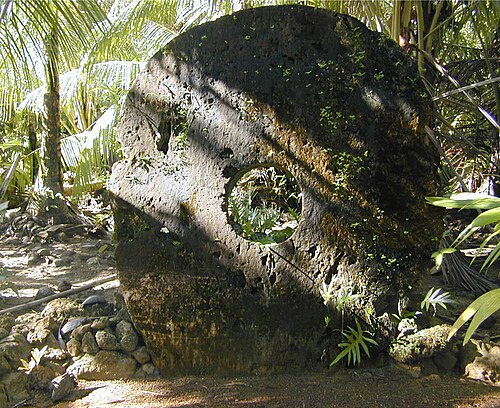
[IMAGE: Large carved rai stones with central holes, the stone money of Yap] (Eric Guinther / Wikimedia Commons, CC BY-SA 3.0; opens as a separate document)
![[IMAGE: Large carved rai stones with central holes, the stone money of Yap]](https://upload.wikimedia.org/wikipedia/commons/thumb/5/54/Yap_Stone_Money.jpg/500px-Yap_Stone_Money.jpg)
On the island of Yap, in the western Pacific, there is a bank with no walls, no vault and no guards.
It's a path through the village, lined with enormous stone discs. Some are the size of a dinner plate. Some are taller than a person, with a hole in the middle so a pole can be passed through to carry them.
They are money. Some of them are still used today.
And the most valuable one of all may be lying at the bottom of the sea.
Money you can't put in your pocket
The stones are called rai (sometimes fei). They are made of a crystalline limestone that doesn't exist on Yap. To get it, Yapese voyagers sailed to the islands of Palau, roughly 400 kilometres away, where they quarried the stone — with permission from Palauan chiefs — carved it into discs, and then hauled it back across open ocean by canoe and raft.
The largest stones are around 3.6 metres across and weigh several tonnes.
That journey was dangerous. Canoes capsized. People died. And that history became part of each stone's value.
FACT Established by documentary or physical evidence.
How a rai stone was valued
A stone's value depended on more than its size. Its craftsmanship mattered, and so did its story: who brought it, how difficult the voyage was, whether people had died bringing it to Yap. Two stones of the same size could be worth very different amounts.
The stone that never moves
Here is the clever part.
Moving a four-tonne stone every time you buy something would be absurd. So the Yapese didn't. When a stone changed hands — as part of a marriage settlement, a land deal, a political alliance or compensation for a wrong — the stone usually stayed exactly where it was. What changed was the shared knowledge of who owned it.
Everybody knew. The community remembered. Ownership was recorded not in a book but in collective memory, and was passed down through oral history.
The stone stayed put. The ownership moved. Which raises a strange question: what, exactly, was the money — the stone or the memory?
The stone at the bottom of the sea
Now for the most famous story.
In 1903, an American anthropologist named William Henry Furness III spent several months on Yap. In his 1910 book The Island of Stone Money, he described a remarkable case.
According to what he was told, a family in one village was considered extremely wealthy, but nobody had ever seen the source of their wealth. Generations earlier, an ancestor had been bringing back a huge, fine stone from Palau. During a storm, the raft carrying it had to be cut loose, and the stone sank.
When the crew got home, they all testified that the stone had been magnificent, and that it was lost through no fault of the owner.
So the village agreed: the stone still counted. It was still wealth. It could still be traded. It just happened to be at the bottom of the ocean.
A voyage worth more than the stone
It's worth pausing on how extraordinary the logistics were.
Palau and Yap are separated by hundreds of kilometres of open Pacific. Yapese voyagers had to navigate there by stars, swells and accumulated knowledge, negotiate with Palauan leaders for the right to quarry, spend weeks or months shaping the stone with simple tools, and then bring tonnes of rock home over the sea on canoes and rafts.
Every successful stone represented an enormous investment of skill, labour and risk. In a sense, the stone was a receipt for the voyage. It was proof that something difficult had been done, by particular people, at a particular cost.
That's why a smaller stone with a dramatic history could be worth more than a larger one with a dull one. The Yapese weren't valuing limestone. They were valuing what it took to get it.
Enter the economists
Furness's book had an unexpected afterlife. The economist John Maynard Keynes reviewed it in 1915, struck by how familiar the Yapese system was.
Then, in 1991, the Nobel laureate Milton Friedman wrote an essay called The Island of Stone Money. His point was simple and a little unsettling: the Yapese weren't strange at all. We do exactly the same thing.
He pointed to a striking episode from 1932. The Bank of France, worried about the US dollar, asked the Federal Reserve Bank of New York to convert some of its dollar holdings into gold — but to keep the gold in New York. So Fed employees went down to the vaults and moved gold bars into a separate drawer labelled as belonging to France.
The gold didn't cross the ocean. It moved a few feet inside a basement. Yet newspapers reported a "loss of gold" by the United States, and the episode fed fears about American banks.
Is that really so different from a stone at the bottom of the sea?
A captain and an inflation crisis
Yap's stone economy had its own disruption from outside.
In the 1870s, an Irish-American sea captain named David O'Keefe was shipwrecked near Yap. He later returned with a ship and Western tools, and began offering to transport rai stones from Palau in exchange for valuable copra (dried coconut) and other goods.
Suddenly, stones were easier to get. Many more arrived. But the Yapese, sensibly, didn't value them as highly as the old stones. A stone that came easily, without danger or sacrifice, didn't carry the same story.
It's a lesson that central bankers know well: make money too easily and it buys less. The Yapese had worked it out with limestone.
What money really is
Strip away the stones, the gold bars and the banknotes, and here's what's left.
Money is a shared record of who owes what to whom, backed by everyone's belief that the record is accurate and will be honoured. The physical object — stone, metal, paper, a number in a database — is mostly just a way of keeping track.
The Yapese simply made this obvious, because their "coins" were too big to pretend otherwise.
From Yap to the ledger
There's a newer echo of the stone money story, too.
When people first tried to explain cryptocurrencies such as Bitcoin, many reached for Yap. A cryptocurrency is, at its heart, a shared record of who owns what, kept by a whole community rather than a single bank, with nothing physical changing hands. The "coins" don't move. The ledger does.
That comparison can be overstretched — Yap's stones were embedded in kinship, ceremony and history in ways no software is. But the core idea is the same one Furness stumbled onto in 1903: what makes something money is not the object, but the agreement about the record.
The Yapese ledger was kept in human memory, passed down through generations. It was remarkably robust. It survived colonial rule by Spain, Germany, Japan and the United States. It survived typhoons and wars. Some of it is still running today.
The stones today
Rai stones are still found across Yap, many lined up along paths and outside meeting houses. They aren't used to buy groceries — Yap, part of the Federated States of Micronesia, uses the US dollar for that — but they still play a role in important traditional exchanges and ceremonies.
They are a monument to an idea that most of the world took far longer to understand: that money is not a thing.
It's a promise that everyone has agreed to remember.
You learned this today!!! YOU LEARNED THIS TODAY !!!
- On Yap, in Micronesia, large carved stone discs called rai were used as money.
- The stones were quarried on Palau, around 400 kilometres away, and brought back by canoe or raft.
- Ownership could change without the stone moving; the community simply remembered who owned it.
- A famous account describes a stone lost at sea that was still treated as wealth because everyone agreed it existed.
- Milton Friedman used Yap's stones to explain how the gold standard and modern money really work.
One more thing
A group of flamingos is called a flamboyance.
→ Read something elseSources & further reading
- Furness, William Henry, III. The Island of Stone Money: Uap of the Carolines, J. B. Lippincott, 1910
- Friedman, Milton. The Island of Stone Money, Hoover Institution working paper, 1991; reprinted in Money Mischief, 1992
- Keynes, J. M. Review of The Island of Stone Money, The Economic Journal, 1915
- Rai stones, Wikipedia
- Yap, Wikipedia
StoneRed separates fact, hypothesis and speculation. Spotted an error? We'd genuinely like to know.
If you liked this…
 Ancient World · The Deep Dive
The Concrete That Heals Itself
Modern concrete starts falling apart within decades. Roman harbour walls have been sitting in seawater for two thousand years. In 2023, scientists finally worked out one of the reasons why.
The connection: Another civilisation that put its faith in stone.
Ancient World · The Deep Dive
The Concrete That Heals Itself
Modern concrete starts falling apart within decades. Roman harbour walls have been sitting in seawater for two thousand years. In 2023, scientists finally worked out one of the reasons why.
The connection: Another civilisation that put its faith in stone.
 Philosophy · The Question
If You Replace Every Plank, Is It Still the Same Ship?
A 2,000-year-old puzzle about a wooden boat turns out to be a question about your body, your memories, and whether you are the same person who woke up this morning.
The connection: If a coin never moves, how do you know whose it is? Identity by agreement.
Philosophy · The Question
If You Replace Every Plank, Is It Still the Same Ship?
A 2,000-year-old puzzle about a wooden boat turns out to be a question about your body, your memories, and whether you are the same person who woke up this morning.
The connection: If a coin never moves, how do you know whose it is? Identity by agreement.
 Random · The Question
The Goat Behind Door Number Three
In 1990, a magazine columnist answered a simple puzzle about a game show. Thousands of readers, including mathematicians, wrote in to tell her she was wrong. She wasn't.
The connection: A completely different corner of the archive: random.
Random · The Question
The Goat Behind Door Number Three
In 1990, a magazine columnist answered a simple puzzle about a game show. Thousands of readers, including mathematicians, wrote in to tell her she was wrong. She wasn't.
The connection: A completely different corner of the archive: random.