Psychology The Question
The Pill That Works Even When You Know It's Fake
Sugar pills can make people feel better. That much is familiar. The stranger finding is that, in some studies, they help even when patients are told exactly what they are.
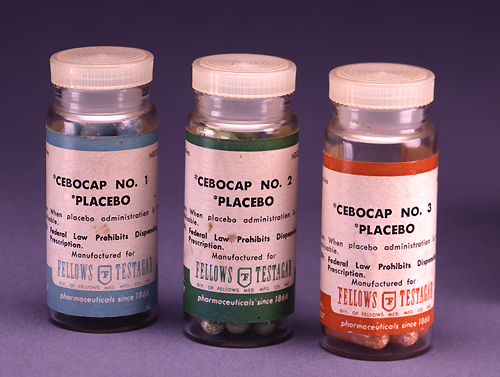
[IMAGE: A bottle of placebo capsules labelled for research use] (NIH, objects donated by Elaine and Arthur Shapiro / Wikimedia Commons, Public domain; opens as a separate document)
![[IMAGE: A bottle of placebo capsules labelled for research use]](https://upload.wikimedia.org/wikipedia/commons/1/1c/Cebocap.jpg)
Here's a question that sounds like a trick: can a pill with nothing in it make you feel better?
Yes. That's the placebo effect, and it's one of the most studied phenomena in medicine. In clinical trials, people given sugar pills often report real improvements, especially in symptoms like pain, nausea and fatigue.
But here's a stranger question: can a pill with nothing in it make you feel better if you know there's nothing in it?
The open-label experiment
In 2010, a team led by Ted Kaptchuk at Harvard ran a study with people suffering from irritable bowel syndrome. Half got no treatment. The other half were given pills and told plainly: these are placebo pills, made of an inert substance like sugar, and they have been shown in studies to produce improvement through mind-body self-healing processes.
The people taking the honest placebo reported significantly more improvement than those who got nothing.
They knew it was fake. It helped anyway.
Similar "open-label placebo" studies have since been run for back pain, fatigue and other conditions, with mixed but often positive results.
How could this possibly work?
FACT Established by documentary or physical evidence.
It's not imaginary
Placebo effects on pain are linked to real changes in the brain, including the release of the body's own opioid-like chemicals in some studies. Placebos don't shrink tumours or cure infections. They seem to work mainly on symptoms the brain helps to produce or interpret.
HYPOTHESIS A credible explanation that some experts support, not proven.
Ritual and expectation
The act of taking a treatment — the pill, the routine, the attention of a caring practitioner — may itself trigger expectation and learned responses. Even when you know the pill is inert, the ritual of care may still matter.
You learned this today!!! YOU LEARNED THIS TODAY !!!
- A placebo is a treatment with no active ingredient, such as a sugar pill.
- Placebos can measurably affect symptoms like pain and nausea, though not things like tumour growth.
- In a 2010 study led by Ted Kaptchuk, patients with irritable bowel syndrome improved on "open-label" placebos they knew were fake.
- The nocebo effect is the reverse: expecting harm can make people feel worse.
- The colour, price and ritual of a treatment can change how strongly people respond.
One more thing
Hawaiian pizza was invented in Canada, by a Greek-born restaurant owner, in 1962.
→ Read something elseSources & further reading
- Placebo, Wikipedia
- Kaptchuk, T. J. et al. Placebos without deception: a randomized controlled trial in irritable bowel syndrome, PLoS ONE, 2010
- Nocebo, Wikipedia
StoneRed separates fact, hypothesis and speculation. Spotted an error? We'd genuinely like to know.
If you liked this…
 Weird · The Strange Case
The Summer Strasbourg Couldn't Stop Dancing
In July 1518, a woman stepped into a street and began to dance. Within weeks, dozens — perhaps hundreds — had joined her, and nobody could make them stop.
The connection: When belief becomes a physical symptom.
Weird · The Strange Case
The Summer Strasbourg Couldn't Stop Dancing
In July 1518, a woman stepped into a street and began to dance. Within weeks, dozens — perhaps hundreds — had joined her, and nobody could make them stop.
The connection: When belief becomes a physical symptom.
 Psychology · The Person
The Man With a Hole in His Head
In 1848, an iron rod more than a metre long shot through Phineas Gage's skull. He sat up, talked, and lived for another eleven years — and became the most famous patient in the history of neuroscience.
The connection: Where does the mind end and the brain begin?
Psychology · The Person
The Man With a Hole in His Head
In 1848, an iron rod more than a metre long shot through Phineas Gage's skull. He sat up, talked, and lived for another eleven years — and became the most famous patient in the history of neuroscience.
The connection: Where does the mind end and the brain begin?
 Ancient World · The Deep Dive
The 2,000-Year-Old Computer
In 1901, divers pulled a corroded lump of bronze from an ancient shipwreck. It turned out to be a geared machine for predicting the heavens — and nothing as complex would be built again for more than a thousand years.
The connection: A completely different corner of the archive: ancient world.
Ancient World · The Deep Dive
The 2,000-Year-Old Computer
In 1901, divers pulled a corroded lump of bronze from an ancient shipwreck. It turned out to be a geared machine for predicting the heavens — and nothing as complex would be built again for more than a thousand years.
The connection: A completely different corner of the archive: ancient world.