Science The Question
Why Is the Sky Blue — and Not Violet?
Everyone learns that the sky is blue because air scatters blue light. But violet light scatters even more. So why isn't the sky purple?
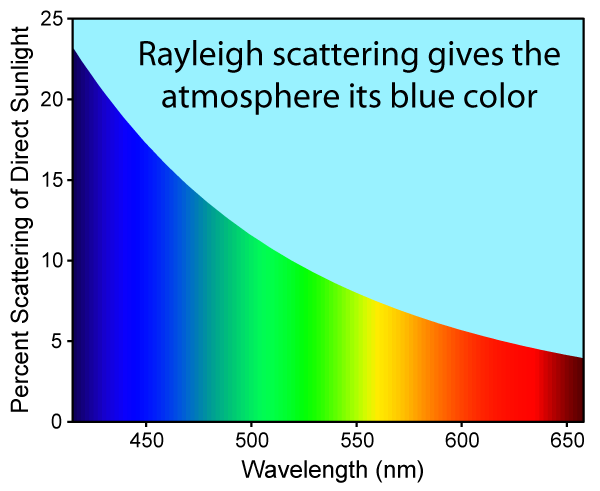
[IMAGE: Diagram showing sunlight scattering in the atmosphere, blue skylight overhead and red at sunset] (Robert A. Rohde / Wikimedia Commons, CC BY-SA 3.0; opens as a separate document)

Here's a question children ask, and adults usually answer half-correctly: why is the sky blue?
The standard answer is right as far as it goes. Sunlight contains all the colours of the rainbow. As it passes through the atmosphere, it bumps into gas molecules, mostly nitrogen and oxygen. These molecules scatter short wavelengths of light — the blue end of the spectrum — much more strongly than long wavelengths like red. This is called Rayleigh scattering, after the physicist Lord Rayleigh.
So blue light gets bounced all over the sky, and wherever you look, some of it is coming toward you.
The catch
Violet light has an even shorter wavelength than blue. That means it's scattered even more.
So shouldn't the sky be violet?
By the physics of scattering alone, the sky should lean purple. It doesn't. Two reasons explain why.
Reason one: there's less violet to begin with
Sunlight isn't an even mix of colours. It contains less violet than blue, and some violet is absorbed high in the atmosphere.
Reason two: your eyes
Our eyes detect colour using three types of cone cells, roughly sensitive to red, green and blue light. They're much less sensitive to violet. And the scattered skylight that reaches us is a mix of wavelengths, not pure violet or pure blue. Our brains combine the signals from all three cone types, and the result is what we perceive as sky blue — a slightly whitish blue.
FACT Established by documentary or physical evidence.
Sunsets
At sunrise and sunset, sunlight travels through much more atmosphere to reach you. By the time it arrives, most of the blue has been scattered away out of the beam, leaving the oranges and reds. That's why sunsets glow warm — and why they can become spectacular after volcanic eruptions put extra particles in the air.
You learned this today!!! YOU LEARNED THIS TODAY !!!
- The sky looks blue because air molecules scatter short wavelengths of sunlight more than long ones, a process called Rayleigh scattering.
- Violet light is scattered even more than blue.
- The sky isn't violet partly because sunlight contains less violet, and partly because our eyes are less sensitive to it.
- Sunsets look red and orange because the light passes through more air, scattering away much of the blue.
One more thing
A day on Venus is longer than a year on Venus.
→ Read something elseSources & further reading
- Rayleigh scattering, Wikipedia
- Diffuse sky radiation, Wikipedia
StoneRed separates fact, hypothesis and speculation. Spotted an error? We'd genuinely like to know.
If you liked this…
 Space · The Story
The Day the Sun Set Telegraphs on Fire
In 1859, the biggest solar storm on record lit up skies with auroras as far south as the Caribbean and made telegraph wires spark. If it happened today, it would be a very different story.
The connection: The Sun can light the sky in stranger ways too.
 Science · The Story
The Year Without a Summer
In 1816, snow fell in New England in June, harvests failed across Europe, and a group of bored writers stuck indoors invented Frankenstein. The cause was a volcano on the other side of the world.
The connection: Volcanic skies turned sunsets into strange colours.
 Psychology · The Question
The Pill That Works Even When You Know It's Fake
Sugar pills can make people feel better. That much is familiar. The stranger finding is that, in some studies, they help even when patients are told exactly what they are.
The connection: What we "see" depends on our brains as much as on the world.