Music The Theory
The Devil's Interval That Was Never Banned
You've probably heard that the medieval Church outlawed a certain musical interval as satanic. It's a great story. The truth is better — and you can hear it in The Simpsons.
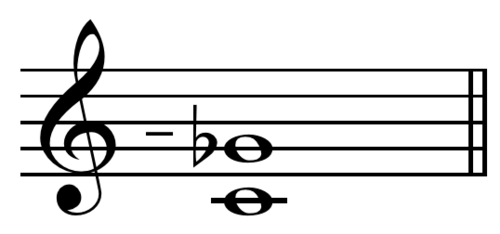
[IMAGE: Musical notation showing a tritone, written as a diminished fifth above C] (Hyacinth / Wikimedia Commons, Public domain; opens as a separate document)

Play two notes on a piano: a C, and the F-sharp just above it.
Listen to that sound. It's tense, unresolved, slightly sinister. It sounds like a question nobody wants answered.
That interval is called the tritone, and it has one of the best reputations in music. For centuries it has been known as diabolus in musica — "the devil in music". You will find it said again and again, in books, documentaries and countless music lessons, that the medieval Church banned it, believing it summoned Satan, and that composers who used it risked punishment.
It's a fantastic story.
There's no evidence it's true.
What the tritone actually is
An octave — from one C to the next — is divided into twelve semitones. The tritone sits exactly halfway: six semitones, or three whole tones (hence the name).
Because it cuts the octave precisely in half, it's an unusual interval. Flip it upside down and you get another tritone. It doesn't belong comfortably to any single key. And it sits in a frequency ratio that the ear hears as unstable — it wants to go somewhere.
That restlessness is the key to everything that follows.
The ban that wasn't
FACT Established by documentary or physical evidence.
What the record shows
Medieval music theorists did discourage the tritone in melodies. Singers were taught to avoid it, and theorists developed rules — including a practice of adjusting notes so that a melody would not outline the interval. But historians have found no papal decree, council ruling or church law banning it, and no record of anyone being punished for using it.
So why did theorists avoid it?
Mostly for practical reasons. Medieval singers learned music using a system of overlapping six-note scales called hexachords, each sung with syllables like ut, re, mi, fa, sol, la — the ancestors of "do, re, mi". A tritone often fell between a mi in one hexachord and a fa in another. It was awkward to find by ear, hard to sing in tune, and didn't fit the system cleanly.
Theorists summed it up in a little Latin rule: mi contra fa. Mi against fa: avoid it.
The "devil" was less a theological threat than a technical nuisance — the medieval equivalent of a chord that's hard to play.
Where did the devil come from?
The phrase mi contra fa est diabolus in musica — "mi against fa is the devil in music" — is real, but it appears in sources from around the early 1700s, centuries after the supposed medieval ban. By then, it was a colourful teacher's warning, the kind of thing you'd tell students so they'd remember.
Over time, the nickname and the story of a ban merged. The more dramatic version won.
HYPOTHESIS A credible explanation that some experts support, not proven.
Why the myth stuck
The idea of forbidden, dangerous music is irresistible — especially to a genre that wants to sound dangerous. When 20th-century rock and metal musicians embraced the tritone, the "banned by the Church" story became part of the music's mythology. It's a great story to tell on an album sleeve. It just isn't history.
The devil's greatest hits
Once you know the sound, you start hearing it everywhere.
- Black Sabbath, "Black Sabbath" (1970). The riff that arguably launched heavy metal is built on a tritone. It sounds like a door creaking open into something you shouldn't see.
- Jimi Hendrix, "Purple Haze" (1967). The opening clash of notes is a tritone.
- **Camille Saint-Saëns, Danse macabre (1874).** The solo violinist tunes one string down so that Death's fiddle plays a tritone right at the start.
- **Leonard Bernstein, "Maria" from West Side Story (1957).** The first two notes of "Ma-ri-a" form a tritone, which then resolves upward — yearning that finds its answer.
- **Danny Elfman, The Simpsons theme (1989).** The choir's opening "The Simp-sons" leaps up by a tritone.
The same interval can sound evil, ecstatic or comic. It depends entirely on what happens next.
Hearing it differently
Jazz musicians love the tritone so much they built a technique around it. In tritone substitution, a player swaps one dominant chord for another that sits a tritone away — the two chords share the same tense pair of notes, so the substitution works, and it adds a sly, chromatic sound.
Film composers use it for unease and suspense. Metal bands use it for menace. Broadway uses it for longing. And a cartoon uses it to announce a yellow family on a couch.
The verdict
The medieval Church did not ban the tritone. Medieval musicians avoided it because it was difficult, not because it was demonic. The "devil in music" label is real but came later. And the interval itself, far from being exiled, became one of the most important engines of harmony in Western music.
The next time someone tells you about the forbidden chord that scared the Pope, play them the opening of The Simpsons.
Then ask them how scared they are.
You learned this today!!! YOU LEARNED THIS TODAY !!!
- The tritone is the interval of three whole tones, or six semitones — exactly half an octave.
- There is no evidence that the medieval Church ever officially banned it.
- The nickname "diabolus in musica" is attested from around the early 18th century, long after the supposed ban.
- Medieval theorists did advise avoiding it, largely because it was awkward to sing and clashed with their system of scales.
- The tritone opens The Simpsons theme and Leonard Bernstein's "Maria", and drives Black Sabbath's song "Black Sabbath".
One more thing
Wombats produce cube-shaped droppings.
→ Read something elseSources & further reading
- Tritone, Wikipedia
- Mi contra fa, Wikipedia
- Drabkin, William. Tritone, Grove Music Online, Oxford University Press
- Hexachord, Wikipedia
StoneRed separates fact, hypothesis and speculation. Spotted an error? We'd genuinely like to know.
If you liked this…
 Art · The Rabbit Hole
Why Medieval Knights Keep Fighting Snails
Open certain 13th- and 14th-century manuscripts and you'll find armoured knights in desperate combat with garden snails. It's one of art history's best running jokes — and it goes much deeper than snails.
The connection: Another medieval "fact" that turns out to be much more interesting than the myth.
 Space · The Theory
72 Seconds in 1977
A radio telescope in Ohio picked up a signal so striking that the astronomer reviewing it wrote one word in the margin: "Wow!" It has never been heard again.
The connection: One frequency that everyone listens to — and one that nobody can explain.
 Cold Cases · The Strange Case
The Man on Somerton Beach
In 1948 a well-dressed stranger was found dead on an Australian beach, with the labels cut from his clothes and a scrap of poetry hidden in his pocket. It took 74 years to learn his name.
The connection: A completely different corner of the archive: cold cases.