Space The Theory
72 Seconds in 1977
A radio telescope in Ohio picked up a signal so striking that the astronomer reviewing it wrote one word in the margin: "Wow!" It has never been heard again.
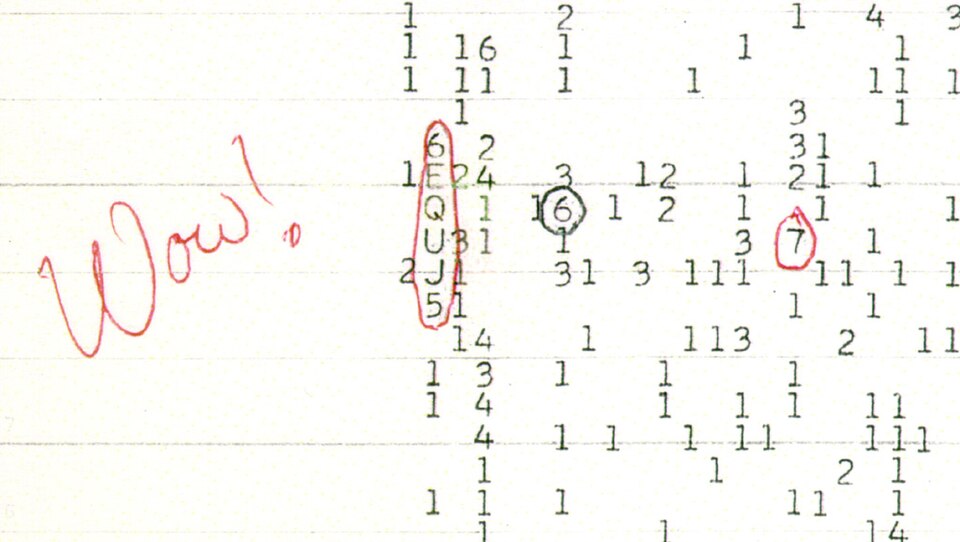
[IMAGE: The 1977 Big Ear printout with the sequence 6EQUJ5 circled and “Wow!” written in the margin] (Big Ear Radio Observatory and North American AstroPhysical Observatory (NAAPO) / Wikimedia Commons, Public domain; opens as a separate document)

A few days after 15 August 1977, an astronomer named Jerry Ehman sat at his kitchen table in Ohio, working his way through a stack of computer printouts.
It was not glamorous work. The printouts came from Big Ear, a radio telescope run by Ohio State University, which was scanning the sky for signals from alien civilisations. Most of what it recorded was noise: columns of numbers and letters, mostly 1s, 2s and blanks.
Then Ehman found this:
6EQUJ5
He circled it in red pen. And next to it, in the margin, he wrote a single word.
Wow!
What the code means
Big Ear's printout used a simple shorthand for the strength of a signal compared to the background noise. A blank meant nothing. The numbers 1 to 9 meant progressively stronger signals. When the signal got stronger than 9, the computer switched to letters: A for 10, B for 11, and so on.
So "6EQUJ5" means: the signal was 6, then 14, then 26, then 30, then 19, then 5 times stronger than the background. A sharp rise and fall.
That shape is the remarkable part.
Big Ear didn't move. It relied on Earth's rotation to sweep its beam across the sky. Any fixed source in space would pass through the beam in about 72 seconds, getting stronger as it reached the centre and weaker as it left. That is exactly the shape of the Wow! signal. It behaved precisely like something that was out there, among the stars — not like interference from the ground.
For 72 seconds, Big Ear saw something that looked exactly like what a message from space would look like.
Why the frequency mattered
The signal was also in a very special place on the radio dial: very close to 1420 megahertz.
That's the frequency at which hydrogen, the most common element in the universe, naturally emits radio waves. In 1959, physicists Giuseppe Cocconi and Philip Morrison suggested that any civilisation looking to be found might broadcast near this frequency, because any astronomer, anywhere, would know to listen there. It's also a frequency band that international agreements protect from transmissions on Earth.
So the Wow! signal was strong, narrow, came from the sky, and sat at the frequency SETI researchers had chosen as the most likely place for a message.
It came from the direction of the constellation Sagittarius.
Then it was gone
Here is the frustrating part. Big Ear had two detector "horns" that looked at slightly different patches of sky, a few minutes apart. The signal should have shown up in both. It appeared in only one.
And then nobody ever heard it again.
Ehman searched for it repeatedly. Others have pointed much more sensitive radio telescopes at the same region of the sky, more than once. Nothing.
So what was it?
Let's be careful, because this is exactly the kind of mystery that attracts confident claims. Here's what's on the table, honestly labelled.
FACT Established by documentary or physical evidence.
What's certain
A strong, narrowband signal near 1420 MHz was recorded on 15 August 1977. Its rise and fall match a fixed source passing through the telescope's beam. It has not been detected again.
HYPOTHESIS A credible explanation that some experts support, not proven.
A rare natural astrophysical event
In 2024, a team associated with the Arecibo Wow! project, including astrobiologist Abel Méndez, proposed that the signal came from a cold cloud of hydrogen that briefly brightened — like a natural laser for radio waves — when it was hit by a burst of radiation from something like a magnetar flare. They found similar, much fainter, short-lived emissions in archived data from the Arecibo telescope. It's a promising idea, but it hasn't been confirmed.
HYPOTHESIS A credible explanation that some experts support, not proven.
Interference from Earth or orbit
A reflected terrestrial signal or a satellite could, in principle, produce a strong burst. But the frequency is in a protected band, and the signal's rise and fall so closely match a source fixed in space that most researchers who studied the data have found this explanation hard to fit.
HYPOTHESIS A credible explanation that some experts support, not proven.
A comet
In 2017, one researcher suggested that hydrogen clouds around a comet might be responsible. Many astronomers criticised this idea, pointing out that comets don't emit strongly enough at this frequency and that the comets proposed weren't in the right place. It's widely considered unlikely.
SPECULATION Possible, unproven, and labelled so you can enjoy it responsibly.
A message from another civilisation
This is the explanation everyone wants. It isn't ruled out. But one 72-second signal that never repeats, with no information content we can decode, isn't evidence of aliens. Ehman himself stayed cautious, and in later years suggested that an Earth-based signal reflected off something in orbit couldn't be ruled out.
The best mystery in radio astronomy
The Wow! signal has endured not because it proves anything, but because it's so perfectly almost. Almost the right shape. Almost the right frequency. Almost enough to make you believe.
Somewhere out in the direction of Sagittarius, something happened in 1977. Maybe it was a hydrogen cloud lighting up. Maybe it was something we haven't thought of yet.
We just know that for 72 seconds, it was there.
You learned this today!!! YOU LEARNED THIS TODAY !!!
- The Wow! signal was detected on 15 August 1977 by Ohio State University's Big Ear radio telescope.
- The code "6EQUJ5" on the printout represents the signal's strength rising and falling as Earth's rotation swept the telescope past it.
- The signal was near 1420 MHz, the natural frequency of hydrogen — a frequency some scientists had suggested aliens might use.
- Despite many follow-up searches, the signal has never been detected again.
- A 2024 hypothesis proposes a rare natural cause: a cold hydrogen cloud suddenly brightened by a burst of radiation.
One more thing
Honeybees communicate the location of flowers by dancing.
→ Read something elseSources & further reading
- Wow! signal, Wikipedia
- Ehman, Jerry R. The Big Ear Wow! Signal: What We Know and Don't Know About It After 20 Years, Big Ear Radio Observatory
- Méndez, A., Ortiz-Ceballos, K. N. & Sánchez, J. Arecibo Wow! I: An astrophysical explanation for the Wow! signal, arXiv preprint, 2024
- Hydrogen line, Wikipedia
StoneRed separates fact, hypothesis and speculation. Spotted an error? We'd genuinely like to know.
If you liked this…
 Mysteries · The Theory
The Book Nobody Can Read
Six centuries old, written in an unknown script, illustrated with plants that don't exist. The Voynich Manuscript has defeated wartime codebreakers, linguists and computers. Here is what we actually know.
The connection: Another message that might mean something — or might mean nothing at all.
 People · The Person
The Man Who Didn't Believe the Computer
Just after midnight on 26 September 1983, a Soviet satellite system reported that American nuclear missiles were on their way. The officer on duty had minutes to decide what to tell Moscow.
The connection: Another signal from the sky that turned out not to be what it seemed.
 Science · The Story
The Deepest Hole Ever Dug
For almost twenty years, Soviet scientists drilled straight down into the Arctic. They reached 12,262 metres, found water where there should be none, and stopped — and a rumour about what they heard down there refuses to die.
The connection: We've looked further out than we've ever looked down.