Mysteries The Theory
The Book Nobody Can Read
Six centuries old, written in an unknown script, illustrated with plants that don't exist. The Voynich Manuscript has defeated wartime codebreakers, linguists and computers. Here is what we actually know.
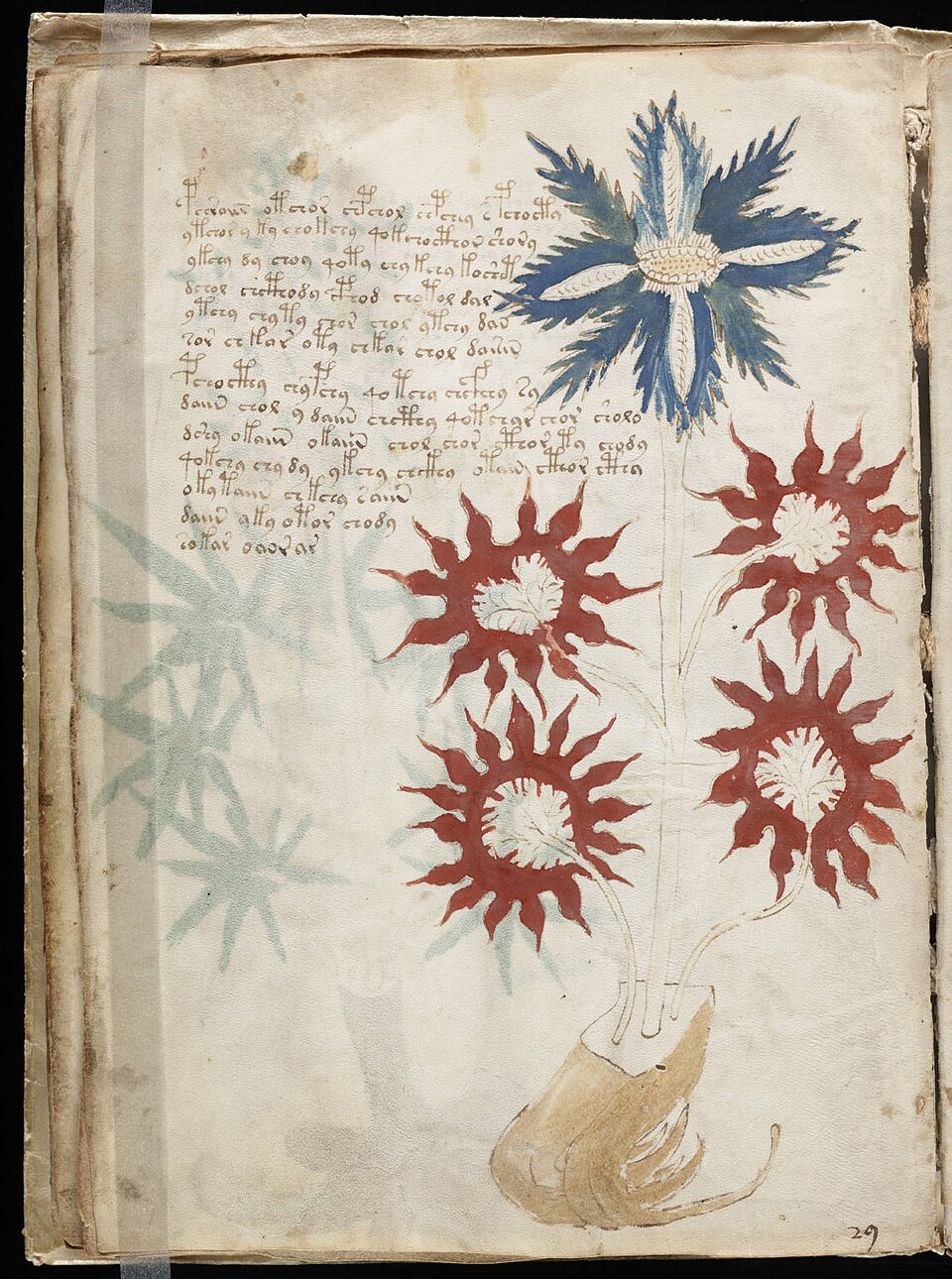
[IMAGE: A page of the Voynich Manuscript, covered in its unknown script beside a plant drawing] (Unknown author / Wikimedia Commons, Public domain; opens as a separate document)
![[IMAGE: A page of the Voynich Manuscript, covered in its unknown script beside a plant drawing]](https://upload.wikimedia.org/wikipedia/commons/thumb/9/93/Voynich_Manuscript_%2832%29.jpg/960px-Voynich_Manuscript_%2832%29.jpg)
Somewhere in a library at Yale University sits a small book, about the size of a modern hardback, bound in limp vellum.
It's around 240 pages long. Every page is covered in elegant, flowing handwriting. There are drawings of plants, stars, strange plumbing, and crowds of small naked women bathing in green pools.
Nobody can read a single word of it.
Not historians. Not linguists. Not the codebreakers who cracked Japanese and German ciphers in the Second World War. Not modern computers. It has been studied for over a century, and we still don't know what language it's written in, what it says — or whether it says anything at all.
It's called the Voynich Manuscript. Let's be careful with it, because few objects have attracted more nonsense.
What we actually know
Before the theories, the facts.
FACT Established by documentary or physical evidence.
The book is genuinely old
In 2009, researchers at the University of Arizona radiocarbon-dated samples of the manuscript's vellum to the early 15th century — roughly 1404 to 1438. Analysis of the ink found it consistent with inks of the period. The book is not a 20th-century forgery.
FACT Established by documentary or physical evidence.
It has a documented history
It's named after Wilfrid Voynich, a Polish-born antiquarian bookseller who bought it in 1912 from a collection of manuscripts held by Jesuits at the Villa Mondragone near Rome. A letter found with it, dated 1665, claims the book had once been bought by the Holy Roman Emperor Rudolf II — a famous collector of curiosities — for 600 gold ducats. The book was donated to Yale in 1969 and is catalogued as Beinecke MS 408.
FACT Established by documentary or physical evidence.
The writing system is unknown
The script uses roughly two dozen to three dozen distinct characters (scholars count them differently), written left to right, with no obvious corrections. It doesn't match any known alphabet.
The pictures
The manuscript is usually divided into sections based on its illustrations:
- Herbal — pages of plants, each drawn alone. Very few can be confidently matched to real species. Some look like several plants stitched together.
- Astronomical — circular diagrams with suns, moons, stars and what look like zodiac symbols.
- Biological or "balneological" — the bathing women, in pools connected by tubes that look like pipes, or perhaps organs.
- Cosmological — large fold-out diagrams, including one sometimes nicknamed the "rosettes" page.
- Pharmaceutical — drawings of plant parts next to objects that resemble apothecary jars.
- Recipes — dense pages of short paragraphs, each marked with a little star.
It looks like a medieval reference book: a herbal, a medical text, an astrological guide. That's what makes it so maddening. It feels like it should be readable.
The strangest part: it behaves like language
The theories
Here's where we have to slow down. There are hundreds of theories. Most of them are wrong, and some of them are wrong in very confident ways. These are the main families, labelled honestly.
HYPOTHESIS A credible explanation that some experts support, not proven.
A cipher
The text is a known language — Latin, perhaps, or an early Italian or German dialect — disguised with a code. The trouble is that simple substitution ciphers would be easy for modern analysis to break, and the text's statistics don't look like any known language encrypted in any of the ways available in the 15th century. Not impossible, but it would have to be an unusual cipher.
HYPOTHESIS A credible explanation that some experts support, not proven.
A constructed language
William Friedman, the codebreaker who led the team that broke Japan's "Purple" cipher before the Second World War, spent years on the manuscript. He came to suspect it was written in an early artificial "philosophical language", in which words are built systematically from categories. That would explain the regular, repetitive structure. The problem is that such languages aren't known to have existed until much later.
HYPOTHESIS A credible explanation that some experts support, not proven.
A real language in an invented script
Perhaps it's a natural language — maybe one with few surviving written records — written in a script created specifically for it. Many such proposals exist. None has produced a translation that other experts can verify.
HYPOTHESIS A credible explanation that some experts support, not proven.
A hoax, made to look meaningful
In 2004, computer scientist Gordon Rugg showed that text with very similar features could be generated using a table of syllables and a perforated card called a Cardan grille — a tool known in the 16th century. This shows a hoax is possible. It doesn't prove the manuscript is one, and others have argued that the method doesn't reproduce all of the text's properties.
SPECULATION Possible, unproven, and labelled so you can enjoy it responsibly.
Edward Kelley, Roger Bacon, aliens, and so on
Voynich himself believed the book was written by the 13th-century friar Roger Bacon. Radiocarbon dating rules that out: Bacon died more than a century before the vellum was made. Others have blamed Edward Kelley, a con man who visited Rudolf II's court. And, of course, the internet has proposed time travellers and visitors from other planets. There is no evidence for any of these.
"I've solved it!"
Every few years, someone announces that the Voynich Manuscript has been cracked. There have been claimed solutions based on Latin abbreviations, Hebrew, Turkish, Nahuatl, a "proto-Romance" language, and many more. They often get a burst of headlines.
So far, every one has fallen apart under expert scrutiny. A successful decipherment would need to produce consistent, meaningful text across the whole manuscript, using rules that other people can apply and get the same result. Nobody has done that.
When you read that the Voynich Manuscript has been decoded, the safe assumption is: not yet.
You can look at it yourself
Here's the best part: you don't need to travel to Yale. The Beinecke Library has photographed every page and made the scans freely available online.
So tonight, if you want, you can sit with a document that has defeated some of the best codebreakers who ever lived, and turn its pages one by one.
You won't be able to read it either. But you'll be in very good company.
You learned this today!!! YOU LEARNED THIS TODAY !!!
- The Voynich Manuscript's vellum has been radiocarbon-dated to the early 15th century (roughly 1404–1438).
- It is named after Wilfrid Voynich, a book dealer who acquired it in 1912, and is now held at Yale's Beinecke Library as MS 408.
- Its text follows statistical patterns found in real languages, which makes a meaningless hoax harder — but not impossible — to argue.
- Second World War codebreaker William Friedman studied it and suspected it was an early constructed language.
- Many claimed decipherments have been published; none has been accepted by specialists.
One more thing
Koalas have fingerprints so similar to human ones that they can be hard to tell apart under a microscope.
→ Read something elseSources & further reading
- Voynich Manuscript, Beinecke MS 408, Beinecke Rare Book & Manuscript Library, Yale
- Voynich manuscript, Wikipedia
- Clemens, Raymond (ed.). The Voynich Manuscript, Yale University Press, 2016
- Davis, Lisa Fagin. How many glyphs and how many scribes? Digital paleography and the Voynich Manuscript, Manuscript Studies, 2020
- Rugg, Gordon. An elegant hoax? A possible solution to the Voynich manuscript, Cryptologia, 2004
StoneRed separates fact, hypothesis and speculation. Spotted an error? We'd genuinely like to know.
If you liked this…
 Art · The Rabbit Hole
Why Medieval Knights Keep Fighting Snails
Open certain 13th- and 14th-century manuscripts and you'll find armoured knights in desperate combat with garden snails. It's one of art history's best running jokes — and it goes much deeper than snails.
The connection: The margins of medieval books contain stranger things than anyone expected.
Art · The Rabbit Hole
Why Medieval Knights Keep Fighting Snails
Open certain 13th- and 14th-century manuscripts and you'll find armoured knights in desperate combat with garden snails. It's one of art history's best running jokes — and it goes much deeper than snails.
The connection: The margins of medieval books contain stranger things than anyone expected.
 Weird · The Strange Case
The Summer Strasbourg Couldn't Stop Dancing
In July 1518, a woman stepped into a street and began to dance. Within weeks, dozens — perhaps hundreds — had joined her, and nobody could make them stop.
The connection: Early 1500s Europe: when even the explainable things were bizarre.
Weird · The Strange Case
The Summer Strasbourg Couldn't Stop Dancing
In July 1518, a woman stepped into a street and began to dance. Within weeks, dozens — perhaps hundreds — had joined her, and nobody could make them stop.
The connection: Early 1500s Europe: when even the explainable things were bizarre.
 Psychology · The Question
The Pill That Works Even When You Know It's Fake
Sugar pills can make people feel better. That much is familiar. The stranger finding is that, in some studies, they help even when patients are told exactly what they are.
The connection: A completely different corner of the archive: psychology.
Psychology · The Question
The Pill That Works Even When You Know It's Fake
Sugar pills can make people feel better. That much is familiar. The stranger finding is that, in some studies, they help even when patients are told exactly what they are.
The connection: A completely different corner of the archive: psychology.