Music The Theory
Can Anyone Actually Hear a Stradivarius?
Stradivarius violins sell for millions. But when world-class violinists played them blindfolded alongside modern instruments, most couldn't tell them apart — and many preferred the new ones.
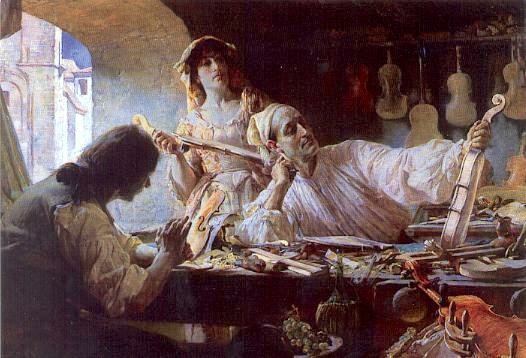
[IMAGE: A Stradivarius violin] (Edgar Bundy / Wikimedia Commons, Public domain; opens as a separate document)
![[IMAGE: A Stradivarius violin]](https://upload.wikimedia.org/wikipedia/commons/d/d8/Stradshp.jpg)
Antonio Stradivari worked in Cremona, northern Italy, in the late 1600s and early 1700s. His violins are among the most valuable musical instruments in the world. A few have sold for well over ten million dollars.
The reason, we're often told, is the sound: a brilliance and depth that no modern maker has been able to match.
So here's an interesting question. If you blindfolded a professional violinist, could they tell?
The experiments
In 2010, at a violin competition in Indianapolis, a team led by acoustics researcher Claudia Fritz ran an unusual experiment. Professional violinists, wearing modified welding goggles so they couldn't see the instruments, played a set of violins — some old Italian masterpieces, including Stradivari, and some brand-new modern instruments.
The results, published in 2012, surprised a lot of people. The most-preferred violin was new. The least-preferred was a Stradivarius. And players couldn't reliably tell which instruments were old.
In 2014, the team ran a bigger test with ten internationally renowned soloists, in a rehearsal room and a concert hall, over longer sessions. Again, most preferred new violins — and again, they did no better than chance at guessing which were old.
In a fair test, the world's most famous violins didn't reliably win.
So what's going on?
FACT Established by documentary or physical evidence.
What the tests show
In these controlled studies, many expert players and listeners could not reliably distinguish old Italian violins from good modern ones, and often preferred the modern ones. The studies don't prove all old violins are the same as new ones — but they challenge the idea that Stradivari's sound is unmistakable.
HYPOTHESIS A credible explanation that some experts support, not proven.
The "secret" theories
For centuries, people have searched for Stradivari's secret: special wood grown during a colder period with denser growth rings, mineral treatments of the wood, unique varnish. Some studies have found chemical differences in the wood of old Cremonese instruments. Whether those differences produce a sound anyone can reliably hear is another question.
You learned this today!!! YOU LEARNED THIS TODAY !!!
- Antonio Stradivari made violins in Cremona, Italy, in the late 17th and early 18th centuries.
- His violins have sold for well over ten million dollars.
- In blind tests published in 2012 and 2014, many professional violinists preferred new violins over old Italian ones.
- Players and listeners often could not reliably tell old from new instruments.
- Theories about Stradivari's "secret" include wood chemistry and treatments, but none is settled.
One more thing
The word "robot" comes from a 1920 Czech play, from "robota", meaning forced labour.
→ Read something elseSources & further reading
- Stradivarius, Wikipedia
- Fritz, C. et al. Player preferences among new and old violins, Proceedings of the National Academy of Sciences, 2012
- Fritz, C. et al. Soloist evaluations of six Old Italian and six new violins, Proceedings of the National Academy of Sciences, 2014
StoneRed separates fact, hypothesis and speculation. Spotted an error? We'd genuinely like to know.
If you liked this…
 Psychology · The Question
The Pill That Works Even When You Know It's Fake
Sugar pills can make people feel better. That much is familiar. The stranger finding is that, in some studies, they help even when patients are told exactly what they are.
The connection: What we expect changes what we experience.
Psychology · The Question
The Pill That Works Even When You Know It's Fake
Sugar pills can make people feel better. That much is familiar. The stranger finding is that, in some studies, they help even when patients are told exactly what they are.
The connection: What we expect changes what we experience.
 Economics · The Theory
When a Tulip Cost as Much as a House
Tulip mania is the most famous financial bubble in history — a tale of Dutch merchants ruined by flower bulbs. The real story is stranger, smaller, and much more interesting.
The connection: When something is worth what people believe it's worth.
Economics · The Theory
When a Tulip Cost as Much as a House
Tulip mania is the most famous financial bubble in history — a tale of Dutch merchants ruined by flower bulbs. The real story is stranger, smaller, and much more interesting.
The connection: When something is worth what people believe it's worth.
 Mysteries · The Theory
The Book Nobody Can Read
Six centuries old, written in an unknown script, illustrated with plants that don't exist. The Voynich Manuscript has defeated wartime codebreakers, linguists and computers. Here is what we actually know.
The connection: A completely different corner of the archive: mysteries.
Mysteries · The Theory
The Book Nobody Can Read
Six centuries old, written in an unknown script, illustrated with plants that don't exist. The Voynich Manuscript has defeated wartime codebreakers, linguists and computers. Here is what we actually know.
The connection: A completely different corner of the archive: mysteries.