Nature The Story
The Banana Your Grandparents Ate
The banana in your kitchen isn't the one people ate in 1940. That one was wiped out by a fungus — and the replacement is under threat too.
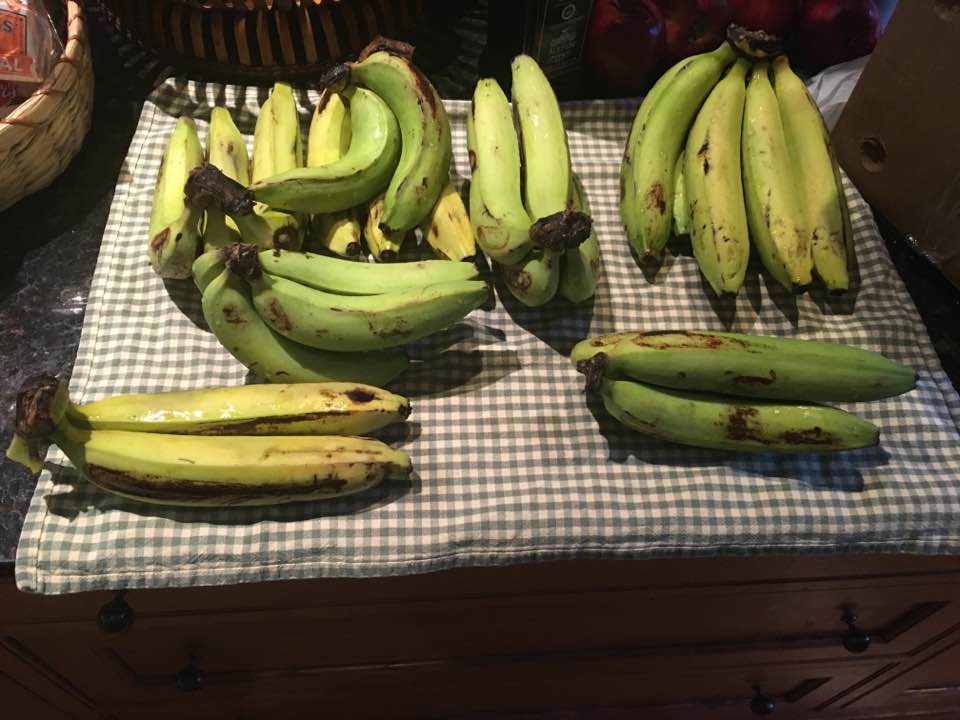
[IMAGE: A large bunch of Gros Michel bananas] (Zwifree / Wikimedia Commons, CC BY 4.0; opens as a separate document)
![[IMAGE: A large bunch of Gros Michel bananas]](https://upload.wikimedia.org/wikipedia/commons/4/4e/Approximately_30_Gros_Michel_Bananas.jpg)
If you've ever eaten artificial banana flavouring — in sweets, milkshakes or medicine — and thought it tasted nothing like a real banana, here's a popular theory: it might taste like a banana you've never eaten.
The Big Mike
For the first half of the twentieth century, the banana sold in shops across Europe and North America was mostly a variety called the Gros Michel — "Big Mike". By many accounts it was larger, creamier, and had a richer flavour than today's banana. Its thick skin also made it tough enough to ship green across oceans.
Then the fungus came.
A disease in the soil
Panama disease, caused by a soil fungus, attacks banana plants through their roots and blocks the vessels that carry water. The plant wilts and dies. Worse, the fungus can survive in soil for decades, so you can't simply replant.
It spread through plantations across Central America and the Caribbean in the early twentieth century. Companies kept moving to fresh land, clearing new forest, but the disease followed. By the 1950s, the Gros Michel export industry was collapsing.
Why one fungus could kill a whole variety
Here's the strange part: commercial bananas don't have useful seeds. They're grown from cuttings, which means every Gros Michel plant was essentially a clone — genetically identical.
When every plant is a copy of the same plant, a disease that can kill one can kill them all.
The industry switched to the Cavendish, a variety that resisted the strain of the fungus that had destroyed the Gros Michel. The Cavendish is the banana most of the world eats today.
It is also a clone.
FACT Established by documentary or physical evidence.
The new threat
A newer strain of the fungus, known as Tropical Race 4, can kill Cavendish plants. It has spread across Asia, Africa, the Middle East and — since 2019 — parts of South America. Scientists are racing to breed or engineer resistant bananas.
HYPOTHESIS A credible explanation that some experts support, not proven.
The flavouring theory
The idea that artificial banana flavour is based on the Gros Michel is widely repeated. It's plausible — the main compound in banana flavouring, isoamyl acetate, is found in both varieties — but it's hard to prove, and the flavour may simply be a crude imitation of any banana.
You learned this today!!! YOU LEARNED THIS TODAY !!!
- Until the 1950s, the main export banana was the Gros Michel, said to be creamier and more flavourful than today's.
- A soil fungus causing Panama disease devastated Gros Michel plantations.
- The industry switched to the Cavendish, which resisted that strain of the disease.
- Commercial bananas are clones grown from cuttings, so a disease that kills one plant can kill them all.
- A newer strain, Tropical Race 4, now threatens the Cavendish.
One more thing
Sea otters sometimes hold paws while they sleep so they don't drift apart.
→ Read something elseSources & further reading
- Gros Michel banana, Wikipedia
- Panama disease, Wikipedia
- Koeppel, Dan. Banana: The Fate of the Fruit That Changed the World, Hudson Street Press, 2008
StoneRed separates fact, hypothesis and speculation. Spotted an error? We'd genuinely like to know.
If you liked this…
 Nature · The Story
The Jellyfish That Hits Rewind
When life gets hard, Turritopsis dohrnii doesn't die. It turns back into a baby.
The connection: Clones, copies and the strange ways living things persist.
Nature · The Story
The Jellyfish That Hits Rewind
When life gets hard, Turritopsis dohrnii doesn't die. It turns back into a baby.
The connection: Clones, copies and the strange ways living things persist.
 People · The Person
The Girl Who Found Sea Dragons
Mary Anning was poor, had little schooling, and was barred from the scientific societies of her day because she was a woman. She also found some of the most important fossils in history.
The connection: Extinction isn't only something that happened long ago.
People · The Person
The Girl Who Found Sea Dragons
Mary Anning was poor, had little schooling, and was barred from the scientific societies of her day because she was a woman. She also found some of the most important fossils in history.
The connection: Extinction isn't only something that happened long ago.
 Ancient World · The Deep Dive
The Concrete That Heals Itself
Modern concrete starts falling apart within decades. Roman harbour walls have been sitting in seawater for two thousand years. In 2023, scientists finally worked out one of the reasons why.
The connection: A completely different corner of the archive: ancient world.
Ancient World · The Deep Dive
The Concrete That Heals Itself
Modern concrete starts falling apart within decades. Roman harbour walls have been sitting in seawater for two thousand years. In 2023, scientists finally worked out one of the reasons why.
The connection: A completely different corner of the archive: ancient world.