Cold Cases The Story
The Cipher That Took 51 Years
In 1969, a killer mailed a page of 340 strange symbols to a San Francisco newspaper. For half a century, nobody could read it. In 2020, three amateurs finally did.
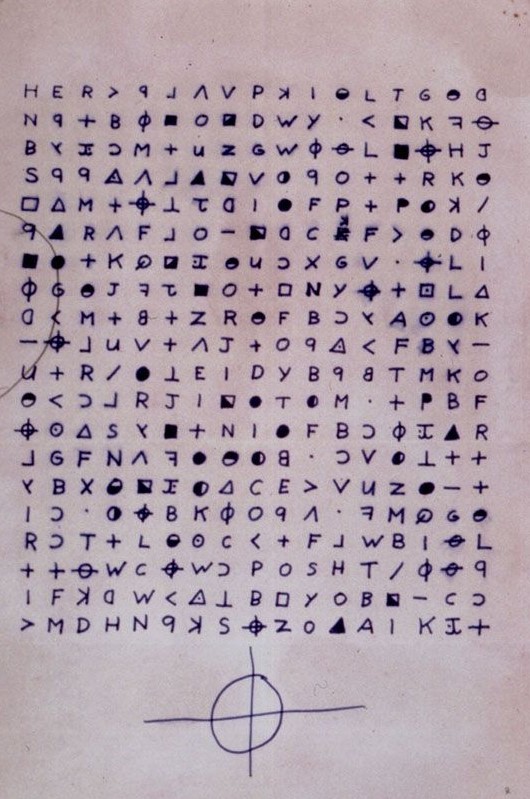
[IMAGE: A page covered in rows of hand-drawn letters and symbols] (Wikimedia Commons, Public domain; opens as a separate document)
![[IMAGE: A page covered in rows of hand-drawn letters and symbols]](https://upload.wikimedia.org/wikipedia/commons/e/e3/4abc_-_San_Francisco_Chronicle_Dripping_Pen_Card_November_8_1969_340_Cipher_COLOR.jpg)
This is a story about a code — and about the strange way it was finally broken. It is also connected to real crimes, and we'll keep that in view.
In the late 1960s, a serial killer attacked people in Northern California. He was never caught. He called himself "the Zodiac", and he did something that set him apart: he wrote to newspapers, taunting the police, and he sent them puzzles.
The first code
In the summer of 1969, three newspapers each received one part of a 408-character cipher. The killer demanded they print it.
They did. And within about a week, a high-school teacher from Salinas, Donald Harden, and his wife Bettye, had solved it at their kitchen table. It was a simple substitution cipher — each symbol stood for a letter — made harder by having several symbols for common letters. The message was boastful and disturbing. It did not contain his name.
The 340
In November 1969, the San Francisco Chronicle received a greeting card containing a new cipher: 340 characters arranged in 20 rows of 17.
This one did not crack.
For decades, professional cryptographers, intelligence agencies, hobbyists and computers attacked it. Some people suspected it was gibberish, a hoax designed to waste investigators' time.
For fifty-one years, the 340 sat in the record — unreadable, unsolved, and one of the most famous unbroken codes in the world.
Three amateurs
The team that finally broke it was not a government agency. It was three people who had never met in person: David Oranchak, a software developer in Virginia; Sam Blake, an applied mathematician in Australia; and Jarl Van Eycke, a warehouse operator and programmer in Belgium.
Oranchak had been working on the cipher for years. Blake used software to test hundreds of thousands of possible ways of reading the symbols. Van Eycke's code-breaking program could then try to solve each variation.
The key turned out to be a twist: the message wasn't written in normal rows. It had to be read diagonally, in a pattern that stepped down and across the page, in sections. Once the diagonal pattern was found, the substitution could be solved.
FACT Established by documentary or physical evidence.
What the message said
The decoded text is a taunting note. The writer says he hopes the police are having fun trying to catch him, that he is not afraid of the gas chamber, and denies being a man who had called a TV talk show claiming to be him. It does not reveal his identity.
In December 2020, the FBI confirmed that the solution was correct.
Still unsolved
The cipher is solved. The case is not. The Zodiac's identity has never been established, and despite many theories and suspects, no one has ever been charged. Two very short ciphers he sent remain unsolved — they may simply be too short to crack.
You learned this today!!! YOU LEARNED THIS TODAY !!!
- The Zodiac Killer was a serial killer active in Northern California in the late 1960s, who sent taunting letters and ciphers to newspapers.
- His first long cipher, sent in 1969, was solved within about a week by a schoolteacher and his wife.
- A second, 340-character cipher, mailed in November 1969, resisted all attempts for 51 years.
- In December 2020, David Oranchak, Sam Blake and Jarl Van Eycke solved it using a mix of human insight and computer analysis; the FBI confirmed the solution.
- The killer has never been identified.
One more thing
Bananas are botanically berries. Strawberries are not.
→ Read something elseSources & further reading
- Zodiac Killer, Wikipedia
- FBI statement on the Z340 solution, December 2020
- Oranchak, David. Let’s Crack Zodiac, YouTube video series, 2020
StoneRed separates fact, hypothesis and speculation. Spotted an error? We'd genuinely like to know.
If you liked this…
 Mysteries · The Theory
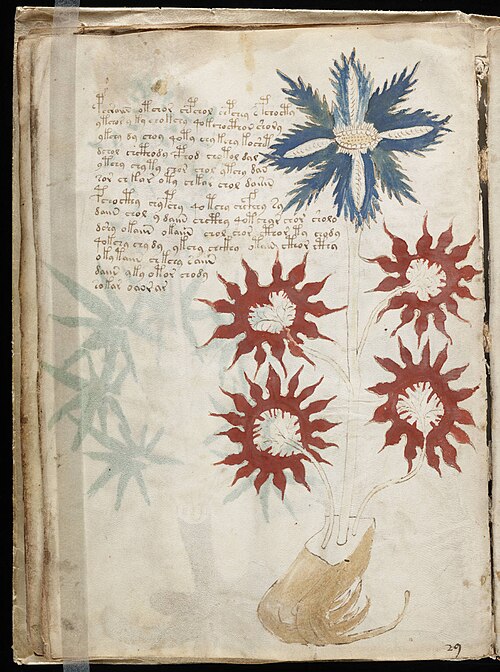
The Book Nobody Can Read
Six centuries old, written in an unknown script, illustrated with plants that don't exist. The Voynich Manuscript has defeated wartime codebreakers, linguists and computers. Here is what we actually know.
The connection: Another text that has defeated generations of code-breakers.
Mysteries · The Theory
The Book Nobody Can Read
Six centuries old, written in an unknown script, illustrated with plants that don't exist. The Voynich Manuscript has defeated wartime codebreakers, linguists and computers. Here is what we actually know.
The connection: Another text that has defeated generations of code-breakers.
 Cold Cases · The Strange Case
The Man on Somerton Beach
In 1948 a well-dressed stranger was found dead on an Australian beach, with the labels cut from his clothes and a scrap of poetry hidden in his pocket. It took 74 years to learn his name.
The connection: Another code, still unbroken.
Cold Cases · The Strange Case
The Man on Somerton Beach
In 1948 a well-dressed stranger was found dead on an Australian beach, with the labels cut from his clothes and a scrap of poetry hidden in his pocket. It took 74 years to learn his name.
The connection: Another code, still unbroken.
 Cold Cases · The Strange Case
The Woman in Ice Valley
In 1970, hikers in Norway found the burned body of a woman nobody could identify. She had travelled under at least eight false names. Half a century later, we still don’t know who she was.
The connection: Another coded notebook in a cold case.
Cold Cases · The Strange Case
The Woman in Ice Valley
In 1970, hikers in Norway found the burned body of a woman nobody could identify. She had travelled under at least eight false names. Half a century later, we still don’t know who she was.
The connection: Another coded notebook in a cold case.