Aviation The Story
The Day a Jet Ran Out of Fuel at 41,000 Feet
In 1983, an almost brand-new Boeing 767 ran completely dry over Canada. The pilots had to glide it down to an abandoned air base — which, unknown to them, was hosting a family racing day.
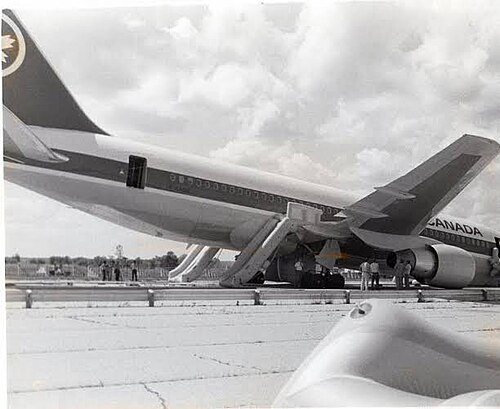
[IMAGE: The Air Canada Boeing 767 resting nose-down on the runway at Gimli after its emergency landing] (FAA / Wikimedia Commons, Public domain; opens as a separate document)
![[IMAGE: The Air Canada Boeing 767 resting nose-down on the runway at Gimli after its emergency landing]](https://upload.wikimedia.org/wikipedia/commons/thumb/9/98/Air_Canada_Flight_143_after_emergency_landing_2.jpg/500px-Air_Canada_Flight_143_after_emergency_landing_2.jpg)
On the evening of 23 July 1983, Air Canada Flight 143 was cruising over northern Ontario at 41,000 feet.
It was a Boeing 767, one of the newest and most advanced airliners in the world. There were 61 passengers and 8 crew on board, flying from Montreal to Edmonton with a stop in Ottawa. Everything was normal.
Then a warning sounded in the cockpit. Low fuel pressure in the left engine.
The captain, Robert Pearson, assumed a faulty fuel pump. A few moments later a second warning sounded, for the right engine. He decided to divert to Winnipeg.
Then the left engine stopped.
Then, as they were preparing for a one-engine landing, the cockpit filled with a sound that nobody on the flight deck had ever heard before: a long "bong" that meant all engines have failed.
And then most of the screens in front of them went dark.
How do you run out of fuel in a brand-new jet?
The answer lies in a mixture of bad luck, unfamiliar technology and one of the most famous arithmetic errors in history.
The gauges didn't work. The 767's fuel quantity system had a faulty processor, so the fuel gauges in the cockpit were blank. The plane was cleared to fly with the gauges inoperative, as long as the fuel was checked manually.
Canada was going metric. The country was in the middle of converting from imperial to metric units, and the 767 was among the first aircraft in Air Canada's fleet to measure fuel in kilograms rather than pounds.
The conversion went wrong. To fuel the plane, the crew and ground staff measured the fuel already in the tanks with a dipstick, in litres, and had to convert that into a weight. The right factor was about 0.8 kilograms per litre. They used 1.77 — the figure for pounds per litre.
Everyone checked the maths. Everyone made the same assumption.
The plane needed 22,300 kilograms of fuel for the trip. It took off with about 22,300 pounds — less than half as much.
A very large glider
When the engines stopped, the 767 became, in effect, an enormous glider.
Most of the cockpit instruments went dark, because they drew power from the engines. A small propeller called a ram air turbine dropped out of the plane's belly and spun in the wind, providing just enough hydraulic power to move the controls — heavily.
Pearson and his first officer, Maurice Quintal, had one crucial piece of luck. Pearson was an experienced glider pilot. He knew how to fly an aircraft with no engine. But the 767 manual didn't have a section on what to do if both engines failed, because it wasn't supposed to happen.
They calculated they couldn't reach Winnipeg. Quintal had a suggestion. He had been stationed at RCAF Station Gimli, a former air force base not far away.
They turned towards it.
Gimli was not empty
What neither pilot knew was that the Gimli base had been decommissioned. One of its runways had been converted into a drag-racing strip.
And that evening, it was hosting a "family day" for the local sports car club. There were cars, go-karts, campers and families with children near the runway.
The landing
As they approached, Pearson realised they were too high and too fast. There was no engine power to go around and try again.
So he did something you would almost never see in an airliner: a forward slip. He crossed the controls — turning the plane slightly sideways to the airflow, so that the body of the aircraft acted as a giant air brake. It's a manoeuvre glider pilots know well. In a 767, it was extraordinary.
The plane dropped rapidly. Pearson straightened it at the last moment.
The landing gear had been lowered by gravity, but the nose gear didn't lock. When the jet touched down, the main wheels held — and the nose collapsed onto the runway, scraping along the concrete in a shower of sparks.
That turned out to be lucky too. The friction helped the plane stop. It came to a halt short of the people on the runway.
FACT Established by documentary or physical evidence.
The outcome
Nobody on board or on the ground was killed. Some passengers were hurt during the evacuation, mostly minor injuries from the steep slide at the rear of the plane, which was tilted nose-down. A small fire in the nose was put out quickly — partly, according to accounts, by racing-day attendees with fire extinguishers.
What happened next
An investigation identified a chain of failures: the faulty fuel gauge processor, confusion about whether the plane could legally fly without working gauges, unclear responsibilities for fuel calculations, and inadequate training for the new metric system.
Pearson and Quintal were initially disciplined. But they were later honoured, receiving the first Fédération Aéronautique Internationale Diploma for Outstanding Airmanship in 1985.
Saved by the strangest coincidences
Look at everything that had to line up for Flight 143 to survive.
The captain happened to be a glider pilot. The first officer happened to know about an old air base. The base happened to be in range. The nose gear happened to fail in a way that helped them stop.
A modern airliner, packed with the latest technology, was brought down by a units error and saved by a weekend hobby.
That's aviation in one sentence: incredibly sophisticated machines, flown by humans, in a world where small things matter enormously.
You learned this today!!! YOU LEARNED THIS TODAY !!!
- Air Canada Flight 143 ran out of fuel on 23 July 1983 because the fuel load had been calculated in pounds instead of kilograms.
- The aircraft was carrying less than half the fuel it needed.
- Captain Robert Pearson was an experienced glider pilot, and First Officer Maurice Quintal had served at the old air base at Gimli.
- The plane landed on a decommissioned runway being used for a car-racing event; nobody was seriously hurt.
- The aircraft, nicknamed the Gimli Glider, was repaired and stayed in service until 2008.
One more thing
A teaspoon of neutron-star material would weigh billions of tonnes on Earth.
→ Read something elseSources & further reading
- Gimli Glider, Wikipedia
- Final Report of the Board of Inquiry Investigating the Circumstances of an Accident Involving the Air Canada Boeing 767 Aircraft C-GAUN, Government of Canada, 1985
- Hoffer, William & Hoffer, Marilyn Mona. Freefall: 41,000 Feet and Out of Fuel, St. Martin's Press, 1989
- Ram air turbine, Wikipedia
StoneRed separates fact, hypothesis and speculation. Spotted an error? We'd genuinely like to know.
If you liked this…
 People · The Person
The Man Who Didn't Believe the Computer
Just after midnight on 26 September 1983, a Soviet satellite system reported that American nuclear missiles were on their way. The officer on duty had minutes to decide what to tell Moscow.
The connection: Another crew facing a computer they couldn't trust, with minutes to decide.
People · The Person
The Man Who Didn't Believe the Computer
Just after midnight on 26 September 1983, a Soviet satellite system reported that American nuclear missiles were on their way. The officer on duty had minutes to decide what to tell Moscow.
The connection: Another crew facing a computer they couldn't trust, with minutes to decide.
 Technology · The Timeline
The Chocolate Bar That Melted in the Lab
The microwave oven was invented by a self-taught engineer who never finished grammar school, standing next to radar equipment, with a snack in his pocket.
The connection: A small technical detail that changed history.
Technology · The Timeline
The Chocolate Bar That Melted in the Lab
The microwave oven was invented by a self-taught engineer who never finished grammar school, standing next to radar equipment, with a snack in his pocket.
The connection: A small technical detail that changed history.
 History · The Strange Case
The Day Boston Drowned in Molasses
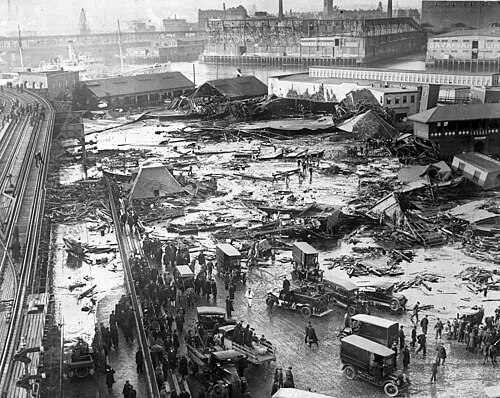
On a mild January afternoon in 1919, a giant tank burst and sent a wave of syrup through the streets of Boston's North End. It sounds like a cartoon. It killed 21 people.
The connection: A completely different corner of the archive: history.
History · The Strange Case
The Day Boston Drowned in Molasses
On a mild January afternoon in 1919, a giant tank burst and sent a wave of syrup through the streets of Boston's North End. It sounds like a cartoon. It killed 21 people.
The connection: A completely different corner of the archive: history.