History The Strange Case
The Day Boston Drowned in Molasses
On a mild January afternoon in 1919, a giant tank burst and sent a wave of syrup through the streets of Boston's North End. It sounds like a cartoon. It killed 21 people.
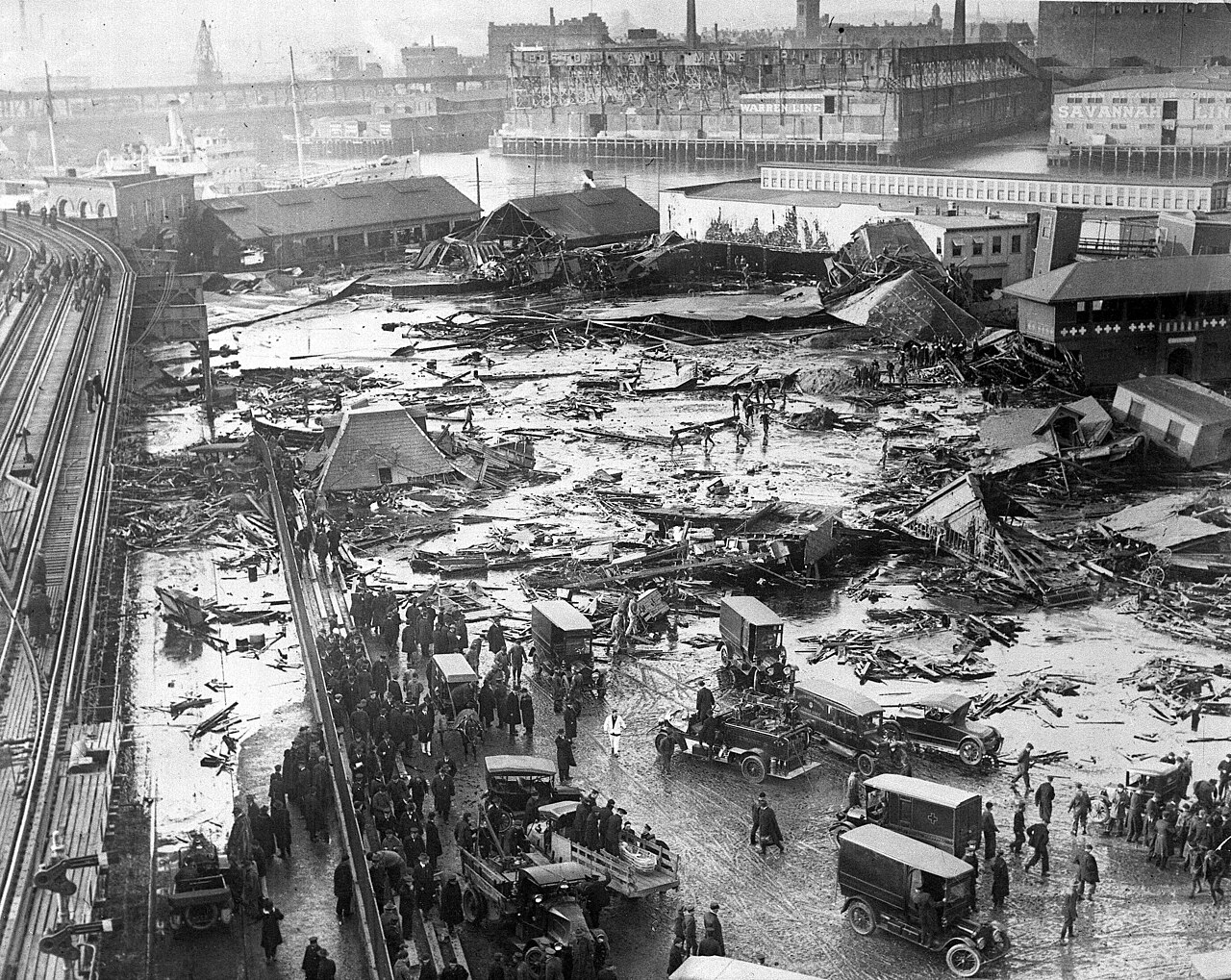
[IMAGE: Wrecked buildings and debris in Boston’s North End after the molasses flood] (BPL / Wikimedia Commons, Public domain; opens as a separate document)
![[IMAGE: Wrecked buildings and debris in Boston’s North End after the molasses flood]](https://upload.wikimedia.org/wikipedia/commons/thumb/7/70/BostonMolassesDisaster.jpg/1280px-BostonMolassesDisaster.jpg)
On 15 January 1919, it was unusually warm in Boston. People in the North End had their coats open. Children were playing near the elevated railway on Commercial Street.
At around 12:30 p.m., residents heard a deep rumble and a series of sharp cracks, like a machine gun. A huge steel tank on the waterfront, holding about 2.3 million gallons of molasses, had split open.
What came out was a wave.
A wall of syrup
Eyewitnesses described a brown wall several metres high, rolling down the street. It moved fast — estimates often put it at around 35 miles an hour at first — far faster than anyone could run. It knocked buildings off their foundations, buckled a girder of the elevated railway, and swept up people, horses and wagons.
Then came the part that made it so deadly. Molasses doesn't drain like water. As it spread and the January air cooled it, it grew thicker and stickier. People caught in it couldn't swim out. Rescuers couldn't wade in.
Twenty-one people died, including children on their way home from school. Around 150 were injured.
It sounds like a punchline. For the families of the North End, it was a catastrophe.
Why was there so much molasses?
Molasses was valuable. It could be fermented and distilled into industrial alcohol, which was used to make munitions. The tank belonged to a subsidiary of the United States Industrial Alcohol Company, and it had been built in a hurry a few years earlier.
The trial
The company first claimed that anarchists had blown up the tank. A long court case, involving thousands of pages of testimony, concluded otherwise: the tank was too weak for its load, built with steel that was too thin and never properly tested by filling it with water.
The company paid out hundreds of thousands of dollars in settlements. More importantly, the disaster helped lead to tougher rules in Massachusetts requiring that building plans be checked and signed by qualified engineers.
FACT Established by documentary or physical evidence.
What modern physics says
In 2016, researchers modelling the flood found that the cold winter air explains why it was so lethal: as the molasses cooled, it became dramatically more viscous, trapping people who had survived the initial wave.
You learned this today!!! YOU LEARNED THIS TODAY !!!
- On 15 January 1919, a storage tank holding about 2.3 million US gallons of molasses burst in Boston's North End.
- The wave was reported to be several metres high and fast enough to outrun people.
- Twenty-one people died and about 150 were injured.
- A long court case found the tank had been poorly built and never properly tested.
- The disaster helped push Massachusetts toward stricter building rules requiring engineers to sign off on structures.
One more thing
Sharks have existed for longer than trees.
→ Read something elseSources & further reading
- Great Molasses Flood, Wikipedia
- Puleo, Stephen. Dark Tide: The Great Boston Molasses Flood of 1919, Beacon Press, 2003
- Sharp, Nicole & Kennedy, Jordan. The Great Molasses Flood of 1919, American Physical Society, Division of Fluid Dynamics meeting, 2016
StoneRed separates fact, hypothesis and speculation. Spotted an error? We'd genuinely like to know.
If you liked this…
 History · The Strange Case
The War That Lasted Less Than an Hour
On a summer morning in 1896, Britain and Zanzibar fought an entire war before most people had finished breakfast. Then came the bill.
The connection: Another catastrophe that sounds like a joke until you read the details.
History · The Strange Case
The War That Lasted Less Than an Hour
On a summer morning in 1896, Britain and Zanzibar fought an entire war before most people had finished breakfast. Then came the bill.
The connection: Another catastrophe that sounds like a joke until you read the details.
 Ancient World · The Deep Dive
The Concrete That Heals Itself
Modern concrete starts falling apart within decades. Roman harbour walls have been sitting in seawater for two thousand years. In 2023, scientists finally worked out one of the reasons why.
The connection: Engineering that lasts — and engineering that fails all at once.
Ancient World · The Deep Dive
The Concrete That Heals Itself
Modern concrete starts falling apart within decades. Roman harbour walls have been sitting in seawater for two thousand years. In 2023, scientists finally worked out one of the reasons why.
The connection: Engineering that lasts — and engineering that fails all at once.
 Random · The Story
best "spots" in boston
The Orgin of the best "Spots in Boston MA"
The connection: A completely different corner of the archive: random.
Random · The Story
best "spots" in boston
The Orgin of the best "Spots in Boston MA"
The connection: A completely different corner of the archive: random.