History The Strange Case
The War That Lasted Less Than an Hour
On a summer morning in 1896, Britain and Zanzibar fought an entire war before most people had finished breakfast. Then came the bill.
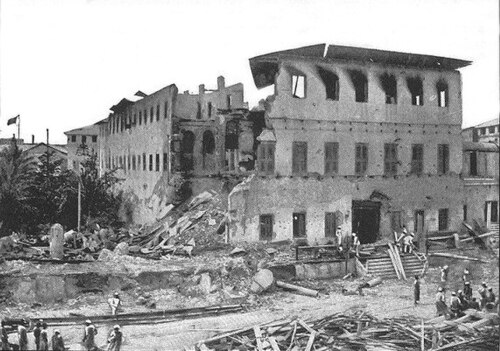
[IMAGE: The sultan's palace complex in Zanzibar Town, wrecked by the British bombardment of 27 August 1896] (Richard Mohun / Wikimedia Commons, Public domain; opens as a separate document)
![[IMAGE: The sultan's palace complex in Zanzibar Town, wrecked by the British bombardment of 27 August 1896]](https://upload.wikimedia.org/wikipedia/commons/thumb/b/b7/AngloZanzibarWar.jpg/500px-AngloZanzibarWar.jpg)
At 9:00 in the morning on 27 August 1896, five British warships sat in the harbour of Zanzibar Town with their guns pointed at the sultan's palace.
At 9:02, they opened fire.
At around 9:40, it was over.
Not the battle. The war. The entire thing. Declared, fought, lost, and won in less time than it takes to watch a television episode. It is the shortest war in recorded history, and Guinness World Records lists it that way to this day.
But the strangest part of the Anglo-Zanzibar War isn't how short it was. It's everything that happened around those 38 minutes — a suspicious death, a midnight seizure of the palace, a royal yacht that tried to fight a battleship, and, according to the most widely repeated account, a bill sent to the losers for the cost of the shells used to defeat them.
An island at the centre of the world
To understand why anyone would fight a war that short, you have to understand why Zanzibar mattered at all.
In the 19th century, the island off the coast of East Africa was one of the busiest trading hubs in the Indian Ocean. Cloves, ivory and — grimly — enslaved people passed through its markets. It was ruled by a dynasty of sultans with roots in Oman, and it was rich, cosmopolitan and strategically priceless.
Which is exactly why Europe wanted it.
By 1890 Britain and Germany had carved up much of East Africa between them, and in the Heligoland–Zanzibar Treaty, Germany recognised Zanzibar as a British protectorate. The sultan still sat on his throne. But Britain now considered itself the landlord, and under an 1886 agreement, a new sultan was expected to have the British consul's approval before taking power.
That clause is the fuse. Hold onto it.
A sudden death
On 25 August 1896, Sultan Hamad bin Thuwaini — a ruler friendly to British interests — died suddenly.
Within hours, his cousin Khalid bin Barghash moved into the palace complex and declared himself sultan. Many people at the time suspected that Khalid had poisoned Hamad. It has never been proven, and it should be read as exactly what it is: a suspicion. But it tells you something about the mood in Zanzibar that week.
The British had a different candidate in mind, a more pliable relative named Hamud bin Muhammed. Khalid had not asked for permission. He had not been given it. And he was not leaving.
By the evening of 26 August, roughly 2,800 armed men were inside or around the palace, along with artillery pieces and the sultan's personal yacht.
The ultimatum
Britain's consul, Basil Cave, and the commander of the naval squadron, Rear-Admiral Harry Rawson, sent Khalid a message: lower your flag and leave the palace by 9:00 a.m. on 27 August, or we open fire.
Khalid's reply, delivered that morning, was reportedly that he had no intention of hauling down his flag and did not believe the British would fire.
It was a catastrophic misjudgement.
Lined up in the harbour were the cruisers HMS St George and HMS Philomel and the gunboats HMS Racoon, HMS Sparrow and HMS Thrush. Facing them was one ship of the Zanzibari navy: the HHS Glasgow, a royal yacht built in Scotland, armed mostly with small guns and designed more for ceremony than combat.
The morning of 27 August 1896
- 8:00Khalid's envoy asks for negotiations. The British reply that he can still comply with their terms.
- 8:55No word. The British ships are signalled to prepare for action.
- 9:02The bombardment begins. Within minutes, the palace's guns are knocked out.
- Minutes laterThe Glasgow fires on HMS St George and is answered with overwhelming fire. It sinks in the shallow harbour.
- ~9:40The flag over the palace is down, the firing stops, and the war is over.
Thirty-eight minutes of chaos
The palace was mostly built of wood. The shells tore through it.
The defenders' artillery was old and poorly positioned, and within minutes it had been silenced. Fires broke out. The harem building and parts of the palace complex collapsed. According to Royal Navy figures repeated in most accounts, the squadron fired about 500 shells, around 4,100 machine-gun rounds and 1,000 rifle rounds.
Ashore, a pro-British force of Zanzibari soldiers led by Lloyd Mathews — a British officer who served as the sultan's first minister — advanced on the palace.
Then the Glasgow did something brave and hopeless: it fired on the flagship. It was immediately answered by the full weight of the British ships and sank at its moorings, its masts still poking out of the water. British sailors rowed out in launches to rescue its crew.
Estimates of the dead and wounded on Khalid's side run to around 500. On the British side, one petty officer aboard HMS Thrush was badly wounded. He recovered.
The men in the room
Wars this short tend to be remembered as numbers. But every one of them is made of decisions by particular people.
Rear-Admiral Harry Rawson commanded the British squadron. He was a career naval officer who had served across the empire, and he would later become Governor of New South Wales in Australia. For him, Zanzibar was a brief operation in a long career.
Lloyd Mathews was perhaps the most interesting figure on the British side. A former Royal Navy officer, he had spent years in Zanzibar, commanded the sultan's army, and served as the sultan's first minister. He was, in a sense, on both sides at once: a British officer, and a senior official of the government he was now helping to overthrow. He led Zanzibari soldiers loyal to Britain's candidate against fellow Zanzibaris loyal to Khalid.
Basil Cave, the consul, was the diplomat who sent the ultimatum and then had to wait to see whether Khalid would blink.
And Khalid bin Barghash himself was young — in his twenties — the son of a former sultan, with real support among some of the island's elite and a belief, perhaps reasonable from where he stood, that Britain would not go as far as shelling the palace.
The legend and the record
Because the war is so short and so strange, it has gathered myths.
You'll sometimes read that the war lasted "exactly 38 minutes", as if timed with a stopwatch. In fact, sources differ, and the end time depends on whether you count the moment the flag fell, the moment the guns stopped, or the moment the palace was secured. The Guinness figure of 38 minutes is the most quoted; some historians prefer about 40 or 45.
You'll also read that Britain "declared war" on Zanzibar. There was no formal declaration in the modern sense — there was an ultimatum with a deadline, and a bombardment when it expired. Whether that counts as a "war" at all is partly a matter of definition. Most historians are happy to call it one; it had two sides, organised forces, a political goal and a decisive result.
The shortest war in history is also one of the hardest to time. That's what happens when history keeps score with pocket watches.
Where did the sultan go?
Khalid did not stay to watch the end. He fled to the German consulate, where the British could not touch him without causing a diplomatic incident.
The British demanded he be handed over. The Germans refused. Instead, they quietly smuggled him out — according to the standard account, by carrying him on a boat from the consulate's own beach so that, technically, he never set foot on Zanzibari soil — and took him to German East Africa, on the mainland.
He lived there for two decades. Then the First World War arrived, British forces invaded German East Africa, and in 1917 Khalid was finally captured. He was exiled to the Seychelles and then to Saint Helena, the same remote island where Napoleon had died. Eventually he was allowed to return to East Africa. He died in Mombasa in 1927.
The man who lost the shortest war in history outlived it by more than thirty years.
The sultan who won
Britain's preferred candidate, Hamud bin Muhammed, was installed that same afternoon. Under heavy British pressure, he abolished slavery in Zanzibar the following year, in 1897 — a genuine and important change, even though the protectorate that produced it was built on force.
For the next six decades, Zanzibar's sultans ruled in name while Britain ruled in practice. Independence finally came in December 1963. Just a month later, in January 1964, a revolution overthrew the sultanate entirely, and by April Zanzibar had united with Tanganyika to form a new country: Tanzania.
Why we remember it
The Anglo-Zanzibar War is usually told as a joke, and it's easy to see why. The numbers are absurd. A royal yacht against a battle fleet. A war shorter than a lunch break.
But it's worth remembering that for the hundreds of people killed and wounded in and around a burning wooden palace, there was nothing funny about that morning at all.
It's a perfect little lens on an entire era: a world where a few lines in a treaty, signed far away, could decide whether a city would be standing by 10 a.m.
And it's a reminder that history's strangest records are rarely just records. Somebody, somewhere, had to live through them.
You learned this today!!! YOU LEARNED THIS TODAY !!!
- The Anglo-Zanzibar War of 27 August 1896 is usually listed as the shortest war in recorded history: roughly 38 to 45 minutes.
- It began because a new sultan took the throne without the approval Britain claimed under an 1886 treaty.
- About 500 Zanzibari fighters were killed or wounded; one British sailor was injured.
- The sultan's only warship, the HHS Glasgow, was sunk in the harbour, and British sailors rescued its crew.
- The losing claimant, Khalid bin Barghash, escaped and lived until 1927.
One more thing
Saturn is less dense than water.
→ Read something elseSources & further reading
- Anglo-Zanzibar War, Wikipedia
- Shortest war, Guinness World Records
- Zanzibar Revolution, Encyclopaedia Britannica
- Hernon, Ian. Britain's Forgotten Wars: Colonial Campaigns of the 19th Century, Sutton Publishing, 2003
StoneRed separates fact, hypothesis and speculation. Spotted an error? We'd genuinely like to know.
If you liked this…
 Modern World · The Strange Case
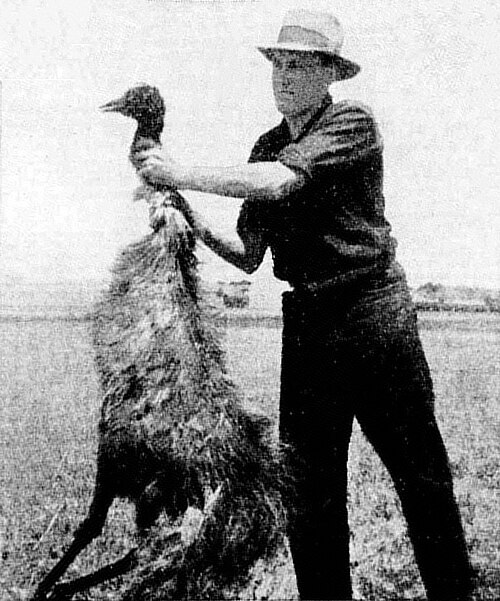
The Emus Won
In 1932, Australia sent soldiers with machine guns to fight a flock of flightless birds. It did not go to plan.
The connection: Another war that went badly for the side with more guns — this time against birds.
Modern World · The Strange Case
The Emus Won
In 1932, Australia sent soldiers with machine guns to fight a flock of flightless birds. It did not go to plan.
The connection: Another war that went badly for the side with more guns — this time against birds.
 People · The Person
The Man Who Didn't Believe the Computer
Just after midnight on 26 September 1983, a Soviet satellite system reported that American nuclear missiles were on their way. The officer on duty had minutes to decide what to tell Moscow.
The connection: The opposite extreme: the war that never started because one man hesitated.
People · The Person
The Man Who Didn't Believe the Computer
Just after midnight on 26 September 1983, a Soviet satellite system reported that American nuclear missiles were on their way. The officer on duty had minutes to decide what to tell Moscow.
The connection: The opposite extreme: the war that never started because one man hesitated.
 Nature · The Story
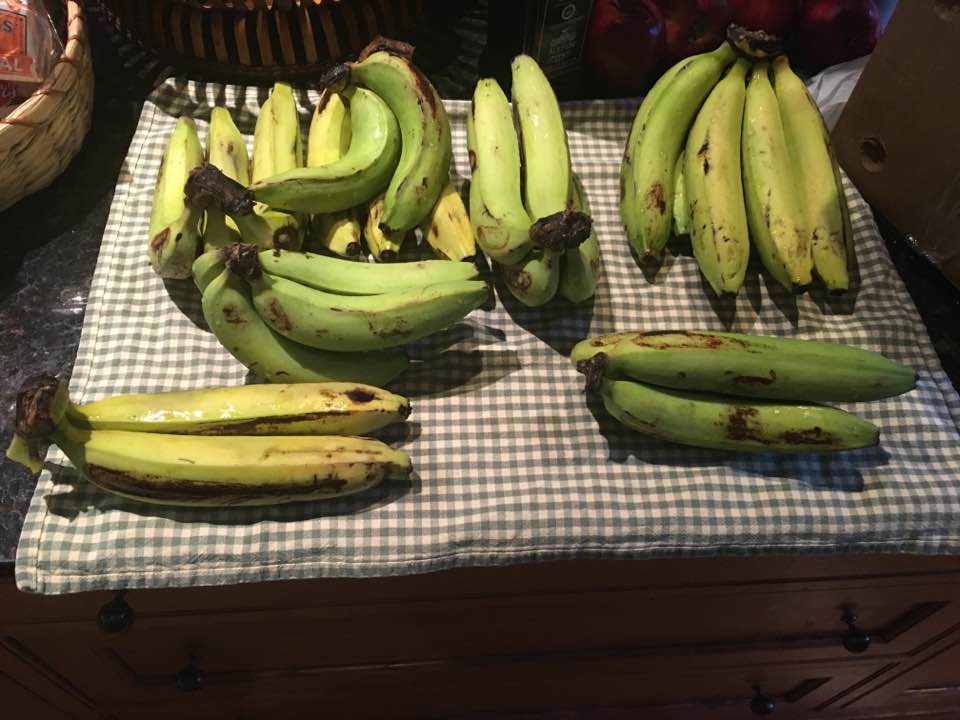
The Banana Your Grandparents Ate
The banana in your kitchen isn't the one people ate in 1940. That one was wiped out by a fungus — and the replacement is under threat too.
The connection: A completely different corner of the archive: nature.
Nature · The Story
The Banana Your Grandparents Ate
The banana in your kitchen isn't the one people ate in 1940. That one was wiped out by a fungus — and the replacement is under threat too.
The connection: A completely different corner of the archive: nature.