History The Story
The Summer London Smelled So Bad Parliament Gave Up
In the hot summer of 1858, the River Thames — full of raw sewage — stank so badly that MPs soaked their curtains in chemicals. The smell finally got London its sewers.

[IMAGE: Victorian cartoon of Death rowing a boat on the filthy River Thames] (Punch Magazine / Wikimedia Commons, Public domain; opens as a separate document)

In the summer of 1858, London was hot. Very hot. And the River Thames, which flowed through the heart of the city, was full of sewage.
For decades, the waste of more than two million people had been flowing into the river through old drains and cesspools. The arrival of flushing toilets had made it worse: more water, more waste, nowhere to go but the Thames.
That June, the heat cooked the river. The smell was so overwhelming that it became known as the Great Stink.
Parliament holds its nose
The Houses of Parliament stand right on the riverbank. MPs found the smell unbearable. The curtains of the building were soaked in chloride of lime in an attempt to mask the stench. There was talk of moving Parliament out of London altogether.
For years, Londoners had suffered. It took one summer of politicians suffering too for something to happen.
Within weeks, Parliament rushed through legislation giving the Metropolitan Board of Works the power and the money to build a new sewer system.
The engineer
The man in charge was Joseph Bazalgette, the Board's chief engineer. His plan was enormous: a network of large "intercepting" sewers running parallel to the Thames, catching the waste from the old drains and carrying it east, away from central London, to be released downstream.
The project required hundreds of kilometres of main and local sewers, pumping stations and new riverside embankments — the Victoria, Albert and Chelsea Embankments, which also created new roads and gardens along the Thames.
FACT Established by documentary or physical evidence.
The wrong theory, the right result
Many Victorians believed diseases like cholera were spread by bad smells — "miasma". They were wrong: cholera spreads through contaminated water, as the physician John Snow had argued in 1854. But by removing sewage from the drinking water supply, the new sewers helped end London's cholera epidemics anyway.
You learned this today!!! YOU LEARNED THIS TODAY !!!
- In the hot summer of 1858, sewage in the River Thames created a smell known as the Great Stink.
- Parliament, beside the river, tried soaking curtains in chloride of lime to block the smell.
- Within weeks, Parliament passed legislation to fund a new sewer system.
- Engineer Joseph Bazalgette built a network of intercepting sewers that carried waste away from central London.
- Many people then believed diseases like cholera were caused by bad air, a theory called miasma.
One more thing
Greenland sharks can live for at least 270 years, and possibly much longer.
→ Read something elseSources & further reading
- Great Stink, Wikipedia
- Joseph Bazalgette, Wikipedia
- Halliday, Stephen. The Great Stink of London, Sutton Publishing, 1999
StoneRed separates fact, hypothesis and speculation. Spotted an error? We'd genuinely like to know.
If you liked this…
 History · The Strange Case
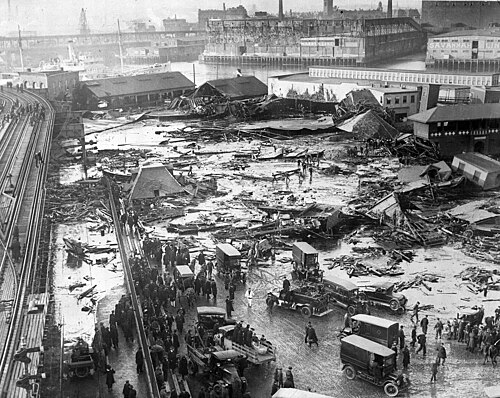
The Day Boston Drowned in Molasses
On a mild January afternoon in 1919, a giant tank burst and sent a wave of syrup through the streets of Boston's North End. It sounds like a cartoon. It killed 21 people.
The connection: Another city, another liquid, another disaster that changed the rules.
 Ancient World · The Deep Dive
The Concrete That Heals Itself
Modern concrete starts falling apart within decades. Roman harbour walls have been sitting in seawater for two thousand years. In 2023, scientists finally worked out one of the reasons why.
The connection: Great infrastructure, built to last.
 Psychology · The Question
The Pill That Works Even When You Know It's Fake
Sugar pills can make people feel better. That much is familiar. The stranger finding is that, in some studies, they help even when patients are told exactly what they are.
The connection: Sometimes the wrong theory leads to the right answer.