Space The Theory
The Explosion That Flattened a Forest
In 1908, something exploded above a remote Siberian forest with the force of a large nuclear weapon. It flattened about 80 million trees. No crater was ever found.
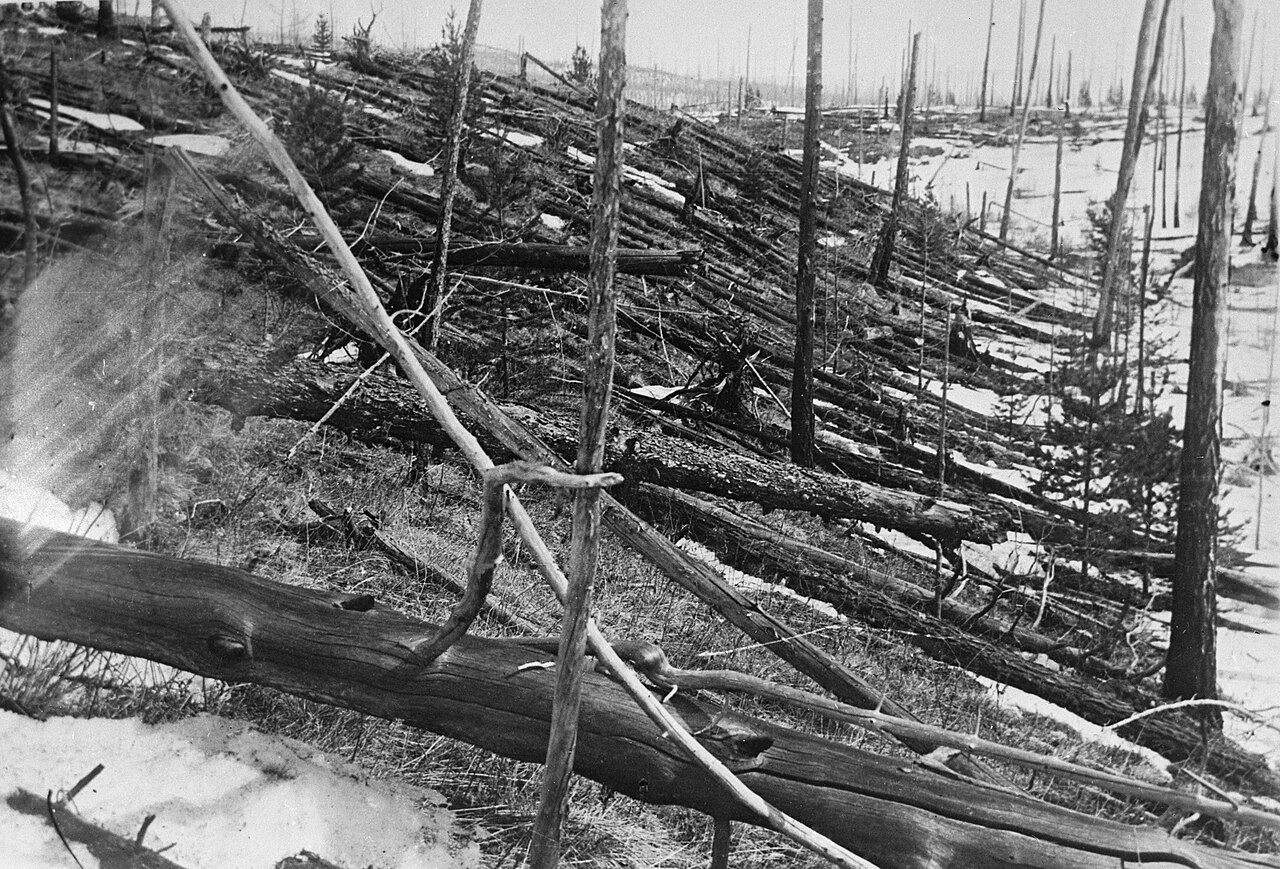
[IMAGE: Trees knocked flat across the Siberian forest at Tunguska] (Leonid Kulik, the expedition to the Tunguska event / Wikimedia Commons, Public domain; opens as a separate document)
![[IMAGE: Trees knocked flat across the Siberian forest at Tunguska]](https://upload.wikimedia.org/wikipedia/commons/thumb/a/a4/Tunguska_Ereignis-1.jpg/1280px-Tunguska_Ereignis-1.jpg)
Early on the morning of 30 June 1908, people in central Siberia saw a column of bluish light, nearly as bright as the Sun, move across the sky. Then came a flash, and a sound like artillery.
At a trading post about 60 kilometres away, a man later described being thrown from his chair by a blast of heat so intense he felt his shirt was on fire.
Near the Podkamennaya Tunguska River, across about 2,000 square kilometres of forest, something had knocked down roughly 80 million trees.
The forest that pointed
The region was so remote that no scientist reached it for nearly two decades. In 1927, the Russian mineralogist Leonid Kulik led an expedition and found an astonishing sight: trees lying flat for kilometres, all pointing away from a central point, like spokes of a wheel.
At the centre, strangely, some trees were still standing — stripped of their branches, like telegraph poles.
And there was no crater.
Something huge had exploded. But it seemed to have exploded in mid-air.
So what happened?
FACT Established by documentary or physical evidence.
What's certain
A massive explosion occurred over the Tunguska region on 30 June 1908, flattening forest over about 2,000 square kilometres. The blast was recorded by seismic stations and barometers far away. For several nights afterwards, skies over Europe and Asia were unusually bright.
HYPOTHESIS A credible explanation that some experts support, not proven.
An airburst
Most scientists think a stony asteroid or a comet — perhaps tens of metres across — entered the atmosphere at tremendous speed and blew apart several kilometres above the ground. The energy released is usually estimated at several to more than ten megatons of TNT, hundreds of times the Hiroshima bomb. An airburst explains the radial pattern of fallen trees, the standing "telegraph pole" trees directly below, and the lack of a crater.
SPECULATION Possible, unproven, and labelled so you can enjoy it responsibly.
The wild theories
Over the years, people have blamed a tiny black hole, antimatter, a natural gas eruption, and of course an alien spacecraft. There's no good evidence for any of them.
You learned this today!!! YOU LEARNED THIS TODAY !!!
- On 30 June 1908, a huge explosion over the Tunguska region of Siberia flattened about 2,000 square kilometres of forest.
- Roughly 80 million trees were knocked down in a radial pattern.
- The leading explanation is the airburst of an asteroid or comet several kilometres above the ground.
- Because it exploded in the air, it left no impact crater.
- The first scientific expedition, led by Leonid Kulik, did not reach the site until 1927.
One more thing
In 1947, engineers found a moth stuck in a relay of the Harvard Mark II computer and taped it into the logbook as the "first actual case of bug being found".
→ Read something elseSources & further reading
- Tunguska event, Wikipedia
- Chyba, C. F., Thomas, P. J. & Zahnle, K. J. The 1908 Tunguska explosion: atmospheric disruption of a stony asteroid, Nature, 1993
- Tunguska event, NASA Science
StoneRed separates fact, hypothesis and speculation. Spotted an error? We'd genuinely like to know.
If you liked this…
 Science · The Story
The Year Without a Summer
In 1816, snow fell in New England in June, harvests failed across Europe, and a group of bored writers stuck indoors invented Frankenstein. The cause was a volcano on the other side of the world.
The connection: When forces from above or below remake the world in an instant.
Science · The Story
The Year Without a Summer
In 1816, snow fell in New England in June, harvests failed across Europe, and a group of bored writers stuck indoors invented Frankenstein. The cause was a volcano on the other side of the world.
The connection: When forces from above or below remake the world in an instant.
 Geography · The Story
The Loneliest Place on Earth
In the South Pacific there's a point so far from land that the nearest humans are often astronauts. It's also where old spacecraft go to die.
The connection: A completely different corner of the archive: geography.
Geography · The Story
The Loneliest Place on Earth
In the South Pacific there's a point so far from land that the nearest humans are often astronauts. It's also where old spacecraft go to die.
The connection: A completely different corner of the archive: geography.
 Nature · The Story
The Jellyfish That Hits Rewind
When life gets hard, Turritopsis dohrnii doesn't die. It turns back into a baby.
The connection: A completely different corner of the archive: nature.
Nature · The Story
The Jellyfish That Hits Rewind
When life gets hard, Turritopsis dohrnii doesn't die. It turns back into a baby.
The connection: A completely different corner of the archive: nature.