Ancient World The Rabbit Hole
The Fire That Burned on Water
For centuries, the Byzantine Empire defended Constantinople with a secret weapon: a liquid fire sprayed from ships that kept burning even on the sea. The recipe was so well guarded that it has been lost.
In the late 670s, a great Arab fleet had been threatening Constantinople, the capital of the Byzantine Empire. The city's walls were strong, but its survival depended on the sea.
Then the Byzantine ships went out to meet the enemy. From pipes mounted on their bows, they sprayed out jets of liquid that burst into flame. The fire clung to the enemy ships, set sails and rigging alight — and, most terrifying of all, kept burning on the surface of the water.
The Byzantines called it "sea fire" or "liquid fire". Their enemies, and later historians, called it Greek fire.
A refugee's invention
According to the Byzantine chronicler Theophanes the Confessor, the weapon was brought to Constantinople around 672 CE by Kallinikos, an architect or engineer who had fled from Syria. He is said to have shown the Byzantines how to make and use it.
Incendiary weapons were nothing new. Armies had thrown burning pitch, sulphur and oil at each other for centuries. What made Greek fire different was its effectiveness, the way it was delivered, and the fact that water couldn't put it out.
It wasn't the first fire weapon. It was the first one that turned the sea itself against you.
How it was used
The most famous delivery system was the siphon: a tube mounted on the bow of a ship, through which the liquid was pumped under pressure, apparently after being heated, and ignited as it sprayed out. Contemporary illustrations show sailors aiming jets of flame at enemy ships like a flamethrower.
Later sources also describe handheld siphons, and pots or grenades filled with the substance that could be thrown. It was used again and again in naval battles and sieges over the following centuries.
FACT Established by documentary or physical evidence.
What's established
Byzantine sources describe the weapon, its use from ships and its role in battles, including the great siege of Constantinople in 717–718, when Byzantine ships helped destroy much of an attacking fleet. Its importance in defending the city is widely accepted by historians.
The lost recipe
The recipe was treated as one of the most closely guarded secrets of the state. Production appears to have been kept in the hands of a few specialists. In the 10th century, the scholar-emperor Constantine VII wrote advice for his son warning that the secret of the liquid fire must never be revealed to foreigners — claiming it had been revealed by an angel to the first Christian emperor, Constantine the Great.
The secret was kept so well that it was eventually lost. By the time of the Fourth Crusade in 1204, when Western crusaders sacked Constantinople, Greek fire seems no longer to have been in effective use.
HYPOTHESIS A credible explanation that some experts support, not proven.
What was it?
Most historians think the main ingredient was probably crude oil (petroleum), which seeped naturally from the ground around the Black Sea, perhaps mixed with resins to make it sticky. The real secret may have been less the ingredients than the whole system: how to refine and heat the liquid, and how to pressurise and fire it safely without burning your own ship.
SPECULATION Possible, unproven, and labelled so you can enjoy it responsibly.
Other ingredients
Suggestions over the centuries have included quicklime, sulphur, saltpetre and various resins. Some of these are unlikely; saltpetre, for instance, was probably not known in the region at the time. Without surviving recipes, every reconstruction remains a hypothesis.
A legend that won't go out
Greek fire has had a long afterlife in stories. Medieval chroniclers described it with awe and exaggeration, crediting it with powers it probably never had. Modern novelists and screenwriters have borrowed it freely. The green "wildfire" that destroys a fleet in the fantasy series Game of Thrones is widely seen as a nod to it.
Scientists and historians have tried to reconstruct it, mixing petroleum with resins and testing different ways to pressurise and fire the liquid. Some of these experiments have produced impressive, sticky jets of flame. None can prove that it is the real recipe, because there is nothing to compare it with.
A weapon that shaped history
Constantinople survived the great Arab sieges, and the Byzantine Empire lasted for centuries afterwards. Historians debate how much credit Greek fire deserves, alongside the city's walls, its navy and its leaders. But it became one of the most famous weapons of the medieval world — and one of history's great lost technologies.
You learned this today!!! YOU LEARNED THIS TODAY !!!
- Greek fire was an incendiary weapon used by the Byzantine Empire from the 7th century onwards.
- Tradition credits its invention to Kallinikos, an architect or engineer from Syria, around 672 CE.
- It was often sprayed from pressurised siphons mounted on ships and could keep burning on the surface of water.
- It played a major role in defending Constantinople during Arab sieges in the 670s and 717–718.
- The exact recipe was a closely guarded state secret and is now lost.
One more thing
Cleopatra lived closer in time to the Moon landing than to the building of the Great Pyramid of Giza.
→ Read something elseSources & further reading
- Greek fire, Wikipedia
- Haldon, John and Byrne, Maurice. A possible solution to the problem of Greek fire, Byzantinische Zeitschrift, 1977
- Partington, J. R. A History of Greek Fire and Gunpowder, Johns Hopkins University Press, 1999 (reprint)
StoneRed separates fact, hypothesis and speculation. Spotted an error? We'd genuinely like to know.
If you liked this…
 Ancient World · The Deep Dive
The Concrete That Heals Itself
Modern concrete starts falling apart within decades. Roman harbour walls have been sitting in seawater for two thousand years. In 2023, scientists finally worked out one of the reasons why.
The connection: Another ancient technology with a lost secret.
 Ancient World · The Deep Dive
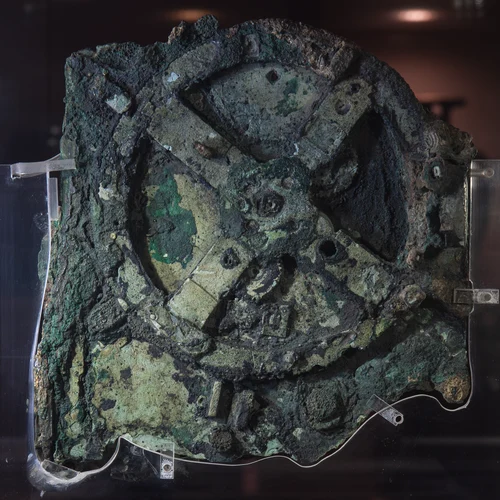
The 2,000-Year-Old Computer
In 1901, divers pulled a corroded lump of bronze from an ancient shipwreck. It turned out to be a geared machine for predicting the heavens — and nothing as complex would be built again for more than a thousand years.
The connection: More astonishing ancient engineering.
 People · The Person
The Girl Who Found Sea Dragons
Mary Anning was poor, had little schooling, and was barred from the scientific societies of her day because she was a woman. She also found some of the most important fossils in history.
The connection: A completely different corner of the archive: people.