History The Theory
The Jar That Might Have Been a Battery
In the 1930s, a German archaeologist in Baghdad described an ancient clay jar containing a copper tube and an iron rod. Fill it with vinegar, he suggested, and it would make electricity. Was it a two-thousand-year-old battery? Most archaeologists think not.
In 1938, a German archaeologist named Wilhelm König was working at the National Museum of Iraq in Baghdad. Among the objects in the collection, he described something strange.
It was a small clay jar, about 13 centimetres tall. Inside was a cylinder made of rolled copper sheet. Inside that was a rod of iron, which showed signs of corrosion. The copper cylinder had been sealed at the bottom with a disc of copper and asphalt, and the top had been sealed with asphalt too.
König thought it looked familiar. It looked, he suggested, like a battery.
How a battery works
A simple battery, known as a galvanic cell, needs two different metals and a liquid that can conduct electricity, called an electrolyte. When the metals are placed in the liquid, a chemical reaction makes electrons flow from one to the other, producing an electric current.
The Italian scientist Alessandro Volta invented the first true battery, the "voltaic pile", around 1800. If the Baghdad jar was a battery, it would have been made nearly two thousand years earlier.
A copper tube, an iron rod and a jar. Add vinegar, and you have electricity. But was that what it was for?
The theory
König suggested that the jar could have been filled with an acidic liquid, like vinegar or grape juice, to make it work as a battery. He thought that several jars might have been connected together and used to electroplate objects, coating them with a thin layer of gold or silver.
The idea was exciting. It suggested that people in the ancient Near East might have known about electricity many centuries before European scientists.
FACT Established by documentary or physical evidence.
It can work
Replicas of the Baghdad Battery, filled with acidic liquids, can produce a small voltage, typically around half a volt to two volts. Experiments, including by the television programme MythBusters, have shown that several jars linked together could produce a small current.
The problems
Most archaeologists are sceptical. Here's why.
There is no evidence of wires or conductors found with the jars, which would be needed to connect them to anything. No ancient texts mention electricity being used this way. And objects from the period that look gilded were made with known techniques, such as fire gilding using mercury, which don't require electricity.
The sealing is also a problem. The asphalt at the top seems to have covered the iron rod completely, which would make it difficult to connect wires to it. And if the jar was sealed, it would be hard to refill with fresh electrolyte.
HYPOTHESIS A credible explanation that some experts support, not proven.
A storage jar
Many archaeologists think the jars were used for storing sacred scrolls. Similar jars containing bronze cylinders with remains of papyrus or parchment have been found at the nearby site of Seleucia. If the scrolls rotted away, the corrosion on the iron could be explained by acids from the decaying organic material.
HYPOTHESIS A credible explanation that some experts support, not proven.
A medical device
Some researchers have suggested that the jars might have produced a small current used for healing — for example, to give a mild tingling sensation, as with electric fish, which were known to ancient people and used in medicine. But there is no direct evidence of this either.
A popular mystery
Despite the scepticism, the Baghdad Battery became famous. It appears in books on ancient mysteries, documentaries and websites. Some writers have used it to argue that ancient civilisations had secret, advanced technology, or that they were taught by visitors from other worlds. There is no evidence for any of this.
Why it matters
The Baghdad Battery is a good example of how archaeologists test exciting ideas. An object that looks like something modern can tempt people to imagine modern uses. But a good explanation has to fit all the evidence, including where the object was found, what else was found with it and what written sources say.
That doesn't mean ancient people weren't clever. The jars show skilled metalworking. And some ancient technologies really were astonishing, like the Antikythera mechanism, a Greek gear-driven calculator. The question is not whether ancient people were capable of brilliance, but what this particular jar was for.
You learned this today!!! YOU LEARNED THIS TODAY !!!
- The Baghdad Battery is the name given to a set of artefacts found in Iraq: a clay jar, a copper cylinder and an iron rod.
- It was described in 1938 by the German archaeologist Wilhelm König, who suggested it might be an electrical cell.
- The objects are thought to date from the Parthian or Sasanian periods, roughly 2,000 years ago.
- Replicas filled with an acidic liquid such as vinegar can produce a small electric current.
- Most archaeologists believe it was more likely used for storing scrolls or other items, not producing electricity.
One more thing
Koalas have fingerprints so similar to human ones that they can be hard to tell apart under a microscope.
→ Read something elseSources & further reading
- Baghdad Battery, Wikipedia
- König, Wilhelm. Ein galvanisches Element aus der Partherzeit?, Forschungen und Fortschritte, 1938
- Eggert, Gerhard. The enigmatic "battery of Baghdad", Skeptical Inquirer, 1996
StoneRed separates fact, hypothesis and speculation. Spotted an error? We'd genuinely like to know.
If you liked this…
 Ancient World · The Deep Dive
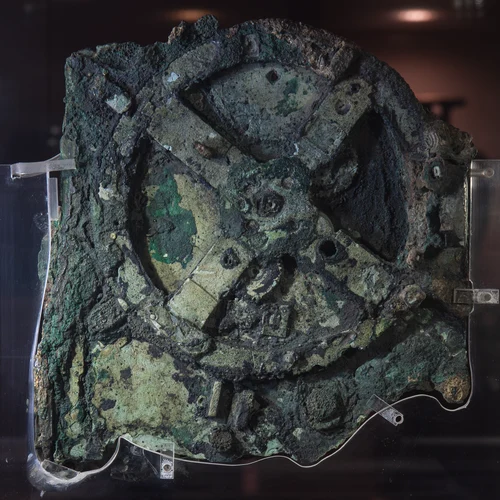
The 2,000-Year-Old Computer
In 1901, divers pulled a corroded lump of bronze from an ancient shipwreck. It turned out to be a geared machine for predicting the heavens — and nothing as complex would be built again for more than a thousand years.
The connection: Another ancient device that seems ahead of its time.
Ancient World · The Deep Dive
The 2,000-Year-Old Computer
In 1901, divers pulled a corroded lump of bronze from an ancient shipwreck. It turned out to be a geared machine for predicting the heavens — and nothing as complex would be built again for more than a thousand years.
The connection: Another ancient device that seems ahead of its time.
 Cold Cases · The Story
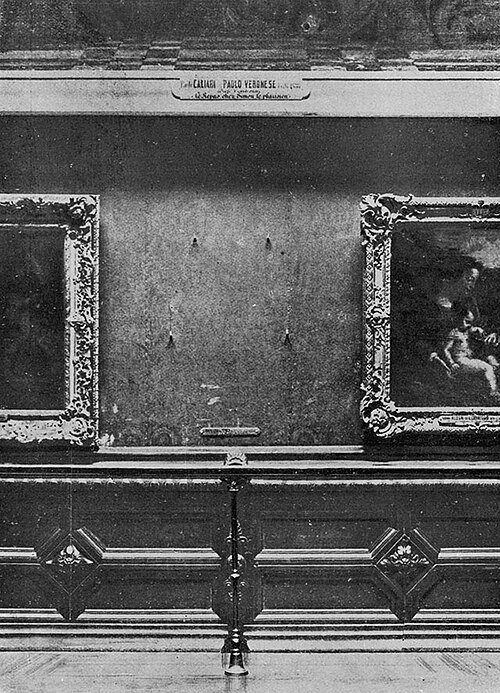
The Summer the Mona Lisa Vanished
In 1911, a handyman walked out of the Louvre with the Mona Lisa under his smock. Nobody noticed for a day — and the theft is a big part of why she became the most famous painting in the world.
The connection: A completely different corner of the archive: cold cases.
Cold Cases · The Story
The Summer the Mona Lisa Vanished
In 1911, a handyman walked out of the Louvre with the Mona Lisa under his smock. Nobody noticed for a day — and the theft is a big part of why she became the most famous painting in the world.
The connection: A completely different corner of the archive: cold cases.
 Music · The Theory
Can Anyone Actually Hear a Stradivarius?
Stradivarius violins sell for millions. But when world-class violinists played them blindfolded alongside modern instruments, most couldn't tell them apart — and many preferred the new ones.
The connection: A completely different corner of the archive: music.
Music · The Theory
Can Anyone Actually Hear a Stradivarius?
Stradivarius violins sell for millions. But when world-class violinists played them blindfolded alongside modern instruments, most couldn't tell them apart — and many preferred the new ones.
The connection: A completely different corner of the archive: music.