Cold Cases The Strange Case
The Night Max Headroom Hijacked Chicago
In 1987, a man in a rubber mask took over two Chicago TV stations, rambled, hummed, and was spanked with a flyswatter on air. He was never caught.
It was a Sunday night in Chicago, 22 November 1987. On WGN-TV, the sports news was on. At about 9:14 p.m., the screen suddenly went black.
Then a figure appeared: a man wearing a rubber mask and sunglasses, bobbing about in front of a swaying sheet of corrugated metal. The picture buzzed. There was no proper sound.
He was dressed as Max Headroom — a fictional "computer-generated" TV presenter with slicked-back hair and a stuttering voice, who was enormously popular in the 1980s. (In reality, Max was played by an actor in prosthetic make-up.)
Engineers at WGN switched the frequency of the link that carried the signal to their transmitter, and after about 25 seconds, the masked man vanished. The baffled sportscaster came back on air and admitted he had no idea what had just happened either.
Round two
At about 11:15 p.m., viewers of WTTW, Chicago's public television station, were watching an episode of Doctor Who. Suddenly, the masked man was back.
This time there was sound — distorted, garbled, but audible. For about a minute and a half, "Max" rambled, made fun of a WGN sports presenter, hummed the theme tune of an old cartoon, held up a can of soft drink and parroted an advertising slogan, and generally behaved like the strangest public-access show ever made.
There were no engineers at WTTW's transmitter that night to stop him. So the station simply had to let it play.
The broadcast ended with the man's trousers pulled down and a second person, mostly out of frame, swatting him with a flyswatter. Then Doctor Who resumed, as if nothing had happened.
How did they do it?
Television stations used microwave links to send their programmes from the studio to a transmitter, often on top of a tall building. The pirates seem to have pointed their own, more powerful transmitter at the station's receiving dish, overpowering the real signal.
It was technically sophisticated. It needed the right equipment, the right frequencies and a line of sight to the receiver — and the people involved must have had real expertise.
FACT Established by documentary or physical evidence.
What's documented
Both interruptions were recorded by viewers and are widely available. The FCC investigated and confirmed that the stations' studio-to-transmitter links had been hijacked.
SPECULATION Possible, unproven, and labelled so you can enjoy it responsibly.
What's guessed
Over the years, people online have suggested various suspects — but there has never been any official identification, and nobody has ever been charged.
Why it still fascinates
The incident has become a legend of early hacking culture: an anonymous, funny, slightly unsettling act that took over a mass medium for a few minutes and then disappeared into the night.
At the time, broadcast signal intrusion was a serious federal crime, with heavy fines and possible prison sentences. Whoever did it has kept the secret for decades.
You learned this today!!! YOU LEARNED THIS TODAY !!!
- On the evening of 22 November 1987, an unknown person hijacked the broadcast signal of WGN-TV in Chicago for about 25 seconds.
- Around two hours later, the same intruder took over the signal of public TV station WTTW for about 90 seconds, during an episode of Doctor Who.
- The intruder wore a mask of Max Headroom, a fictional computer-generated TV character who was popular at the time.
- The hijackers overpowered the stations’ microwave links that carried programmes from the studio to the transmitter.
- Despite investigations by the Federal Communications Commission and the FBI, the culprits were never identified.
One more thing
Greenland sharks can live for at least 270 years, and possibly much longer.
→ Read something elseSources & further reading
- Max Headroom signal hijacking, Wikipedia
- Federal Communications Commission, statements reported in contemporary news coverage, 1987
StoneRed separates fact, hypothesis and speculation. Spotted an error? We'd genuinely like to know.
If you liked this…
 Cold Cases · The Strange Case
The Hijacker Who Jumped Into the Rain
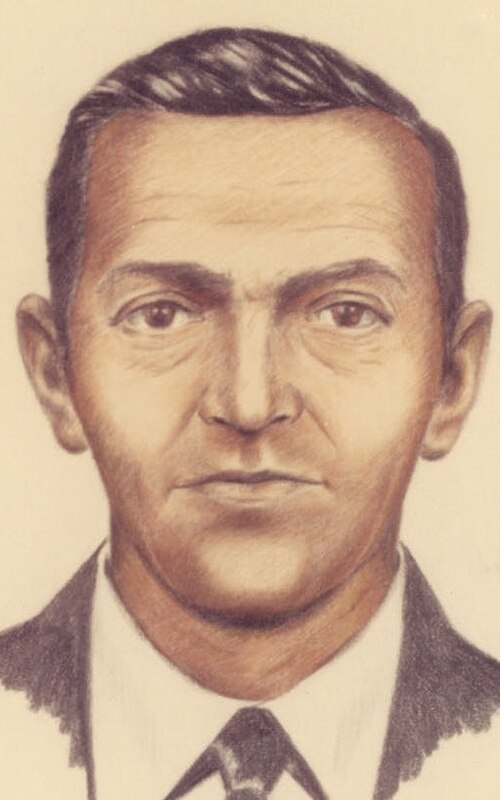
In 1971 a quiet man in a business suit hijacked a passenger jet, collected $200,000, and stepped out of the back of the plane into a storm at night. Nobody has seen him since.
The connection: Another hijacker who vanished without a trace.
Cold Cases · The Strange Case
The Hijacker Who Jumped Into the Rain
In 1971 a quiet man in a business suit hijacked a passenger jet, collected $200,000, and stepped out of the back of the plane into a storm at night. Nobody has seen him since.
The connection: Another hijacker who vanished without a trace.
 People · The Person
The Man Who Didn't Believe the Computer
Just after midnight on 26 September 1983, a Soviet satellite system reported that American nuclear missiles were on their way. The officer on duty had minutes to decide what to tell Moscow.
The connection: Another story about the night the machines went strange.
People · The Person
The Man Who Didn't Believe the Computer
Just after midnight on 26 September 1983, a Soviet satellite system reported that American nuclear missiles were on their way. The officer on duty had minutes to decide what to tell Moscow.
The connection: Another story about the night the machines went strange.
 Technology · The Timeline
The Chocolate Bar That Melted in the Lab
The microwave oven was invented by a self-taught engineer who never finished grammar school, standing next to radar equipment, with a snack in his pocket.
The connection: A completely different corner of the archive: technology.
Technology · The Timeline
The Chocolate Bar That Melted in the Lab
The microwave oven was invented by a self-taught engineer who never finished grammar school, standing next to radar equipment, with a snack in his pocket.
The connection: A completely different corner of the archive: technology.