Mysteries The Theory
The Sound From the Bottom of the World
In 1997, underwater microphones picked up an enormous, mysterious sound in the remote South Pacific. Some people said it must be a giant creature. The truth turned out to be colder.
The ocean is not silent. Under the waves, whales sing, shrimp crackle, ships thrum, earthquakes rumble and ice groans. For decades, scientists have listened to it all with hydrophones — underwater microphones, some of them originally built by the US Navy to track submarines during the Cold War.
In 1997, those microphones picked up something big.
The sound rose quickly in pitch and lasted about a minute. It was very low, below what most of us could hear without speeding up the recording, and it was loud — so loud that it was detected by hydrophones thousands of kilometres apart. Scientists at the US National Oceanic and Atmospheric Administration traced it to a remote stretch of the South Pacific, west of the southern tip of South America.
They gave it a name: the Bloop.
Cold War ears
The hydrophones that heard the Bloop have a secret history. In the 1950s, the US Navy began building a network of listening stations on the sea floor, called SOSUS, to track Soviet submarines. Long cables ran from arrays of hydrophones on the ocean floor to shore stations, where analysts watched paper printouts of underwater sound for the signatures of submarine engines and propellers.
When the Cold War ended, the Navy allowed civilian scientists to use parts of the system. Researchers at NOAA suddenly had access to a global ear in the ocean. They began to hear the sea in a way nobody had before: undersea volcanoes erupting, earthquakes on the sea floor, whales calling across whole ocean basins — and a handful of sounds nobody could identify.
A monster in the deep?
When news of the Bloop spread online, it quickly took on a life of its own. Some scientists noted that its sound profile looked somewhat like the noises made by living animals. And it was enormously loud — louder than any known animal could produce.
That opened the door to speculation. Could there be something in the deep ocean larger than a blue whale? A giant squid? Something unknown?
A loud sound, a lonely ocean and an unknown source: the perfect recipe for a sea monster.
Fans of the horror writer H. P. Lovecraft noticed that the sound's approximate source was not far from where he had placed R'lyeh, the sunken city of his monstrous creature Cthulhu, in a 1928 story. That coincidence made the Bloop internet-famous.
The cold answer
NOAA's researchers kept listening. Over the following years, they set up hydrophones closer to Antarctica, where huge icebergs break off ice shelves and drift into the Southern Ocean. They recorded many sounds made as icebergs cracked, scraped along the sea floor and broke apart. These "icequakes" can be extraordinarily loud underwater and can travel enormous distances.
Their conclusion, published around 2012, was that the Bloop matched these icequake sounds very well. The most likely explanation was a large iceberg cracking or breaking apart somewhere between the Bransfield Strait and the Ross Sea, near Antarctica.
FACT Established by documentary or physical evidence.
What we know
The Bloop was a real, recorded sound. NOAA scientists who studied it concluded it was consistent with an icequake. There is no scientific evidence that it was made by an animal.
HYPOTHESIS A credible explanation that some experts support, not proven.
Why it sounded alive
Sounds from cracking ice can rise and fall in pitch in ways that resemble animal calls, which helps explain the initial confusion. Sound also travels exceptionally far in a layer of the ocean called the SOFAR channel, where it can bounce along for thousands of kilometres with little loss.
Still listening
The ocean is getting noisier, with ships, sonar and seismic surveys adding to its natural sounds. Researchers use hydrophone networks to track whales, monitor undersea earthquakes and volcanoes, and even listen to ice shelves as they change in a warming climate.
The Bloop turned out not to be a monster. But it was a reminder of how much is happening in the deep ocean that we rarely hear.
You learned this today!!! YOU LEARNED THIS TODAY !!!
- The "Bloop" was an extremely loud, low-frequency underwater sound recorded in 1997 by the US National Oceanic and Atmospheric Administration (NOAA).
- It was detected by underwater microphones, or hydrophones, thousands of kilometres apart.
- It seemed to come from the remote South Pacific, west of the southern tip of South America.
- Some people speculated it was made by an unknown giant animal.
- NOAA scientists later concluded it was most likely an icequake — the sound of a large iceberg cracking or breaking up.
One more thing
In 1947, engineers found a moth stuck in a relay of the Harvard Mark II computer and taped it into the logbook as the "first actual case of bug being found".
→ Read something elseSources & further reading
- Bloop, Wikipedia
- Sounds in the Sea: Icequakes, NOAA Pacific Marine Environmental Laboratory
StoneRed separates fact, hypothesis and speculation. Spotted an error? We'd genuinely like to know.
If you liked this…
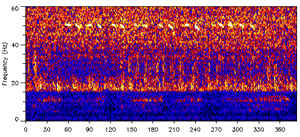 Nature · The Theory
The Loneliest Whale in the World
Since 1989, ocean microphones have picked up the song of a single whale singing at a frequency no other whale seems to use. It's been called the loneliest whale in the world. The truth is more complicated.
The connection: Another mysterious sound in the ocean.
 Cold Cases · The Strange Case
The Night Max Headroom Hijacked Chicago
In 1987, a man in a rubber mask took over two Chicago TV stations, rambled, hummed, and was spanked with a flyswatter on air. He was never caught.
The connection: A completely different corner of the archive: cold cases.
 Space · The Theory
The Explosion That Flattened a Forest
In 1908, something exploded above a remote Siberian forest with the force of a large nuclear weapon. It flattened about 80 million trees. No crater was ever found.
The connection: A completely different corner of the archive: space.