Music The Story
The Sound That Rises Forever
The Shepard tone seems to climb endlessly upwards in pitch without ever getting higher. It's an audio illusion — and filmmakers use it to make your heart race.
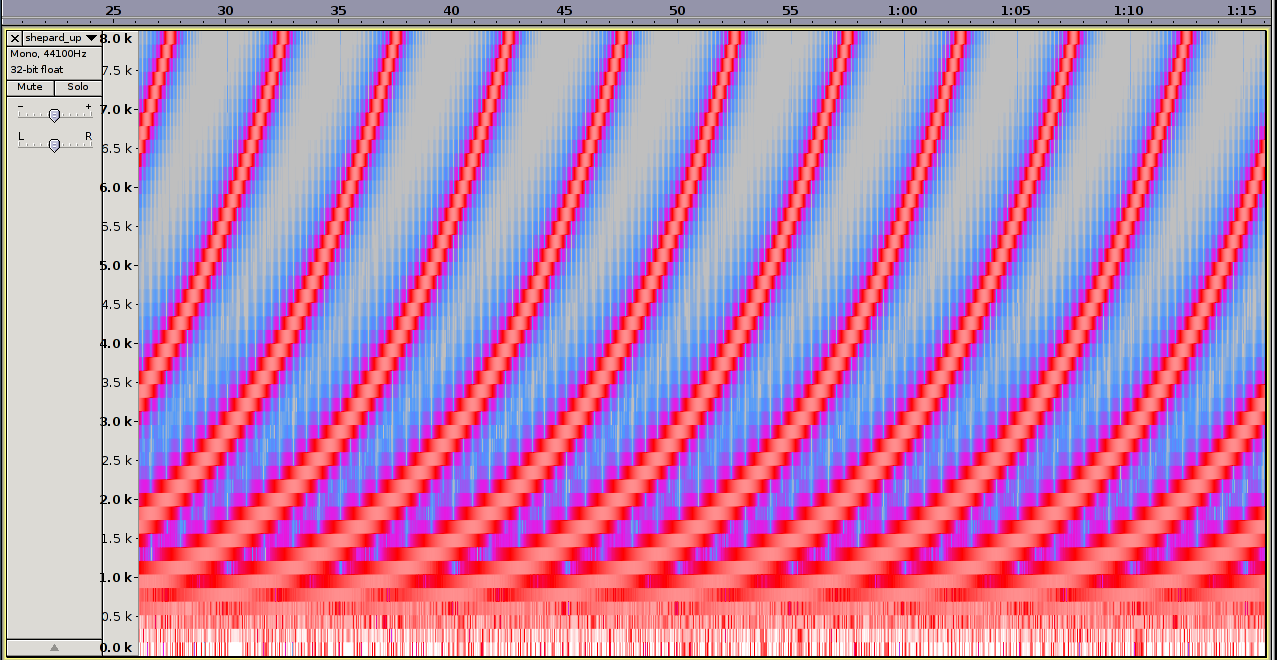
[IMAGE: Spectrum diagram of a Shepard tone: stacked octaves fading in and out] (Grin / Wikimedia Commons, CC BY-SA 4.0; opens as a separate document)
![[IMAGE: Spectrum diagram of a Shepard tone: stacked octaves fading in and out]](https://upload.wikimedia.org/wikipedia/commons/4/48/Shepard_Tones_spectrum_linear_scale.png)
Imagine a staircase where every step goes up — and yet, somehow, you never get any higher. You've seen it in drawings: the "Penrose stairs", famously used by M. C. Escher in his lithograph Ascending and Descending.
Now imagine that, as a sound.
The illusion
In 1964, the cognitive scientist Roger Shepard described a strange auditory effect. He created a sound that seems to rise in pitch, step after step, forever — without ever actually getting higher.
It's called the Shepard tone.
How it works
The trick is to play several tones at once, each an octave apart. All of them rise together. But they don't all play at the same volume:
- the tones in the middle of the range are loudest
- the highest tones gradually fade out as they rise
- new low tones gradually fade in at the bottom
Your brain follows the overall upward movement, but never notices the top notes disappearing or the bottom notes arriving. So the climb feels endless.
It's like a barber's pole for your ears: the stripes always move up, but the pole never gets taller.
FACT Established by documentary or physical evidence.
The French cousin
A continuously gliding version, rather than step by step, is often called the Shepard–Risset glissando, after the French composer and scientist Jean-Claude Risset, who developed it further.
You learned this today!!! YOU LEARNED THIS TODAY !!!
- The Shepard tone is an auditory illusion of a pitch that seems to rise (or fall) forever.
- It was described by cognitive scientist Roger Shepard in 1964.
- It works by layering tones an octave apart, fading the highest out as a new low one fades in.
- It is the sound equivalent of the "endless staircase" visual illusion.
- Film composers have used the idea to create a feeling of constantly rising tension.
One more thing
A group of flamingos is called a flamboyance.
→ Read something elseSources & further reading
- Shepard tone, Wikipedia
- Shepard, R. N. Circularity in judgments of relative pitch, Journal of the Acoustical Society of America, 1964
StoneRed separates fact, hypothesis and speculation. Spotted an error? We'd genuinely like to know.
If you liked this…
 Psychology · The Question
The Pill That Works Even When You Know It's Fake
Sugar pills can make people feel better. That much is familiar. The stranger finding is that, in some studies, they help even when patients are told exactly what they are.
The connection: Knowing it's an illusion doesn't stop it working.
Psychology · The Question
The Pill That Works Even When You Know It's Fake
Sugar pills can make people feel better. That much is familiar. The stranger finding is that, in some studies, they help even when patients are told exactly what they are.
The connection: Knowing it's an illusion doesn't stop it working.
 Modern World · The Strange Case
The Emus Won
In 1932, Australia sent soldiers with machine guns to fight a flock of flightless birds. It did not go to plan.
The connection: A completely different corner of the archive: modern world.
Modern World · The Strange Case
The Emus Won
In 1932, Australia sent soldiers with machine guns to fight a flock of flightless birds. It did not go to plan.
The connection: A completely different corner of the archive: modern world.
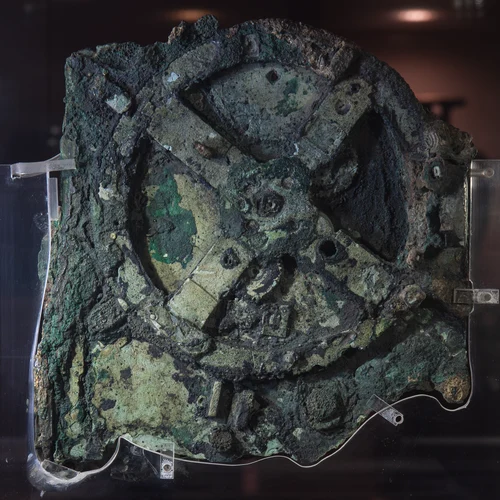 Ancient World · The Deep Dive
The 2,000-Year-Old Computer
In 1901, divers pulled a corroded lump of bronze from an ancient shipwreck. It turned out to be a geared machine for predicting the heavens — and nothing as complex would be built again for more than a thousand years.
The connection: A completely different corner of the archive: ancient world.
Ancient World · The Deep Dive
The 2,000-Year-Old Computer
In 1901, divers pulled a corroded lump of bronze from an ancient shipwreck. It turned out to be a geared machine for predicting the heavens — and nothing as complex would be built again for more than a thousand years.
The connection: A completely different corner of the archive: ancient world.