Cold Cases The Strange Case
Thirteen Empty Frames
In 1990, two men dressed as police officers walked into a Boston museum and left with a Vermeer, three Rembrandts and more. The empty frames are still hanging on the wall.
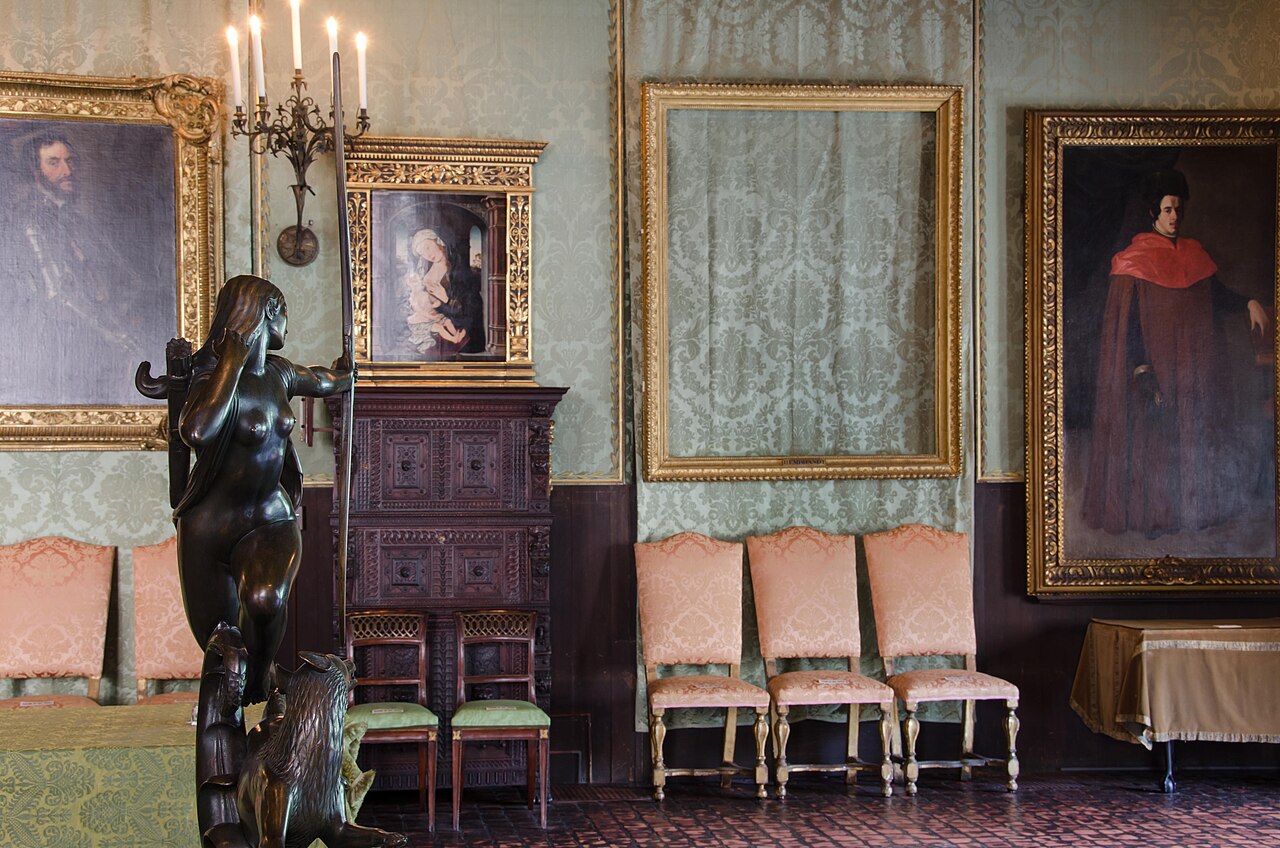
[IMAGE: Empty gilded picture frames hanging on a richly decorated museum wall] (FBI / Wikimedia Commons, Public domain; opens as a separate document)
![[IMAGE: Empty gilded picture frames hanging on a richly decorated museum wall]](https://upload.wikimedia.org/wikipedia/commons/thumb/c/cb/Empty_Frames_at_Isabella_Stewart_Gardner_Museum.jpg/1280px-Empty_Frames_at_Isabella_Stewart_Gardner_Museum.jpg)
Isabella Stewart Gardner was a wealthy, eccentric Boston collector who built a museum in the style of a Venetian palace and filled it with paintings, sculpture, furniture and tapestries. She arranged everything herself, exactly as she wanted it.
When she died in 1924, her will was strict: the collection had to stay as she left it. Nothing could be added, sold or rearranged.
That rule is why, today, if you walk into the Dutch Room of the Gardner Museum, you'll see something extraordinary: empty frames, hanging on the wall where masterpieces used to be.
St Patrick's night
At about 1:24 a.m. on 18 March 1990 — the night of St Patrick's Day celebrations in Boston — two men in police uniforms pressed the buzzer at the museum's side door. They told the young guard on duty they were responding to a disturbance.
Against the museum's rules, he let them in.
Within minutes, the "officers" had told him there was a warrant for his arrest, handcuffed him, and called the second guard. Both were taken to the basement, tied up with duct tape and left there.
Then the thieves went to work. They spent about 81 minutes inside the museum.
They had the building to themselves for well over an hour. What they took — and what they left behind — has puzzled investigators ever since.
What was taken
The thieves took thirteen works. Among them:
- The Concert by Johannes Vermeer — one of only about 35 known paintings by Vermeer in the world.
- The Storm on the Sea of Galilee, Rembrandt's only known seascape, cut from its frame.
- A Lady and Gentleman in Black, also by Rembrandt, and a small Rembrandt self-portrait etching.
- Chez Tortoni by Édouard Manet.
- Five drawings by Edgar Degas, a landscape by Govaert Flinck, an ancient Chinese bronze beaker — and the bronze eagle from the top of a Napoleonic flag.
The investigation
The total value is often estimated at around half a billion dollars. It is the largest property theft in American history, and the FBI has pursued it for decades.
In 2013, the FBI announced that it believed it knew who the thieves were — members of a criminal organisation, both since dead — and that some of the works had been taken to Connecticut and the Philadelphia area and offered for sale in the early 2000s. After that, the trail went cold.
FACT Established by documentary or physical evidence.
What's known
The time, the method, the list of stolen works and the reward are all public. The FBI's statements about the thieves' identities are on record.
SPECULATION Possible, unproven, and labelled so you can enjoy it responsibly.
What's unknown
Where the paintings are today — and whether they still exist at all — is unknown. Paintings rolled up, cut from frames or stored badly for decades may be seriously damaged.
The museum's reward stands at $10 million for information leading directly to the recovery of the works in good condition.
You learned this today!!! YOU LEARNED THIS TODAY !!!
- In the early hours of 18 March 1990, two men dressed as police officers talked their way into the Isabella Stewart Gardner Museum in Boston.
- They tied up the two guards and spent about 81 minutes in the museum.
- Thirteen works were taken, including Vermeer’s The Concert and Rembrandt’s The Storm on the Sea of Galilee, his only known seascape.
- The stolen works are often valued at around $500 million, making it the largest art theft on record.
- None of the works has been recovered. The museum offers a reward of $10 million for information leading to their return in good condition.
One more thing
Bananas are botanically berries. Strawberries are not.
→ Read something elseSources & further reading
- Isabella Stewart Gardner Museum theft, Wikipedia
- Theft, Isabella Stewart Gardner Museum
- Art Theft: Gardner Museum, FBI
StoneRed separates fact, hypothesis and speculation. Spotted an error? We'd genuinely like to know.
If you liked this…
 Cold Cases · The Story
The Summer the Mona Lisa Vanished
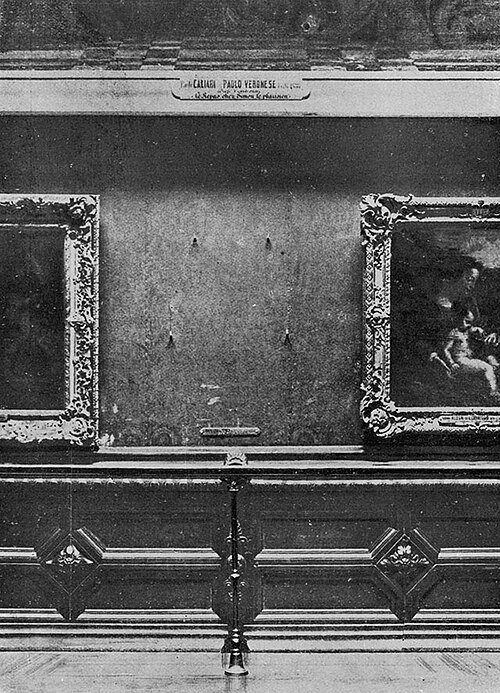
In 1911, a handyman walked out of the Louvre with the Mona Lisa under his smock. Nobody noticed for a day — and the theft is a big part of why she became the most famous painting in the world.
The connection: Another stolen masterpiece — one that came home.
Cold Cases · The Story
The Summer the Mona Lisa Vanished
In 1911, a handyman walked out of the Louvre with the Mona Lisa under his smock. Nobody noticed for a day — and the theft is a big part of why she became the most famous painting in the world.
The connection: Another stolen masterpiece — one that came home.
 Cold Cases · The Strange Case
The Hijacker Who Jumped Into the Rain
In 1971 a quiet man in a business suit hijacked a passenger jet, collected $200,000, and stepped out of the back of the plane into a storm at night. Nobody has seen him since.
The connection: Another crime that went perfectly, and then went cold.
Cold Cases · The Strange Case
The Hijacker Who Jumped Into the Rain
In 1971 a quiet man in a business suit hijacked a passenger jet, collected $200,000, and stepped out of the back of the plane into a storm at night. Nobody has seen him since.
The connection: Another crime that went perfectly, and then went cold.
 Music · The Theory
Can Anyone Actually Hear a Stradivarius?
Stradivarius violins sell for millions. But when world-class violinists played them blindfolded alongside modern instruments, most couldn't tell them apart — and many preferred the new ones.
The connection: Another story about what makes a work of art priceless.
Music · The Theory
Can Anyone Actually Hear a Stradivarius?
Stradivarius violins sell for millions. But when world-class violinists played them blindfolded alongside modern instruments, most couldn't tell them apart — and many preferred the new ones.
The connection: Another story about what makes a work of art priceless.